You're Not Looking for Scammers. You're Looking for Inflation.
Most advice about fake followers focuses on obvious fraud. Accounts with zero engagement. Comments that are just emoji strings from bot usernames. Growth charts that spike from 5,000 to 50,000 overnight.
Those are easy to spot. Five minutes of scrolling and you'll know.
The harder problem is partial fraud. An influencer with 100,000 followers where 30,000 are purchased. Their engagement rate looks reasonable because the real 70,000 do engage. Their content seems authentic because it mostly is. But you're paying for reach you'll never get.
According to Favikon's 2025 Influencer Integrity Report, "42% of Instagram influencers have at least one-third fake followers." That's not a fringe problem. That's nearly half the market.
The math: if you're paying $50 CPM based on claimed reach, but 30% of that reach is fake, your real CPM is $71. On a $10,000 campaign, that's $3,000 you lit on fire. And you'll never know, because the campaign will just "underperform" and you'll blame the creative.
Partial fraud doesn't get caught. It gets rationalized.
The Vetting Trap: Too Much or Too Little
Most teams get vetting wrong in one of two directions.
Some treat every creator like a potential criminal. They spend three hours investigating someone for a $150 gifted product, running tools and cross-referencing platforms for a campaign that doesn't justify the effort. They burn hours they don't have and slow their program to a crawl.
Others do the same five-minute scroll for a $20,000 deal that they'd do for a free sample. They glance at follower count, check that the aesthetic fits, and wire the money. Then they wonder why results are inconsistent.
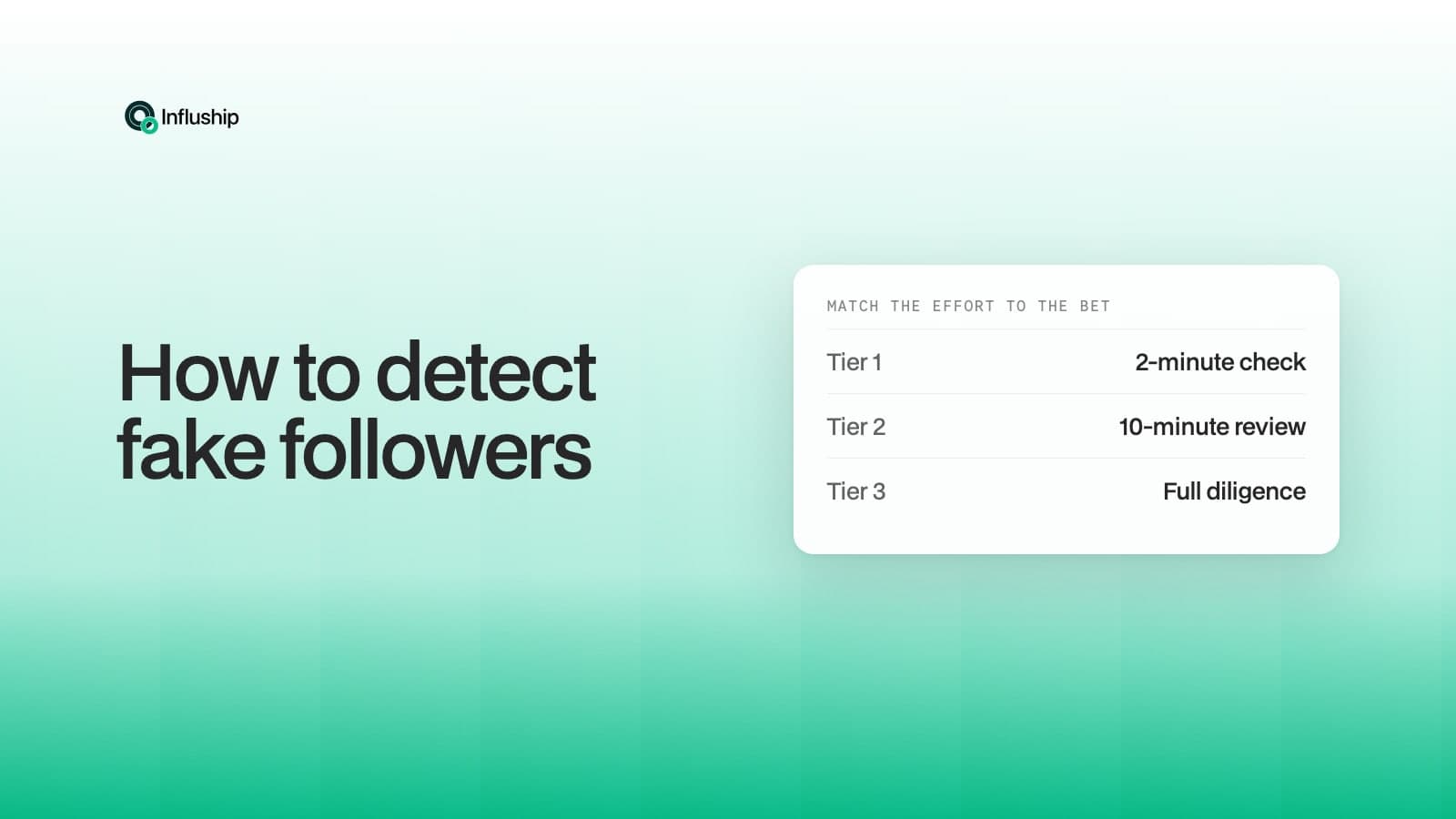
Matched vetting is the fix. Your diligence should scale to your risk.
Tier 1: The Two-Minute Check for Small Bets
For gifted campaigns or paid posts under $500, you need to catch obvious fraud without overthinking.
Do an engagement gut check first. Pull up their last few posts and divide likes by followers. A 50,000-follower account should get at least 500 likes per post. Under 1% on accounts over 50K is worth noting. Under 0.5% is a problem.
Scroll the comments on three recent posts. Real comments reference specific content. Someone asks where they got the jacket, disagrees with an opinion, or tags a friend with context. Fake comments are interchangeable. "Love this!" and fire emojis that could apply to any post on the internet.
Check ten random follower profiles. No posts, auto-generated usernames, and following thousands while having zero followers themselves means purchased audience.
The rule: two or more red flags means skip. One flag means note it and proceed if everything else checks out. For this spend level, speed matters more than certainty.
Tier 2: The Ten-Minute Review for Real Money
For campaigns between $500 and $5,000, a quick scroll isn't enough.
Run their username through Social Blade and look at follower growth over the past year. Healthy growth is gradual with bumps around viral content. A spike of 20,000 followers in a week with no corresponding viral post means they bought that growth.
Check audience geography. If you're working with a US lifestyle creator whose content is entirely in English but 60% of followers are from Brazil or Indonesia, that's a mismatch. Bot farms cluster in specific regions.
Read twenty comments across five posts, including comments further down the thread. Real audiences disagree sometimes. Fake engagement is relentlessly positive and generic to the point of absurdity.
Look at follower-to-following ratio. Creators with 50,000 followers who follow 7,000 accounts often got there through follow-unfollow schemes. That audience isn't loyal.
Ask for analytics. A screenshot of Instagram Insights or TikTok analytics showing reach and demographics. Hesitation here is disqualifying. If they won't show you the data, assume it doesn't support their pitch.
Trust your gut. If something feels off after ten minutes and you can't name why, that instinct is usually right.
Tier 3: Full Diligence for Big Bets
For campaigns over $5,000 or ongoing partnerships, you need verification, not estimation.
Run the creator through HypeAuditor, Modash, or a similar fraud detection platform. These tools cost $100-400/month but pay for themselves on a single bad deal avoided. Look for audience quality scores over 70%. Below 60% means significant fake or inactive followers.
Cross-reference platforms. An influencer with 500,000 Instagram followers and 8,000 YouTube subscribers has a suspicious imbalance. Real creators grow proportionally across platforms.
Ask for past campaign receipts. Screenshots of previous brand partnership performance, engagement on sponsored content, conversion data if they've used tracking links. Creators who claim impressive reach but can't document results are hiding something.
Check the audience authenticity breakdown your tool provides. Demographics should match the content. A fitness creator should have followers interested in health and wellness, not a random distribution that suggests purchased audience. Understanding how different creator tiers behave makes these patterns easier to spot.
Build protection into your contract. Tie partial payment to performance, or include renegotiation clauses if sponsored content engagement is dramatically below their stated averages. Resistance to accountability is itself a signal.
Deal Breakers Regardless of Tier
Some signals are bad enough that no investment level justifies proceeding.
Engagement under 0.5% on accounts over 10K means almost nobody cares. Refusal to share analytics is disqualifying. A major follower drop in the past six months often means the platform purged their fakes. Sponsored posts with dramatically lower engagement than organic content means their audience doesn't trust their recommendations. Comments turned off across most posts usually means they're hiding something.
Any of these should end the conversation.
When You Find Partial Fraud
You've vetted a creator and found roughly 25% fake followers. Not a scammer, but not clean. Now what?
The safest play is walking away. Enough legitimate creators exist that you don't need to negotiate with compromised ones.
If you want to proceed anyway, price accordingly. If they claim 100K followers but 75K are real, negotiate based on 75K. Don't pay for reach that doesn't exist.
Or test small. Run a low-budget activation, measure actual performance, and decide whether to scale based on results rather than claims.
The key: don't pretend you didn't see it. Teams spot warning signs and proceed anyway because they like the aesthetic or don't want to restart the search. The warning signs don't disappear because you ignored them.
Detection Is a Tax. Prevention Is a System.
That works, but it's slow. Every creator requires fresh investigation. You're paying a vetting tax on every partnership.
The better approach is reducing your exposure to fraud before you ever start evaluating individuals.
This is the core problem Influship solves. Instead of starting with the full universe of creators and trying to filter out the fraudulent ones, you start with a pool the platform has already screened for audience authenticity. The vetting happens upstream, before you see anyone. You skip fraud checks on individual profiles because the filtering already happened.
The second layer is building your own validated network over time. Once someone performs well on a real campaign, you've verified them in the most meaningful way possible. You don't re-vet creators who've already delivered results. Your best future partners are people who've already proven themselves.
The third layer is deal structure. When you tie payment partly to actual engagement or conversions, the downside of fraud shifts to the creator. Someone with a fake audience won't accept performance terms because they know they can't deliver. The structure itself becomes a filter.
You're not trying to catch every fraudster. You're trying to build a program where fraud rarely reaches you in the first place.
The Bottom Line
Fake followers aren't going away. Nearly half of influencers have meaningful audience inflation, and the tools for faking it keep improving.
You need a system: light checks for small bets, real diligence for big ones, and upstream filtering so you're not starting from scratch every time.
Build a program where you work with people you've already validated. That's the best fraud protection.