What the FTC Actually Requires
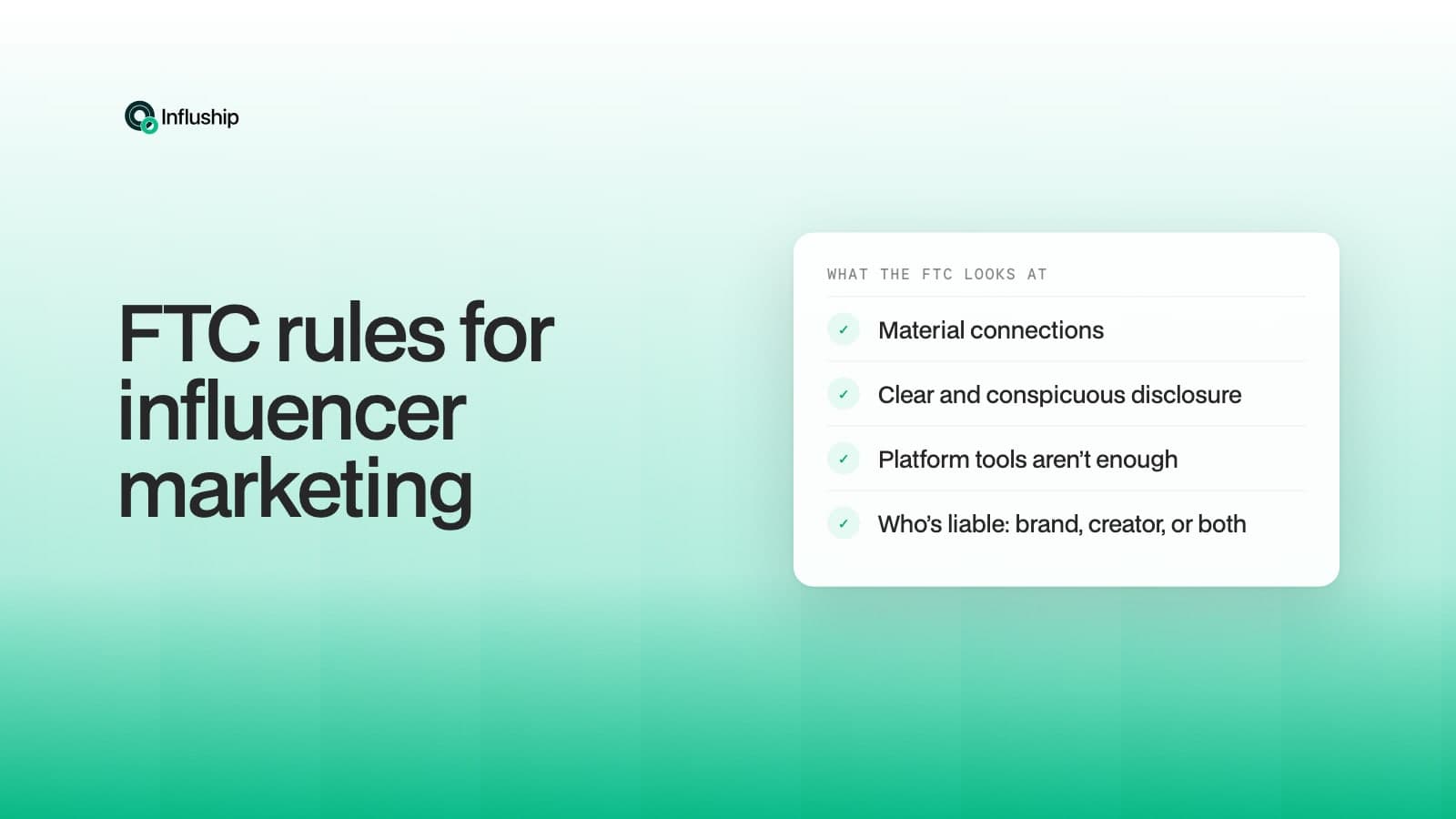
The core rule fits in one sentence: if there's a material connection between an endorser and a brand, disclose it in a way that's impossible to miss.
A "material connection" is any relationship that might affect how much weight a consumer gives to an endorsement. Money is the obvious one. But it also includes free products, discounts, employment relationships, family ties, or any other benefit that could influence credibility.
The test is simple: would knowing about this relationship change how a consumer evaluates the recommendation? If yes, disclose it.
This applies to both creators and brands. The FTC can hold either party liable, and in major enforcement actions, they typically go after both.
What Counts as a Material Connection
The definition is broader than most teams realize. All of the following require disclosure:
Financial relationships:
- Paid sponsorships
- Affiliate commissions
- Contractor or employment relationships
- Payment to the creator's business entity (not just personal payments)
Product relationships:
- Free products, even "no strings attached" gifts
- Discounted products
- Early access or exclusive access
- Loaned products (even if returned after use)
Personal relationships:
- Family connections to brand owners or employees
- Close personal friendships with brand representatives
- Business partnerships or equity stakes
The FTC has made clear that "no strings attached" doesn't exempt gifted products from disclosure. From their perspective, a free product is a form of payment. The relationship exists regardless of whether a post was required.
The Gray Areas That Trip Up Brands
The rules sound straightforward until you hit the edge cases. Here's how the FTC handles the situations that actually cause confusion:
Tagging a brand you genuinely like: If you have a material relationship with that brand, tagging them is an endorsement that requires disclosure. It doesn't matter that you also genuinely like the product. The relationship still exists.
Products you bought yourself: No disclosure needed. If you purchased something with your own money and have no relationship with the brand, you're just a customer sharing an opinion.
Past relationships: The FTC says you should monitor endorsers for "a reasonable time" after a contract ends, typically a few months. If a creator posts about your product six months after a campaign ended, you may still be responsible depending on the circumstances.
Affiliate links vs. sponsored posts: Both require disclosure, but the language differs. For affiliate links, something like "I earn commissions on purchases through this link" works. For sponsored posts, "Sponsored by [Brand]" or "Ad" is clearer.
Negative reviews of gifted products: Still requires disclosure. The fact that you didn't like the product doesn't eliminate the material connection. Consumers should know you received it free even if your review is critical.
Re-sharing old sponsored content: The disclosure requirement doesn't expire. If a creator shares old sponsored content again, it still needs the disclosure.
Employee advocacy: Yes, employees must disclose their employment when endorsing their employer's products. "I work at [Brand]" is sufficient.
The "I'd buy it anyway" argument: Doesn't matter. Even if you genuinely love the product and would purchase it yourself, receiving it free creates a material connection. The FTC cares about the relationship, not your hypothetical purchase intent.
Discount codes with commission: This is an affiliate relationship. If you earn anything when someone uses your code, disclose it. "Use my code for 20% off (I earn commission on purchases)" covers it.
Barter deals: If a brand comps your hotel stay, gives you free meals, or provides any non-cash value in exchange for content, that's a material connection. Disclose the exchange.
PR event invitations: Attending a brand-sponsored event creates a material connection for any content posted about the event or products shown there. "Attended [Brand] event as a guest" or similar disclosure applies.
Products sent to your agent or manager: The disclosure requirement follows the product, not the shipping address. If your management receives products on your behalf, you still need to disclose when posting about them.
Reviewing a competitor after taking money from a brand: This is where it gets uncomfortable. If Brand A pays you to review their product, and you also review competitor Brand B, the FTC doesn't require disclosure on the Brand B review. But if your Brand A relationship influences how you talk about Brand B, you're in murky territory. The safest approach: disclose any relationships that might affect your credibility on the topic.
The "old relationship" loophole: Some creators think if enough time has passed, they no longer need to disclose. There's no fixed expiration date. If the relationship could still reasonably influence your opinion, disclose it. When in doubt, disclose.
Creator's own brand: If you're promoting a brand you own, no disclosure is needed if it's obvious you're the owner. But "obvious" is doing a lot of work. If there's any chance your audience doesn't know you own the brand, disclose it.
Platform-Specific Disclosure Requirements
Each platform has its own norms, but FTC requirements apply everywhere. Here's what compliance looks like on each:
Instagram: Place disclosures above the "more" button so they're visible without tapping to expand. Use the "Paid partnership" tool as a starting point, but add explicit language in the caption too. For Stories, include the disclosure on each frame, not just the first one.
TikTok: Use both on-screen text and caption disclosures. Given how fast TikTok videos move, visual disclosure needs to be large and appear early. For TikTok LIVE, repeat the disclosure periodically since viewers join at different times.
YouTube: Verbal disclosure in the first 30 seconds is expected, plus visual disclosure on screen. The video description alone is not sufficient since many viewers never read it. For Shorts, treat them like TikTok: on-screen text that's visible throughout.
Podcasts: Verbal disclosure at the beginning of the episode and again before any sponsored segment. Listeners need to hear it, not just see it in show notes.
X (Twitter): The disclosure must be in the tweet itself, not in a reply or thread. Character limits aren't an excuse. "Ad" or "Sponsored" fits in any tweet.
Stories and ephemeral content: Every frame needs the disclosure, sized large enough to read before it disappears. Superimposed text works. Tiny text in a corner doesn't.
What "Clear and Conspicuous" Actually Means
The FTC uses this phrase constantly, but what does it mean in practice?
Placement: The disclosure should appear where people will actually see it. That means before the "more" button on Instagram, in the video itself on YouTube, and at the start of posts rather than buried at the end.
Language: Use words that average consumers understand. "Ad," "Sponsored," and "Paid partnership" work. "[Brand] gifted me this product" and "I earn commissions on purchases through this link" also pass the test.
What doesn't work: Vague abbreviations like #sp, #spon, or #collab. Stand-alone terms like "Thanks" or "Ambassador" without context. Disclosures mixed into a block of 30 hashtags where no one will notice them.
Visual standards: Text must be large enough to read, have sufficient contrast with the background, and stay on screen long enough to process. A disclosure that flashes for one second doesn't count.
Audio standards: Spoken disclosures should be clear and at normal pace. Rushing through the words at double speed defeats the purpose.
The scroll test: If someone scrolling quickly would miss the disclosure, it's not conspicuous enough.
Platform Tools Are Not Enough
Instagram's "Paid Partnership" label. TikTok's branded content toggle. YouTube's paid promotion checkbox. These tools are helpful, but the FTC has explicitly stated that using them doesn't guarantee compliance.
The problem: built-in disclosure tools are often small, positioned where users have learned to ignore them, and use language that consumers may not recognize as indicating a paid relationship.
The solution: use platform tools AND your own explicit disclosure. The platform tool provides a baseline. Your own language in the caption, video, or audio makes the relationship unmistakably clear.
Think of platform tools as the floor, not the ceiling.
Who's Liable: Brands, Creators, or Both
Short answer: both.
The FTC revised its Endorsement Guides in 2023 to make this explicit. Brands are responsible for the conduct of influencers they work with. Creators are responsible for the accuracy of their endorsements.
Brands are liable for:
- Failing to instruct creators on disclosure requirements
- Failing to monitor content for compliance
- Failing to take action when violations occur
- Making claims through influencers that they couldn't make directly
Creators are liable for:
- Failing to disclose material connections
- Making false or misleading claims they knew or should have known were untrue
- Endorsing products they haven't actually used
In practice, the FTC typically pursues brands first. They're seen as having more control over campaigns and more resources to ensure compliance. Creators usually receive warning letters rather than immediate penalties.
"Usually" isn't "always," though. High-profile creators have faced significant fines. One celebrity paid over $1.26 million for failing to disclose a paid cryptocurrency endorsement.
What Brands Must Do to Stay Compliant
The FTC expects brands to take four actions: instruct, monitor, remedy, and terminate.
Instruct: Every influencer agreement should include clear disclosure requirements. Specify the exact language that's acceptable, where disclosures should appear, and what's prohibited. Don't assume creators know the rules.
Monitor: Check that posts actually include proper disclosures. This doesn't have to be manual review of every piece of content, but you need a system. Spot-checking, automated scanning, or requiring creators to submit posts for review all work.
Remedy: When you find a violation, require it to be corrected. Document the issue and the fix. A pattern of looking the other way becomes evidence of negligence.
Terminate: Creators who repeatedly fail to comply should be dropped from the program. The FTC has specifically cited this as an expectation in enforcement actions.
The Teami case illustrates the consequences. The company paid over $930,000 and agreed to pre-approve all influencer posts going forward. That level of oversight became mandatory because they failed to implement adequate controls initially.
Contract Language You Can Actually Use
Most influencer contracts mention "FTC compliance" in a single sentence and call it done. That's not enough. Our free contract builder includes FTC and ASA compliance clauses by default, but here's what that language should look like:
Basic disclosure clause:
Creator agrees to clearly and conspicuously disclose the sponsored nature of all Content by including the word "Ad" or "Sponsored" at the beginning of any caption, and by using any applicable platform disclosure tools (for example, Instagram's "Paid Partnership" label). Disclosure must be visible without clicking "more" or expanding the post. For video content, Creator must include both verbal disclosure within the first 30 seconds and on-screen text disclosure. Creator acknowledges that platform disclosure tools alone do not satisfy this requirement.
Gifted product clause:
Creator agrees that any Content featuring Product, whether or not explicitly required under this Agreement, must include disclosure that Product was provided at no cost. Acceptable disclosure language includes "[Brand] gifted me this product" or "PR package from [Brand]." This obligation continues for 12 months following receipt of Product.
Monitoring and correction clause:
Brand reserves the right to review all Content for compliance with FTC disclosure requirements. If Brand identifies non-compliant Content, Creator agrees to correct the disclosure within 24 hours of notification. Repeated failure to comply (three or more instances) constitutes grounds for immediate termination and forfeiture of unpaid fees.
Claims restriction clause:
Creator shall not make any claims about Product's performance, health benefits, or results that are not expressly approved in writing by Brand. Creator shall not state or imply personal results unless Creator has genuinely experienced those results. Creator acknowledges that false or unsubstantiated claims may result in personal liability under FTC regulations.
These aren't legal templates. Run them by your attorney. But they cover the gaps most contracts miss.
How Long You Must Monitor
Monitoring doesn't end when a campaign does.
During the contract: Always monitor. This is non-negotiable.
After the contract ends: The FTC expects monitoring for "a reasonable time," which they define as at least a few months. If a creator continues posting about your product after a paid relationship ends, those posts may still implicate you.
For gifted products with no formal contract: You should still monitor for at least a few months after sending products. The FTC has said you may be responsible for posts made well after the gift was sent.
The uncomfortable truth is that there's no bright-line cutoff. "Reasonable" depends on the specific circumstances. When in doubt, monitor longer.
How to Actually Monitor at Scale
Telling brands to "monitor influencer content" is like telling them to "do marketing." Here's what monitoring actually looks like when you're running 50+ creators:
Weekly monitoring workflow:
- Pull the post list. Every Monday, export all posts from the past week that mention your brand or use campaign hashtags. Most influencer platforms do this automatically. If you're running things manually, set up Google Alerts and social listening for brand mentions.
- Spot-check for disclosure. You don't need to review every post in detail. Scan for: Does the caption start with "Ad," "Sponsored," or similar? Is the platform's paid partnership label enabled? For video, scrub to the first 10 seconds and check for visual/verbal disclosure.
- Flag violations immediately. Create a simple tracking sheet: Creator name, post URL, issue identified, date flagged, date corrected. Send correction requests within 24 hours. The longer a non-compliant post stays up, the worse your liability position.
- Escalate repeat offenders. First violation: polite correction request. Second violation: formal warning citing contract terms. Third violation: termination from program.
For gifted/seeding programs:
Set up social listening for your brand name + product names. Check weekly for posts from anyone you've gifted. When you find an undisclosed post, reach out directly: "Thanks for sharing. Just a heads up: since we sent you this product, the FTC requires a disclosure like 'gifted by [Brand].' Would you mind updating the caption?"
Most creators comply immediately. They didn't know, not because they were trying to hide anything.
Tools that help:
- Influencer platforms with built-in compliance tracking (Grin, CreatorIQ, Aspire)
- Social listening tools (Mention, Brand24, Sprout Social)
- Simple spreadsheet if you're just starting out (Google Sheets works fine under 20 creators)
The goal isn't perfection. It's demonstrating reasonable effort. If the FTC ever comes asking, you want to show: written policies, documented monitoring, evidence of corrections, and a pattern of taking compliance seriously.
Penalties and How Enforcement Actually Works
FTC enforcement follows a predictable escalation:
Step 1: Warning letter. The FTC identifies a problem and sends a letter explaining the violation. No fine yet, but the letter goes on record. Future violations become harder to defend.
Step 2: Consent decree. If problems continue or the initial violation was severe, the FTC negotiates a settlement. The company agrees to specific compliance measures and ongoing reporting. Violating a consent decree triggers automatic penalties.
Step 3: Civil penalties. For serious or repeated violations, the FTC can impose fines of up to $53,088 per violation (as of 2025, adjusted annually for inflation). In cases involving thousands of posts, this adds up fast.
Notable enforcement actions:
- Google & iHeartMedia: 29,000 radio endorsements for Pixel 4 by hosts who hadn't used the phone. $9.4 million combined.
- Teami: Unsubstantiated health claims, undisclosed influencer payments. $930,000+ returned to consumers.
- Sunday Riley: Fake reviews posted by employees without disclosure. Consent decree, ongoing compliance requirements.
- Celebrity cryptocurrency promoter: Undisclosed paid endorsement. $1.26 million penalty.
Most violations result in warning letters, not headlines. But warnings establish a record. The next violation faces steeper consequences.
The 2024-2025 Updates You Need to Know
The regulatory environment has tightened significantly.
August 2024: Fake reviews rule finalized. The FTC now explicitly bans:
- Fake reviews, including those generated by AI
- Buying or selling fake followers, views, or engagement
- Insider reviews without disclosure (employees reviewing their employer)
- Review suppression (hiding negative reviews selectively)
Penalties for fake reviews can reach $51,744 per violation.
AI-generated content: If an endorsement is generated or significantly altered by AI, that fact must be disclosed alongside the sponsorship relationship. This creates a "double disclosure" requirement for AI-assisted content.
The 670 warning letters (2023): The FTC sent penalty offense notices to hundreds of companies, establishing a legal basis to seek civil penalties for future violations. Companies that received these letters face heightened liability.
2025 penalty adjustments: Civil penalty maximums increased to $53,088 per violation, up from $50,120 in prior years. These adjustments happen annually.
International Considerations
FTC rules apply to any content that reaches U.S. consumers, regardless of where the creator is located or where the content is posted.
If you run campaigns that target or reach U.S. audiences, you need to comply with FTC requirements. The creator being based in another country doesn't create an exemption.
For global campaigns, you'll also need to consider:
United Kingdom: The Advertising Standards Authority (ASA) and Competition and Markets Authority (CMA) enforce similar disclosure requirements.
Canada: The Competition Bureau handles deceptive marketing, including influencer endorsements.
European Union: Various national regulators enforce consumer protection rules. Requirements vary by country but generally align with the principle of transparent advertising.
Australia: The Australian Competition and Consumer Commission (ACCC) has pursued influencer marketing violations.
Running a compliant global campaign means meeting the requirements of every jurisdiction you're targeting. In most cases, FTC-compliant disclosures will satisfy other regulators too, but verify the specifics for each market.
Disclosure Language That Works
Good disclosure is boring. It says exactly what the relationship is in plain language.
Effective examples:
- "Ad"
- "Sponsored"
- "Paid partnership with [Brand]"
- "[Brand] gifted me this product"
- "I earn commissions on purchases through this link"
- "I work for [Brand]"
Ineffective examples:
- "#sp" or "#spon" (too vague, consumers don't know what it means)
- "#collab" or "#partner" (doesn't specify the nature of the relationship)
- "#ambassador" (sounds like a relationship but doesn't clarify compensation)
- "Thanks [Brand]!" (could be genuine gratitude, doesn't indicate payment)
- Disclosure buried in 30 other hashtags
- Disclosure only in video description, not the video itself
The test: would your grandmother understand that this is a paid advertisement? If not, rewrite it.
Copy-Paste Disclosure Templates by Platform
Stop reinventing disclosure language for every campaign. Here are templates creators can copy directly:
Instagram (feed posts and Reels):
Ad | [Brand name] partner
[Rest of caption here]
Character count: ~25 characters. Fits above the fold. Also enable "Paid partnership" label in the app.
Instagram Stories: Use a text sticker with "AD" or "Paid partnership with [Brand]" in a readable size (minimum 24pt). Place at top of frame. Repeat on every frame that shows the product.
TikTok:
#Ad [Brand] partner | [Rest of caption]
Also enable the "Paid partnership" toggle in posting options. For the video itself, add text overlay "Ad/Sponsored" visible in the first 3 seconds.
YouTube (long-form): Verbal script for first 30 seconds: "This video is sponsored by [Brand]. They provided [product/payment] for this review, but all opinions are my own."
Add on-screen text: "Paid promotion" or "Sponsored by [Brand]" visible for at least 5 seconds at the start.
Check the "paid promotion" box in upload settings.
YouTube Shorts: Same as TikTok. On-screen text "Ad" or "Sponsored" visible throughout. Caption starts with "#Ad [Brand]."
X (Twitter):
Ad | [Tweet content] [Brand handle]
Character count: ~5 characters for disclosure. No room for ambiguity.
Podcast:
Opening script: "Today's episode is brought to you by [Brand]. [One sentence about the partnership.]"
Pre-segment script: "Before we get into [topic], a quick word from our sponsor [Brand]."
Affiliate links (any platform):
I earn a commission if you purchase through my link.
or
Affiliate link - I may earn from purchases.
These templates are deliberately boring. Boring is compliant.
A Compliance Checklist for Every Campaign
Before launch:
- Influencer contract includes specific disclosure requirements
- Contract specifies acceptable disclosure language
- Contract specifies where disclosures must appear (caption, video, audio)
- Creator has received written instructions on FTC requirements
- Review/approval process is defined
During campaign:
- Posts are monitored for proper disclosure
- Violations are flagged within 24-48 hours
- Corrections are requested and confirmed
- Repeated violations trigger escalation
After campaign:
- Continue monitoring for at least 2-3 months
- Document compliance status for all posts
- Update processes based on any issues encountered
- Retain records of instructions, monitoring, and corrections
For ongoing programs:
- Quarterly review of disclosure compliance rates
- Annual refresh of creator instructions
- Update language and requirements when FTC guidance changes
Common Mistakes and How to Avoid Them
Assuming platform tools are sufficient. They're a starting point, not a complete solution. Always add your own explicit disclosure.
Not monitoring after campaigns end. Creators may continue posting about your brand. You're potentially liable for months after the formal relationship ends.
Using vague disclosure language. "#partner" doesn't cut it. Be explicit about what the relationship is.
Burying disclosures at the end. Consumers stop reading. Disclosures need to appear before engagement drops off.
No written instructions to creators. Verbal agreements aren't enough. Document your requirements so creators can't claim ignorance and you can't be accused of failing to instruct.
Not acting on violations. Finding a problem isn't enough. You need to fix it and document the fix.
Thinking small creators don't matter. The FTC applies the same rules regardless of follower count. A nano-influencer with 2,000 followers still needs to disclose.
Forgetting about employees. When employees post about their employer's products, that's an endorsement requiring disclosure too.
The Bottom Line
The FTC exists to protect consumers, not to catch brands in technicalities. The goal is ensuring people can make informed decisions about who to trust.
Every disclosure requirement traces back to a simple question: does this information change how a reasonable consumer would evaluate this recommendation? If the answer is yes, the relationship needs to be visible.
Compliance isn't complicated. It's operational discipline. Build the requirements into your contracts. Monitor the content. Fix problems when you find them. Document everything.
When in doubt, disclose. It's never wrong to be transparent, and the downside of over-disclosure is zero. The downside of under-disclosure is warning letters, consent decrees, and fines that can reach tens of millions of dollars.
The rules exist to protect consumers. Follow them, and you're not just avoiding penalties. You're building the kind of transparent relationships that make influencer marketing work in the first place.