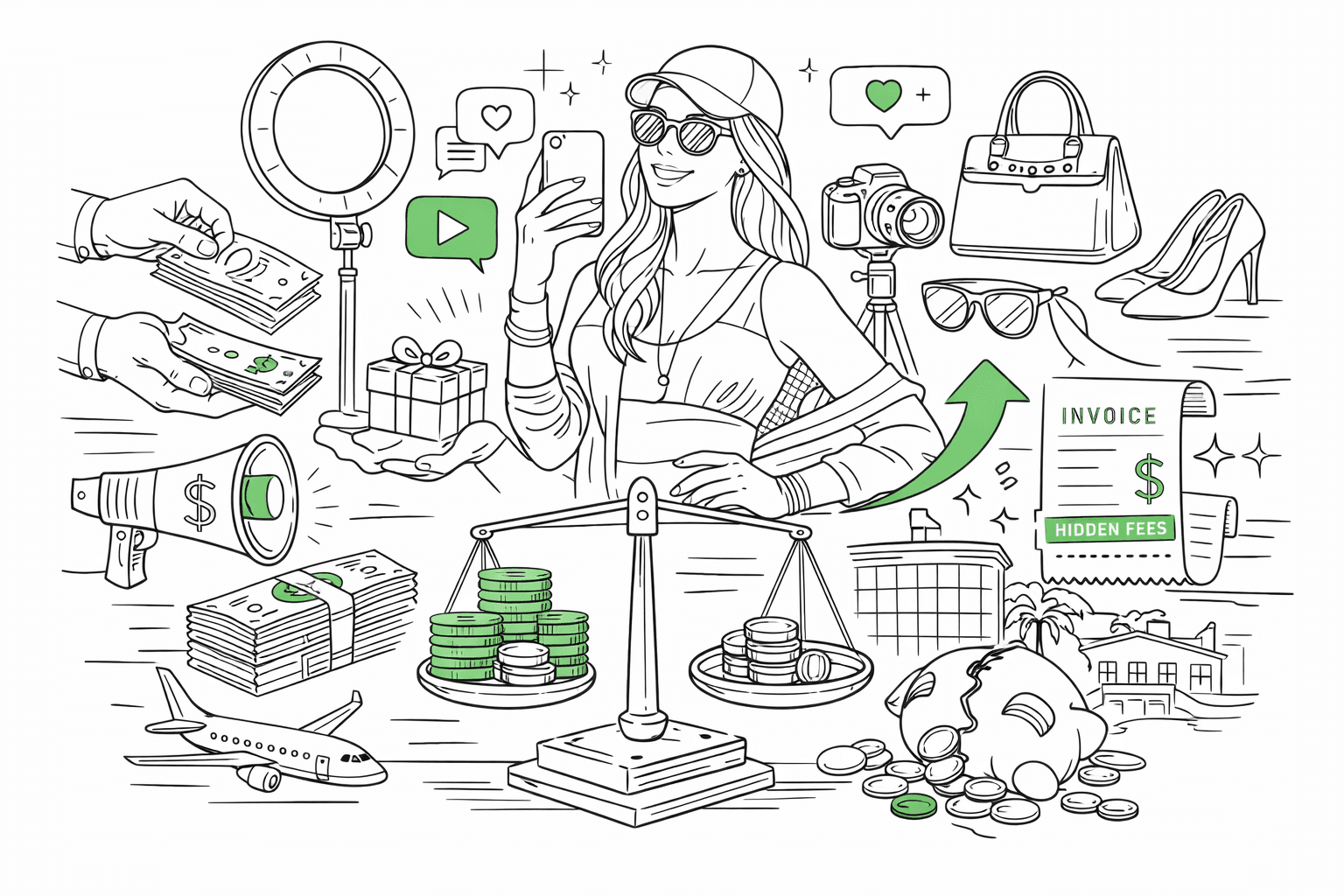
This is how influencer budgets explode. Brands budget for the headline number and forget everything that comes after.
The Base Rate Is Just the Beginning
Every pricing guide shows you ranges. Nano-influencers charge $100-500. Micro-influencers charge $500-2,500. And so on.
These numbers are real. They're also incomplete.
The actual price follows a formula most guides skip:
Real price = Base rate x Multipliers + Add-ons
The base rate is what the creator quotes for a single piece of content. The multipliers are factors that shift that price up or down. The add-ons are everything you'll need beyond the post itself.
If you budget only for the base rate, you'll run out of money mid-campaign. Or worse, you'll skip the add-ons that actually make the content valuable.
What Influencers Quote: Platform Benchmarks
Creators typically charge these rates for a single piece of content in 2026. These are starting points, not final prices. For a disclosed 100,000-creator sample, compare the primary-source creator pricing benchmark.
Nano (1-10K): Instagram Reel $100-500, Instagram Story Set $50-150, TikTok Video $50-200, YouTube Integration $200-500.
Micro (10-100K): Instagram Reel $500-2,500, Instagram Story Set $150-500, TikTok Video $200-1,000, YouTube Integration $500-2,500.
Mid-tier (100-500K): Instagram Reel $2,500-10,000, Instagram Story Set $500-1,500, TikTok Video $1,000-5,000, YouTube Integration $2,500-10,000.
Macro (500K-1M): Instagram Reel $10,000-25,000, Instagram Story Set $1,500-5,000, TikTok Video $5,000-15,000, YouTube Integration $10,000-25,000.
A few things to notice:
YouTube costs more because video production takes longer. A 60-second TikTok takes hours. A 10-minute YouTube integration takes days.
Stories cost less because they disappear in 24 hours. Creators care about their permanent grid. Stories are more casual.
TikTok rates are still catching up to Instagram, though the gap is closing. TikTok's algorithm makes reach less predictable, which some brands use as a bargaining chip.
These ranges are wide for a reason. Where you land depends on the multipliers.
The Five Multipliers That Shift the Price
Two creators with identical follower counts can charge wildly different rates.
1. Content Format
A Reel costs 2-3x more than a Story set. Permanent content requires more production effort and lives on the creator's profile forever. Stories disappear. The creator's bar for quality is different.
Video costs more than static images. Carousels fall in between. If you want a creator to script, shoot, edit, and add music, expect to pay for that time.
2. Creator Niche
Finance and tech creators charge premiums because their audiences have money. A creator reviewing credit cards commands higher rates than a creator posting outfit inspiration.
Luxury, finance, and B2B niches command 2-3x the rates of lifestyle or parenting. Audiences with more purchasing power pay creators more, because brands will pay more to reach them.
3. Audience Geography
US and UK audiences are worth more than global. A creator with 50K followers (80% US) will charge more than a creator with 100K followers (60% global).
Brands target specific markets. Creators know this. If their audience matches your target geography, they'll charge accordingly.
4. Engagement Quality
Follower count matters less than engagement. A 5% engagement rate on 20K followers means 1,000 people actually interacting. A 1% rate on 100K means the same thing, but you're paying for 80,000 ghosts.
High-engagement creators charge more because they deliver more. They've earned an audience that pays attention.
5. Turnaround Time
Need content in five days instead of three weeks? That's a rush fee. Expect 25-50% on top.
Standard timelines (2-3 weeks from brief to publish) get base rates. Flexible timing ("post whenever works for you") can sometimes get discounts.
The Add-Ons Everyone Forgets
This is where budgets break. These costs are often negotiated after the base rate is agreed, which means brands discover them too late.
Usage Rights
Most deals include organic posting rights only. The creator posts to their feed. You can share it. That's it.
If you want to reuse that content on your own channels, website, email, or ads, you need extended usage rights.
- 30 days (often included): Base rate covers this
- 90 days: Add 20-30% to base rate
- 1 year: Add 40-50% to base rate
- Perpetual / buyout: 2-3x base rate
Usage rights sound like paperwork. They're the most expensive line item you're not budgeting for. A brand once paid $40,000 to settle a lawsuit after using an influencer's photo in-store without permission. The original deal only covered social.
Paid Amplification
Running paid ads from the creator's account instead of your brand account is called whitelisting. On TikTok, the feature is Spark Ads. On Meta, it requires Business Manager access.
Why bother? Ads from creator accounts outperform brand accounts by 20-50%. The content looks native. The social proof is built in.
Creators charge for this because they're lending you their identity. Typical fees:
- 25-35% of base rate per month of access
- Some creators charge 4-5% of your ad spend instead
If you're planning to run the content as ads, budget for whitelisting from the start.
Raw Footage
Want the unedited clips so your team can cut them into multiple ads? That's extra.
Raw footage costs 25-50% above base rate. It's often worth it if you have a strong creative team. One shoot can become ten ads.
Revisions
Most contracts include 1-2 revision rounds. Anything beyond that costs $50-200 per round.
Scope creep happens when briefs are vague. You ask for changes. The creator pushes back. Now you're negotiating mid-campaign.
Write a clear brief. Agree on revision limits upfront. Pay for extras if you need them. Need to formalize the deal? Our free influencer contract builder lets you generate a professional agreement with payment terms, revision limits, usage rights, and exclusivity clauses built in.
Exclusivity
Exclusivity means the creator can't work with your competitors for a set period. This is common for bigger deals or brand ambassador relationships.
- 30-day exclusivity: +15-25%
- 90-day exclusivity: +30-50%
- Category-wide exclusivity: negotiate case by case
If you're a protein powder brand, you probably don't want your creator promoting a competitor next week. That peace of mind has a price.
The Real Math: A Worked Example
Let's say you want a micro-influencer Reel on Instagram. The numbers work like this.
Scenario: Product launch, need to run the content as paid ads, want 60 days of usage.
Base rate (Reel): $800
60-day usage rights: +$200
30-day whitelisting: +$280
Raw footage for ads: +$250
Total: $1,530
That's 91% more than the quoted rate.
Is it worth it? Depends on what you're building. If you're running $10,000 in ad spend against that content, the extra $730 for whitelisting and raw footage could 2-3x your performance. If you're just posting organically and hoping for reach, you probably don't need the add-ons.
Know what you're buying. Budget accordingly.
When to Pay More (And When to Push Back)
Pay the Premium When:
The campaign is high-stakes. Product launches, holiday sales, and funding announcements aren't the time to negotiate hard. Get the best creator. Pay the rate.
You need the content for ads. Paid amplification rights and usage rights aren't optional if you're building a paid media library. The content is the asset. Pay to own it properly.
Their audience matches exactly. A perfect demographic fit is worth a premium. You're not just paying for reach; you're paying for relevance.
They have proven conversion history. Ask for case studies. If they've driven sales for similar brands, their rate reflects that track record.
Push Back When:
You're offering a long-term partnership. Volume discounts are standard. Five posts over three months should cost less per post than a one-off.
Timeline is flexible. Creators juggle multiple campaigns. If you can say "post anytime in the next month," that flexibility has value. Use it.
Product seeding is included. Free product offsets the cash rate. A $200 product can reduce a $1,000 fee to $800. Make sure it's actually valuable to them, though.
They're building their portfolio. Newer creators may accept lower rates for the right brand association. Be honest about what you're offering -- exposure alone isn't payment, but a strong brand partnership can help their career.
The Bundling Play
Bundles lower your per-piece cost. Creators prefer predictable income.
- Multi-post packages: 3 Reels over 2 months instead of 1
- Format bundles: Reel + Story set instead of just Reel
- Platform bundles: Instagram + TikTok from the same creator
If you're planning multiple pieces anyway, pitch the bundle upfront. Most creators will offer 10-20% off for the commitment.
What "Fair" Looks Like
Rough benchmarks:
- $10-20 per 1,000 followers as a starting point
- Engagement-adjusted: A 5% engagement rate should command higher rates than 1%
- Platform-adjusted: YouTube > Instagram > TikTok (for now)
The engagement math matters more than follower count. Here's why:
- Creator A: 100K followers, 1% engagement = 1,000 engaged users
- Creator B: 20K followers, 5% engagement = 1,000 engaged users
Same engaged audience. Creator B costs less. If their audience demographics match, Creator B is the better deal.
Don't pay for followers. Pay for attention.
The Rate Reality Check
Before you agree to any rate, answer these five questions:
- Do I need this content for paid ads? If yes, budget for usage rights and whitelisting from day one.
- How long will I use this content? Organic post for a week = base rate. Ads for six months = extended rights.
- Is exclusivity worth it? Only if competitors using this creator would hurt you. Otherwise, skip it.
- What's my actual CPM? Divide total cost by estimated impressions (followers x typical reach rate). Compare to your other channels.
- Can I bundle? If you're working with multiple creators or need multiple posts, negotiate packages.
Organic posting only: Budget for base rate + minor buffer.
Need content for ads: Budget for base + usage rights + whitelisting + raw footage.
Long-term ambassador: Budget for base x posts x discount + exclusivity.
Rush campaign: Budget for base + 25-50% rush fee.
The Bottom Line
The rate card is the opening bid, not the final price.
A $500 post can become $1,500 once you add what you actually need. That's not overcharging. That's complete pricing.
Before you reach out to creators, know what you're building:
- Organic-only campaign? Budget the base rates.
- Paid media library? Add 50-100% for rights and whitelisting.
- Long-term partnership? Negotiate volume discounts upfront.
The brands that get good value from influencer marketing aren't the ones who negotiate the lowest rates. They're the ones who know what they're actually buying.
Budget for the real price. Then go build something worth the investment.