"API access" might be the most abused phrase in influencer marketing software.
We've evaluated most of the influencer marketing APIs and creator discovery platforms while building Influship's influencer marketing API. Some offer genuine developer-grade APIs with comprehensive documentation. Others use "API" to describe what's essentially a CSV export with extra steps.
If you're building on influencer data (custom discovery tool, CRM enrichment, campaign tracking), choosing wrong wastes months. You'll hit undocumented rate limits, discover the "real-time data" is cached weekly, or watch your budget explode when credit costs triple at scale.
This guide covers the best influencer data APIs for developers: which platforms actually have them, what each one offers, and how to match an API to your use case. We're focused on creator discovery APIs and profile analytics, not campaign management integrations.
TL;DR:
- Not all influencer APIs allow discovery. Many only let you look up profiles you've already found.
- Discovery APIs are cheaper and simpler. Raw APIs are fresher but cost more.
- Several platforms gate API access behind enterprise sales.
- Choose based on what you're building, not database size.
What "API Access" Actually Means in Influencer Marketing Platforms
When a platform says "API access," they might mean:
- Export buttons. Download your data as CSV. Not an API.
- Webhooks only. Get notified when something happens. Can't query data.
- One-way sync. Pull data out, but can't search the platform's database.
- Lookup only. Get profiles you've already found. Can't discover new ones.
- Full REST API. Search, lookup, analytics, with real documentation.
- API-first. The API is the product, not an afterthought.
Example: GRIN offers two API versions. Their v1 is one-way: export creator lists, track orders, pull content. Their v2 adds bidirectional sync. But neither lets you search GRIN's database or discover creators programmatically. That's fine. GRIN is a campaign management platform, not a data provider. But if you need discovery, you'd waste weeks evaluating the wrong tool.
The database size on a marketing page tells you almost nothing. What matters is what you can query, how fresh it is, and what it costs at scale.
Before evaluating any platform, ask:
- Can I programmatically search and filter creators? Or only pull profiles I've already found?
- Is data real-time or cached? If cached, how stale?
- Is pricing predictable? Or credit-based with opaque endpoint costs?
Two Types of Influencer APIs: Discovery vs Raw Data
Discovery APIs
Pre-processed, indexed, searchable. The platform has crawled profiles, analyzed audiences, and organized everything into a queryable database.
Best for: Finding creators by filters, audience analysis, building dashboards, bulk operations.
Trade-off: Data might be hours or days old. You're querying snapshots.
Examples: Modash Discovery API, HypeAuditor, Influencers.Club, Influship, and Phyllo Public APIs
Raw/Live APIs
Real-time, on-demand pulls. Each request fetches current data from the source.
Best for: Verifying profiles before outreach, tracking live campaign metrics, monitoring content.
Trade-off: More engineering required. Higher cost per request. Tighter rate limits.
Examples: Modash Raw API, Influship raw endpoints, and Phyllo
Common Influencer API Use Cases
Don't start with "which platform has the most features." Start with what you're building.
Building a White-Label Discovery Platform
You're an agency or SaaS building creator discovery for clients.
Need: Large searchable database, flexible filters, bulk pagination, audience demographics.
Prioritize: Database coverage, query speed, per-query cost (adds up fast).
Best fit: Modash, Influencers.Club, or CreatorIQ (enterprise budget).
Avoid: Lookup-only APIs or those requiring creator authentication.
Enriching Your CRM or Outreach Tool
You have creator handles or emails. You want profile data, audience info, engagement metrics.
Need: Lookup by handle/email/URL, structured profile data, cross-platform identity resolution.
Prioritize: Enrichment endpoints, email-to-profile mapping, cost per lookup.
Best fit: Influship for Instagram creator discovery and handle-based profile lookup, Influencers.Club for email enrichment and cross-platform identity, or Phyllo when you need public discovery plus creator-authorized data.
Avoid: Discovery APIs that charge per search when you already know who you're looking for.
Tracking Campaign Performance
You need live metrics from active campaigns.
Need: Real-time data, post-level analytics, content monitoring, webhooks.
Prioritize: Data freshness, tracking endpoints, webhook support.
Best fit: Modash Raw API, Phyllo (with creator auth).
Avoid: Aggregated APIs with weekly refresh cycles.
Influencer Marketing Platforms With Real Developer APIs
Six platforms worth evaluating. We're starting with Influship because we built it and know it best, and we'll be clear about where others might fit better.
Influship
Database: Searchable Instagram creator index
Platforms: Instagram, YouTube, and TikTok. Public creator search runs on Instagram; raw endpoints cover YouTube channels, transcripts, and search, and TikTok profiles, videos, comments, and transcripts
Pricing: Self-service usage-based API, with credits priced at $0.01
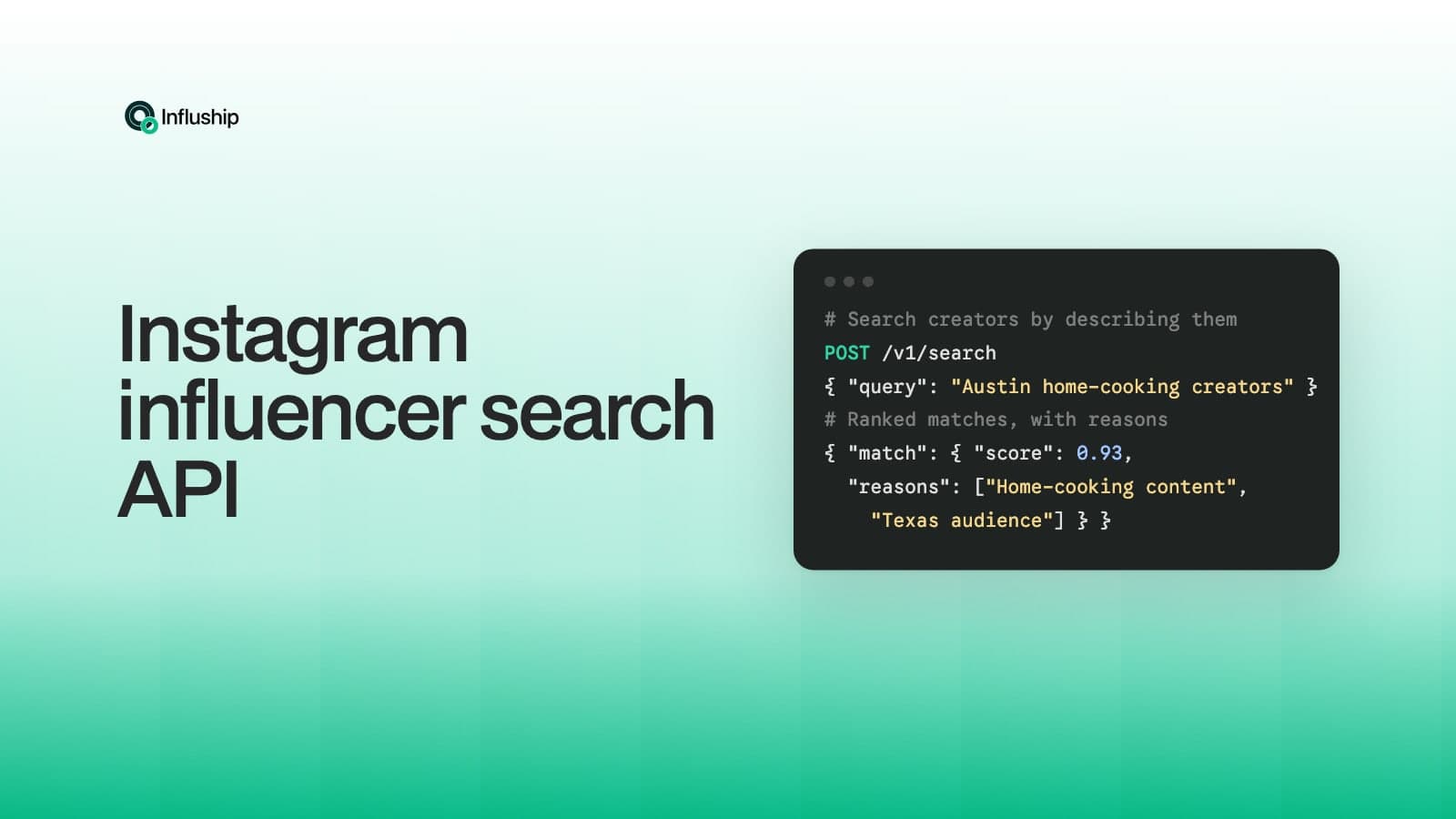
Most influencer APIs make you think in filters: follower count ranges, engagement rate thresholds, location dropdowns. Influship's influencer discovery API works differently. You describe what you're looking for in plain language, and the system finds creators who match.
"Fitness creators in LA who post about running" returns different results than manually setting category=fitness, location=Los Angeles, and hoping running content appears. The natural language search understands context, aesthetics, and content themes that don't fit into dropdown menus.
The other differentiator is the search-to-vetting workflow. Semantic search returns ranked Instagram candidates; lookalike search expands from known creators; match scoring evaluates finalists against a campaign brief with a score, decision, and structured reasons.
Where it's weaker: Public creator search currently covers Instagram, and each search session is capped at 100 results. If you need hundreds of millions of profiles across several networks, Modash or Influencers.Club has broader advertised coverage. Influship is designed for ranked discovery and focused shortlists.
The honest pitch: If you've used filter-based discovery and found it frustrating because of irrelevant results and manual review, natural language search is a different experience. If you just need to pull large lists by follower count and category, a bigger database might serve you better.
Modash
Database: 350M+ creators
Platforms: Instagram, TikTok, YouTube
Pricing: Discovery API from $16,200/year; Raw API from $10,000/year
Modash offers two distinct APIs: Discovery for searching and filtering their indexed database, and Raw for pulling live data on-demand.
Strengths: Documentation includes quickstart guides, interactive API reference, and code samples in multiple languages. The Discovery API uses a credit system where different endpoints cost different amounts. Profile searches are cheaper than full audience demographic reports.
Where it lacks: Three platforms only. No Twitter, Twitch, LinkedIn, or anything beyond IG/TikTok/YouTube. Pricing starts at $16K/year for Discovery, $10K/year for Raw. At scale, you need to architect around credit costs: caching aggressively, batching requests, avoiding redundant calls.
Best for: Teams building white-label discovery tools or internal dashboards who need both analyzed data and real-time verification, and who only care about the big three platforms.
HypeAuditor
Database: 205M+ creators
Platforms: Instagram, TikTok, YouTube, X, Twitch
Pricing: SaaS plans start at $299/month when billed annually; API and MCP access require a sales quote
Strengths: Fraud detection focus. Includes audience quality scores, fake follower analysis, and engagement authenticity checks. Five platform coverage including X and Twitch.
Where it lacks: HypeAuditor publishes entry-level SaaS pricing, but API and MCP pricing remain sales-gated. Teams should confirm tool access, request limits, and data allowances in the quote before committing.
Best for: Enterprise teams where fraud detection and audience authenticity are primary concerns, and where going through a sales process is acceptable.
Influencers.Club
Database: 340M+ creators
Platforms: 47 platforms advertised, including Instagram, TikTok, YouTube, Twitch, X, LinkedIn, Reddit, Discord, and OnlyFans
Pricing: Self-service plans from $140/month; API and dashboard plans from $208/month, with endpoint-specific credit costs
Strengths: Broad platform coverage. Includes Reddit, Discord, and LinkedIn where most competitors have no data. Email enrichment feature: submit an email address, get back associated social profiles (and reverse). Integrates with Clay, HubSpot, and Zapier for workflow automation.
Where it lacks: Credit costs vary substantially by operation and data depth. Model discovery, full enrichment, email resolution, posts, and audience overlap separately against your expected volume.
Best for: Teams that need multi-platform coverage beyond the big three, or who are building around email enrichment workflows.
CreatorIQ
Database: 15M+ creators; CreatorIQ says its Creator Graph processes more than 250M social posts daily
Platforms: Multi-platform
Pricing: Not publicly listed
Strengths: Enterprise creator-program management, content-first discovery, brand-safety workflows, and a bidirectional API for connecting campaign and creator data to other systems.
Where it lacks: Pricing and API access are sales-gated. Confirm the API surface, sandbox availability, implementation scope, and contract terms during evaluation.
Best for: Enterprise teams with budget who need scale and are willing to go through a formal procurement process.
Phyllo
Database: Public and authenticated API families
Platforms: 25+ advertised, including LinkedIn, YouTube, Instagram, TikTok, Twitch, X, Reddit, Snapchat, and Facebook
Pricing: Usage-based plans advertised from $199/month, with custom plans available
Phyllo now offers two API families on a normalized schema. Public APIs support discovery and monitoring without OAuth; authenticated APIs let a creator connect an account so your product can retrieve consented first-party data.
Strengths: One schema across public and authenticated access, broad platform coverage, first-party metrics when creators connect, webhooks, and public developer documentation.
Where it lacks: Public and authenticated calls solve different jobs and have different data rights. Products that need private metrics still require creator consent and OAuth even when public discovery is available.
Best for: Platforms that want public discovery and consented creator data behind one normalized API, including marketplaces, creator tools, and fintech products.
How to Evaluate an Influencer Data API
Features don't matter if the developer experience is broken. Here's how to actually evaluate.
The 30-Minute Test
- Request documentation. Not marketing pages. Technical docs. If they require a sales call, that's a signal about developer priorities.
- Check for sandbox or trial. Can you make real API calls before signing? If not, you're buying blind.
- Time to first call. Sign up and time how long until a working API call. Under an hour is good. Days is a warning.
- Test edge cases. What happens at rate limits? Missing profiles? Special characters?
What to Check in Documentation
- Quickstart with working code samples
- Interactive reference (try calls in browser)
- Examples in cURL, Python, JavaScript minimum
- Clear error codes
- Recent changelog (updated in last 6 months)
Calculate True Cost
Credit-based pricing surprises people. A real scenario:
You budget for 3,000 profile lookups monthly. But audience demographics cost 5 credits per profile while basic data costs 1 credit. You're actually burning 15,000 credits. Your overage rate is 3x in-plan. Your $500 budget just became $2,000.
Ask before signing:
- What does one credit get me, per endpoint?
- What's the overage rate?
- Is there a spending cap?
Hidden Costs to Factor In
Integration time: Include authentication, error handling, caching, schema mapping, and production monitoring in the estimate. A low endpoint price can still be an expensive choice if the integration requires extensive custom work.
Lock-in: Building on proprietary formats makes switching expensive. Abstract your integration behind an internal interface.
Red Flags
- No public documentation
- Credit system without per-endpoint costs published
- No sandbox or trial
- Docs haven't been updated in 12+ months
- "Contact sales" as only path to access
Frequently Asked Questions
Do influencer marketing platforms offer public APIs?
Some do. Influship, Modash, Phyllo, and Influencers.Club publish developer documentation. HypeAuditor advertises API and MCP access but asks you to contact sales for those products; CreatorIQ also handles API access through its enterprise sales process.
Can you discover creators via API, or only look them up?
It depends on the platform. Discovery APIs from Modash, Influship, Influencers.Club, and Phyllo let you search public creator data programmatically. Authenticated products can add first-party metrics when creators connect through OAuth.
Are influencer APIs real-time?
Most are not. Discovery APIs query pre-indexed databases that might be hours or days old. For on-demand data, use a raw endpoint such as Modash Raw or Influship raw, or an authenticated connection where the provider supports one. Expect the pricing and limits to differ from indexed discovery.
Why are influencer APIs so expensive?
Collecting, processing, and indexing millions of public social profiles is expensive. Fraud detection and audience analysis add more cost. The platforms that offer genuine developer APIs maintain substantial data and enrichment infrastructure.
Can I use influencer APIs without a sales contract?
Yes, for some providers. Influship, Influencers.Club, and Phyllo publish self-service entry points, while Modash publishes starting prices. HypeAuditor and CreatorIQ route API access through sales. Influship is available at developers.influship.com, where you can create an account and generate an API key without an enterprise contract. For many other options, expect a sales process.
What's the difference between scraped data and authenticated data?
Public-index data is collected from publicly visible profiles and can include observed fields plus provider-generated estimates. It may be stale and cannot expose private metrics. Authenticated data, accessed through OAuth with a provider such as Phyllo, comes from the platform with creator permission and can include first-party fields unavailable in public profiles.
Conclusion
The market now includes self-service usage-based APIs, sales-gated enterprise platforms, public discovery services, and creator-authorized data providers. Their contracts and data access differ enough that the category label alone is not useful.
The decision comes down to three questions:
- What are you building? Discovery tool, CRM enrichment, or campaign tracking? The architecture you need follows from the use case.
- What's your real budget? Credit-based pricing surprises people. Get the per-endpoint costs and calculate at your actual expected volume.
- Can you evaluate before committing? Public docs, sandbox access, and clear pricing are signals that a platform respects developers. Sales-gated everything is a signal they don't.
If you've been frustrated by filter-based discovery, Influship's influencer marketing API is worth a look. Describe the creator you want in plain English, and get results that actually match.