Follower Count Is a Vanity Metric
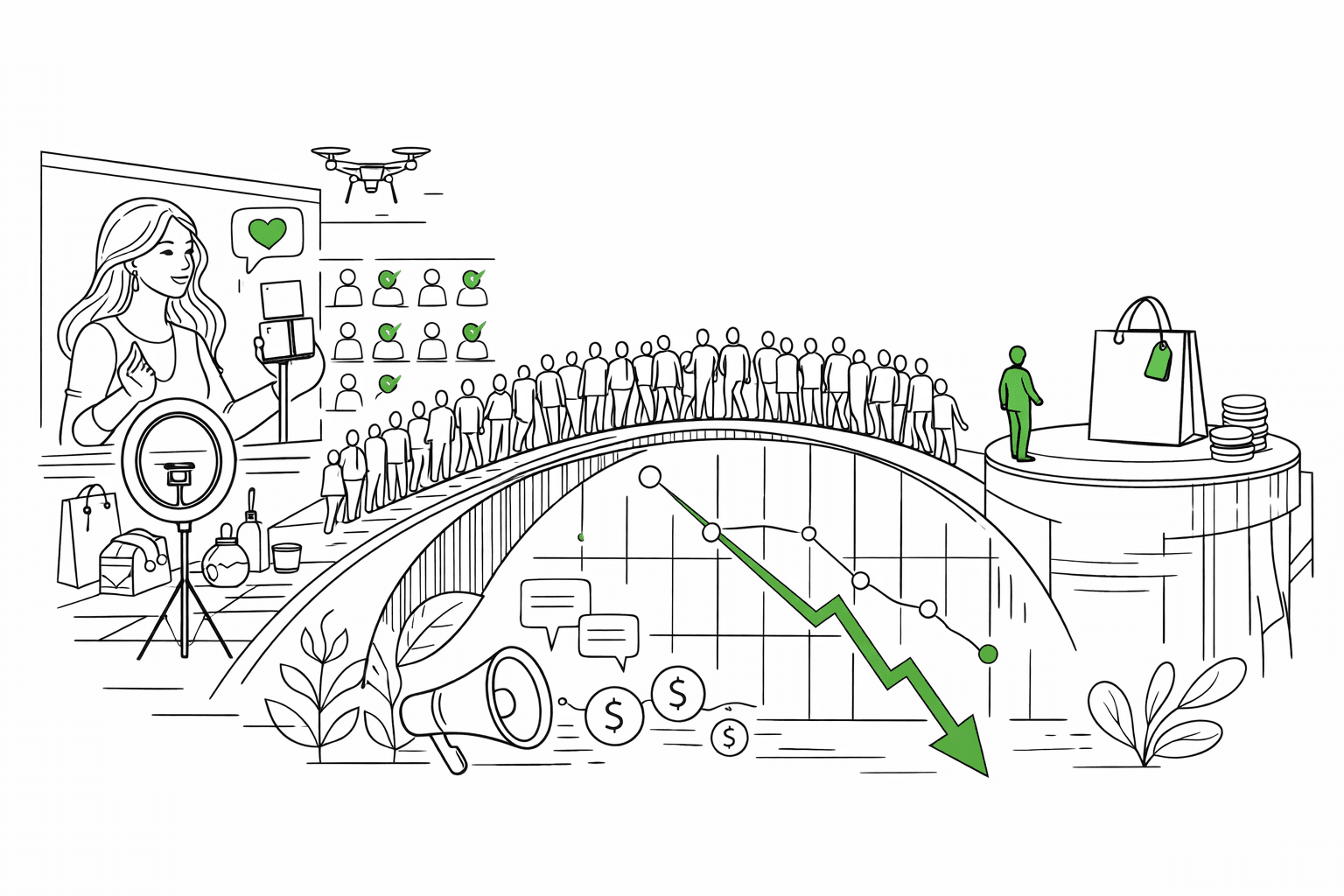
Here's what happens when an influencer posts about your product:
- Followers - The total number on their profile
- Impressions - The percentage who actually see the post (often 30-50% due to algorithm)
- Engagement - The percentage who like, comment, or save
- Clicks - The percentage who tap through to your site
- Conversions - The percentage who buy
Each step has drop-off. Significant drop-off.
Take a 50K follower account with a 2% engagement rate. That's 1,000 people who interacted with the post. Maybe 2% of those click through. That's 20 visitors. If your site converts at 3%, you get less than 1 sale.
50K followers doesn't mean 50K potential customers. Expect 0.5-2% of that number to actually convert, depending on the funnel.
The metric that matters is real audience: people who are likely to see, engage, and take action. This is a much smaller number than followers suggest.
The Real Audience Equation
Want to run this model with your own campaign costs and unit economics? Use the free influencer campaign ROI calculator to forecast buyers, CPA, ROAS and the creator fee you can afford.
Here's the equation:
Expected Buyers = Followers x Engagement Rate x CTR x Conversion Rate
And the one that tells you what you're really paying:
Cost Per Buyer = Influencer Fee / Expected Buyers
Let's break down each variable.
Variable 1: Engagement Rate
This is the percentage of followers who interact with content. Industry benchmarks for 2025:
| Influencer Tier | TikTok | |
|---|---|---|
| nano (1K-10K) | 4-6% | 8-10% |
| micro (10K-100K) | 2-4% | 6-8% |
| macro (100K-500K) | 1-2% | 4-6% |
| mega (500K+) | 0.5-1.5% | 3-5% |
Notice the pattern: engagement drops as follower count rises. A 500K account isn't 10x more valuable than a 50K account. It might deliver only 2-3x the engaged audience.
Variable 2: Click-Through Rate (CTR)
Of those who engage, how many click your link? This depends on:
- Where the link lives (bio, swipe-up, comment)
- How compelling the CTA is
- Whether the audience actually wants what you're selling
Benchmarks are harder to find here, but 1-3% of engaged users clicking through is typical. Strong calls to action with clear buy signals can push this to 5%+.
Variable 3: Conversion Rate
Your site's job. This isn't the influencer's responsibility, but it affects what you should pay them.
Ecommerce conversion rates typically run 1-3%. Well-optimized landing pages with influencer-specific offers can hit 5%+.
The Sanity Check: Your Average Order Value (AOV)
AOV isn't in the equation, but it determines whether the cost-per-buyer makes sense. Paying $250 to get a customer who spends $50 is a disaster. Paying $250 to get one who spends $500 might work.
Worked Example
Let's price a real deal.
The influencer: 75,000 followers on Instagram, 3% engagement rate, asking $800 per post.
Your product: $50 AOV, 2.5% site conversion rate
The math:
- Engaged audience: 75,000 x 3% = 2,250
- Estimated clicks (assume 2% CTR): 2,250 x 2% = 45
- Expected buyers: 45 x 2.5% = 1.1 (round to 1)
Cost per buyer: $800 / 1 = $800
You're paying $800 to get one customer who spends $50. That's a 16x CAC-to-AOV ratio.
Unless you have exceptional LTV or this is purely a brand play, this deal doesn't work.
Now try a different scenario:
The influencer: 20,000 followers, 5% engagement rate, asking $250
Same product math:
- Engaged audience: 20,000 x 5% = 1,000
- Estimated clicks: 1,000 x 2% = 20
- Expected buyers: 20 x 2.5% = 0.5 (round to 1)
Cost per buyer: $250 / 1 = $250
Still expensive, but 3x more efficient than the "bigger" influencer.
This is why micro-influencers often win on ROI despite smaller reach.
How This Compares to Paid Ads (The CPM Reality Check)
Here's another way to price the deal: translate it to CPM (cost per thousand impressions) and compare to paid media.
CPM Formula:
Effective CPM = (Influencer Fee / Estimated Impressions) x 1,000
Let's run it on our first example (75K followers, $800):
Assume 40% of followers see the post = 30,000 impressions.
Effective CPM = ($800 / 30,000) x 1,000 = $26.67 CPM
For comparison, Meta ads typically run $8-15 CPM. TikTok ads run $5-10 CPM.
You're paying 2-3x more per impression than you would with paid ads.
Is that worth it? Sometimes. Influencer content has benefits ads don't:
- Higher trust and engagement
- UGC you can reuse across channels
- Creator ad rights: running ads from their handle
- Audience building through follows
For pure reach optimization, the math often favors paid media.
Decision rule: If your effective CPM is more than 2x your paid media CPM, you're paying a premium for the influencer's audience. Make sure you're getting something beyond reach (UGC rights, affiliate conversion, brand lift) to justify it.
The Two Mistakes That Make Brands Overpay
Mistake 1: Comparing Follower Counts Instead of Real Audience
Quick quiz: Which influencer delivers more value?
- Influencer A: 100,000 followers, 1.2% engagement rate, $1,500 fee
- Influencer B: 35,000 followers, 4.5% engagement rate, $600 fee
Most brands pick A. "More reach."
Let's do the math:
- A's engaged audience: 100,000 x 1.2% = 1,200
- B's engaged audience: 35,000 x 4.5% = 1,575
Influencer B delivers 30% more engaged users for 60% less money.
Cost per engaged user:
- A: $1,500 / 1,200 = $1.25
- B: $600 / 1,575 = $0.38
B is 3x more cost-effective.
This is the math that separates sophisticated influencer programs from expensive experiments.
Mistake 2: Treating All Engagement as Equal
A like from a 16-year-old isn't worth the same as a like from your target buyer.
Two influencers can have identical engagement rates but wildly different audience composition. If 60% of Influencer A's audience is your target demographic and only 20% of Influencer B's is, A's engagement is 3x more valuable.
This is why audience quality data matters as much as engagement rate. You need to know:
- Age and gender distribution
- Location (do they ship to where the audience lives?)
- Interests and behaviors
- Follower authenticity (bots inflate engagement without value)
Engagement rate without audience quality is a misleading metric.
Decision Rules for Pricing Influencer Deals
Use these before negotiating any deal:
Rule 1: Calculate Expected Buyers Before You Negotiate
Run the equation. Know what you're likely to get before you agree to pay for it.
If the math doesn't work at the asking price, you have three options:
- Negotiate down
- Ask for more value (UGC rights, exclusivity, a post series)
- Walk away
Rule 2: Compare Cost-Per-Buyer to Your Other Channels
What's your CAC from Meta ads? Google? Affiliates?
If influencer cost-per-buyer is 5x your paid CAC and you're optimizing for acquisition, the deal doesn't make sense. If it's within 1.5-2x, the premium might be worth it for brand value.
Rule 3: Pay Premiums Only for Specific Value-Adds
It's reasonable to pay more than the pure reach calculation for:
- UGC rights: Reuse the content across ads, email, and web
- Creator ad rights: Running ads from the creator's handle often outperforms brand ads
- Proven converters: Influencers with track records of driving sales command higher rates
- Exclusivity: Keeping them off competitor campaigns has strategic value
Quantify the premium. Don't pay 3x for "vibes."
Rule 4: Default to Micro-Influencers for Performance Campaigns
The math almost always favors micro-influencers (10K-100K) for direct response:
- Higher engagement rates
- Lower fees
- Often more niche-relevant audiences
- More willing to negotiate
Save macro-influencers for awareness campaigns where reach matters more than efficiency.
When the Math Doesn't Apply (And What to Track Instead)
The Real Audience Equation optimizes for direct response. Not every campaign is about immediate sales.
Brand Awareness Campaigns
Goal: Get on people's radar, not their shopping cart.
The real audience equation still helps set expectations, but you're not measuring buyers. Track:
- Branded search lift: Did searches for your brand increase after the campaign?
- Direct traffic: More people typing your URL?
- Social mentions and follows: Growing your own audience
New Product Launches
Attribution is messier when you're introducing something new. People might see the influencer, research for two weeks, then buy through a different channel.
Extended attribution windows and post-purchase surveys ("how did you hear about us?") fill the gap.
Long-Term Audience Building
Some influencer relationships are about building presence in a community over time. The ROI shows up in 6 months, not 6 days.
Here, you're investing in relationship equity. Track:
- Repeat mentions without payment
- Community perception shifts
- Inbound partnership requests
The Bottom Line
Follower count tells you almost nothing about what an influencer will deliver. Real audience matters.
The equation is simple:
Expected Buyers = Followers x Engagement Rate x CTR x Conversion Rate
Cost Per Buyer = Influencer Fee / Expected Buyers
Run this math on your last three influencer deals. Calculate what you actually paid per buyer. Compare it to your other acquisition channels.
If you've been pricing on vibes and follower counts, you'll probably find you've been overpaying. And if you can't calculate expected buyers because you don't have the data, you're not doing influencer marketing. You're gambling.
The fix: demand engagement data, audience demographics, and past performance before signing any deal. If an influencer won't share it, that tells you something too.