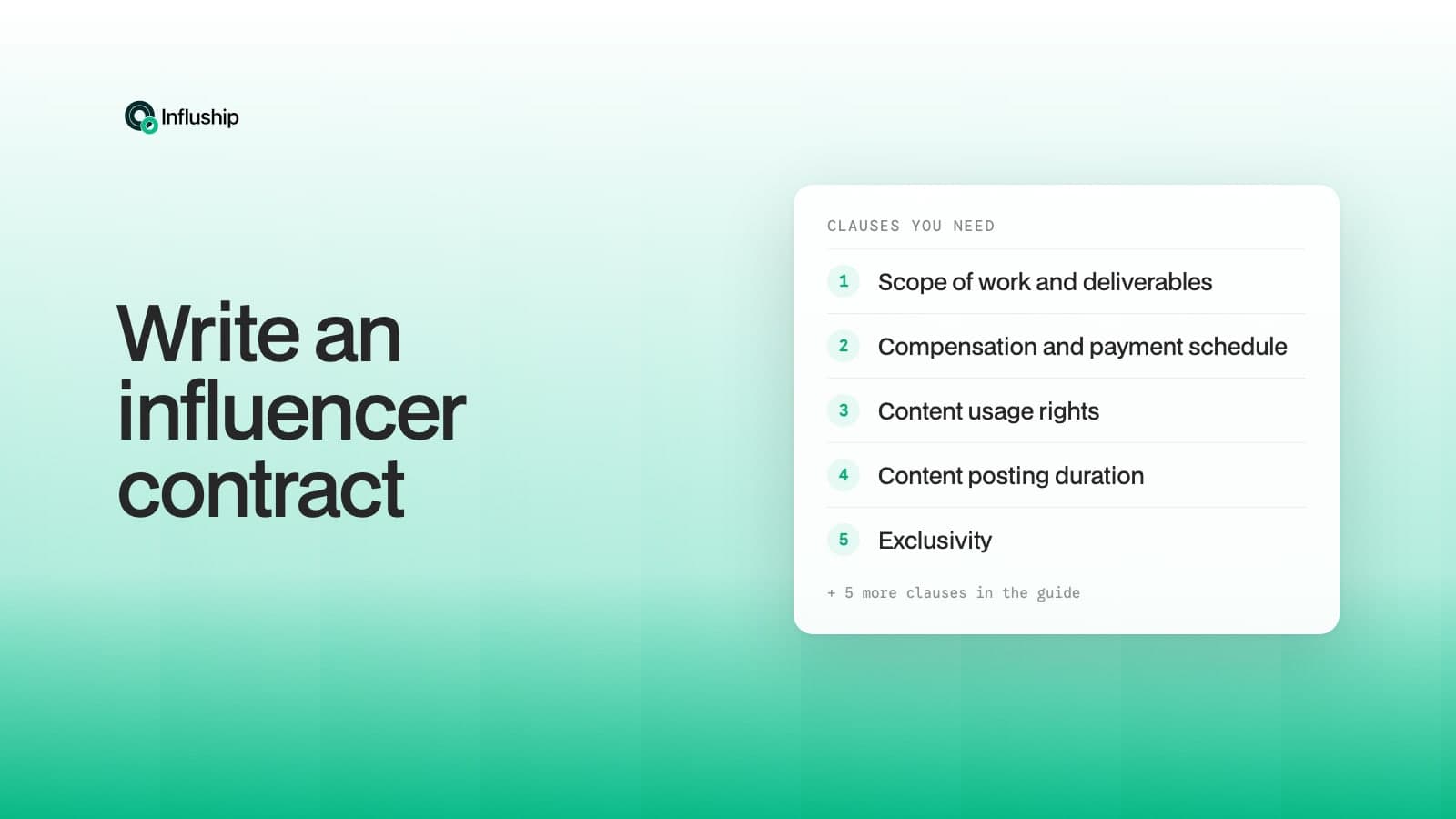
The contract defines what gets made, how money moves, who owns what, and what happens when things fall apart. Most guides list 7 clauses and hand you a Google Doc template. This one gives you the actual language.
The 10 Clauses Your Contract Needs
These are the clauses that belong in every influencer deal, from a $200 gifting arrangement to a $50K campaign. Each one includes contract language you can copy and adapt.
1. Scope of Work and Deliverables
Vague deliverables are the #1 cause of disputes. "Create content for our brand" means something different to every creator. You need format, dimensions, duration, quantity, and platform spelled out in the contract itself.
Creator shall produce and publish: 2x Instagram Reels (9:16 aspect ratio, 30-60 seconds each), 1x Instagram Story sequence (minimum 3 frames with swipe-up link), and 1x TikTok video (9:16, 15-45 seconds). Each deliverable shall feature the Product prominently within the first 3 seconds.
When the platform field says "Multiple," specify which deliverable goes where. A Reel and a TikTok are different content, not the same video cross-posted. If you want cross-posting, say so. If you want native content per platform, say that instead.
2. Compensation and Payment Schedule
Four compensation models exist in influencer marketing: flat fee, gifting (product only), affiliate (commission-based), and hybrid (reduced fee plus commission). Most paid campaigns use flat fee or hybrid.
The industry standard payment split is 50/50. Half on contract signing, half on delivery of all content. This protects both sides. The brand doesn't pay everything upfront. The creator doesn't work for free until the campaign ends.
For rate context: based on real transaction data from Lumanu (255K payments processed), the average payment per transaction is $1,645. Micro creators get $100-500 per post on Instagram. Mega creators get $5K-15K. Your rate should reflect the creator's reach, engagement, and niche. For a full breakdown, see our influencer pricing guide.
Brand shall pay Creator a total fee of $[AMOUNT] USD, payable as follows: (a) 50% ($[HALF]) within 5 business days of contract execution; (b) 50% ($[HALF]) within 5 business days of Brand's written approval of all Deliverables. Late payments shall accrue interest at 1.5% per month.
Consider adding a late delivery clause for time-sensitive campaigns. A standard structure: 5% fee reduction per week of delay, capped at 50%. This gives the creator a real deadline without wiping out their compensation entirely.
3. Content Usage Rights
This clause determines how much value you extract from the content after it goes live. Most guides lump usage rights into one paragraph. That's a mistake. There are four distinct tiers, and each one carries different pricing and legal implications.
Tier 1: Organic only. The creator posts to their feed. You can repost or share with credit. No paid amplification. This is the baseline that comes with every deal.
Tier 2: Whitelisting (Spark Ads / Partnership Ads). You run paid ads through the creator's account or handle. The ad appears to come from them, not your brand. This performs 20-50% better than brand-run ads because the social proof is built in. Industry standard pricing: 20-25% of the base rate per 30-day flight.
Tier 3: Paid ads on brand channels. You take the creator's content and run it as ads from your own accounts, website, email, or other channels. The creator's face and voice appear in your brand's ads. Pricing: 1.5-2x the organic base rate.
Tier 4: Full buyout. Perpetual, worldwide, unlimited rights across all media. You can use the content however you want, forever. Pricing: 3-5x the organic base rate. Most creators resist full buyouts unless the money justifies it.
The critical legal point here: the creator retains copyright in all tiers except a full buyout with explicit assignment. Payment alone does not transfer copyright. What you're buying is a license, not ownership. Your contract needs to specify which tier you're licensing, the duration, and the permitted channels.
Brand shall have the right to use the Deliverables as whitelisted/Spark Ads through Creator's social media account(s) for a period of [30/60/90] days from the date of first publication. Creator shall grant Brand advertising access through the applicable platform's partnership tools within 48 hours of content approval. This license is non-exclusive and limited to paid social advertising. Brand shall not edit, alter, or modify the Deliverables without Creator's prior written consent. Upon expiration of the whitelisting period, Brand shall cease all paid amplification through Creator's account(s) within 24 hours.
That whitelisting clause is the one most competitors skip. It's also the one that causes the most disputes. Get it in writing.
4. Content Posting Duration
This clause governs how long the content stays live on the creator's profile. The industry standard is 12 months. After that period, the creator can remove the content at their discretion. Some brands negotiate permanent posting, but creators push back because sponsored content ages poorly.
Creator shall maintain all Deliverables on their social media profile(s) for a minimum period of 12 months from the date of publication. After this period, Creator may remove content at their sole discretion.
5. Exclusivity
Exclusivity prevents the creator from promoting competing brands for a defined period. Three levels exist: none (creator can work with anyone), category (no competing products in the same vertical), and full (no other brand deals at all). Category exclusivity is the most common. Full exclusivity is rare, expensive, and usually reserved for ambassador deals.
The premium for exclusivity runs 25-100% on top of the base rate, proportional to scope and duration. A 30-day category exclusivity might add 25%. A 90-day full exclusivity could double the entire fee.
During the period beginning on the Effective Date and ending [60] days after publication of the final Deliverable ("Exclusivity Period"), Creator shall not create, publish, or promote content for any brand in the [skincare/protein supplement/fitness apparel] category, including but not limited to [Brand X, Brand Y, Brand Z]. Creator shall notify Brand of any exclusivity conflicts prior to contract execution.
6. Content Approval
Standard practice is 1-2 revision rounds with a defined review window. 48 hours is typical. Go beyond two rounds and you're micromanaging. If the brief was clear, two rounds handles everything.
The auto-approval clause protects creators from brands that go silent mid-review. If the brand doesn't respond within the window, the content is approved. Without this clause, creators sit in limbo waiting for feedback while their posting schedule stalls.
Creator shall submit draft content to Brand for review at least [5] business days prior to the scheduled publication date. Brand shall provide feedback within 48 hours of receipt. If Brand does not respond within this period, the content shall be deemed approved. Creator shall incorporate reasonable revisions within [2] revision rounds. Additional revision rounds beyond [2] shall incur a fee of $[AMOUNT] per round.
7. FTC and ASA Disclosure
Federal law requires creators to disclose paid partnerships. Both the brand and the creator share liability for non-compliance. This is not optional. The FTC has fined individual creators and brands more than $50K per post for missing or buried disclosures.
The disclosure (#ad or #sponsored) must be visible without scrolling or tapping "see more." For video content, the creator must both speak and display the disclosure. For a full breakdown of requirements, see our FTC compliance guide.
Creator shall include clear and conspicuous disclosure of the material connection between Creator and Brand in each Deliverable, in compliance with FTC 16 CFR Part 255 and any applicable local regulations. Disclosures shall appear above the fold (before any "more" truncation) and, for video content, shall be both spoken and displayed on-screen. Brand shall not request, encourage, or instruct Creator to omit or obscure required disclosures.
8. Termination
Either party should be able to exit the agreement with written notice. 14 days is typical, with a 7-day cure period for breach (meaning the breaching party gets 7 days to fix the problem before termination takes effect).
Payment on termination follows a straightforward principle. If the brand terminates without cause, the creator keeps compensation for all completed work. If the creator terminates without cause, they refund payment for undelivered content. One clause people miss: portfolio rights survive termination. The creator can display the work in their portfolio regardless of how usage rights are structured.
Either party may terminate this Agreement with 14 days' written notice. In the event of a material breach, the non-breaching party shall provide written notice specifying the breach, and the breaching party shall have 7 days to cure. Upon termination by Brand without cause, Creator shall retain compensation for all Deliverables completed and approved prior to the termination date. Upon termination by Creator without cause, Creator shall refund pro-rata compensation for any undelivered Deliverables. Creator's right to display Deliverables in their professional portfolio shall survive termination.
9. Confidentiality
A mutual NDA covering campaign strategy, launch dates, compensation terms, and sales data. Standard survival period: 12 months after termination. The key nuance here is that confidentiality obligations cannot conflict with FTC disclosure requirements. The creator must always be able to disclose that a paid partnership exists, even if the specific terms are confidential.
Each party agrees to hold in confidence all non-public information received from the other party, including campaign strategy, launch timelines, compensation terms, and performance data. This obligation survives termination for 12 months. Nothing in this clause shall prevent Creator from making disclosures required by applicable law or regulation, including FTC-mandated sponsorship disclosures.
10. AI Content Protection
This is the clause most contract templates still don't include. 73% of creators now require explicit consent before a brand can use their likeness or content in any AI context. The concerns are real: brands training AI models on creator content, generating synthetic versions of a creator's voice or face, or running creator footage through generative AI tools without permission.
Your contract should address three specific prohibitions. First, no deepfakes or synthetic content using the creator's likeness, voice, or persona. Second, no using the deliverables as training data for AI or machine learning models. Third, no generative AI modifications to the content without the creator's written approval.
Standard editing (cropping, color correction, aspect ratio adjustments) remains permitted. The line is between traditional post-production and AI-powered generation or manipulation.
Brand shall not: (a) create deepfakes, synthetic media, or AI-generated content using Creator's name, likeness, voice, or persona; (b) use the Deliverables or any portion thereof as training data for artificial intelligence, machine learning, or large language models; (c) apply generative AI tools to modify, alter, or create derivative works from the Deliverables without Creator's prior written consent. Standard post-production editing (cropping, color correction, aspect ratio adjustment, subtitling) shall remain permitted. This clause survives termination of the Agreement.
Advanced Clauses for Bigger Deals
These clauses are optional for a $500 gifting deal. They become necessary as budgets grow. Include them for any campaign over $5K.
Mutual Morals Clause
Most contract guides only cover brand-side morals clauses, where the brand can exit if the creator does something that damages the brand's reputation. The modern standard is mutual. Either party can exit if the other causes reputational harm. If the brand triggers the clause (scandal, boycott, discriminatory actions), the creator keeps compensation for completed work. If the creator triggers it, the brand can stop payments for undelivered content.
Either party may terminate this Agreement immediately upon written notice if the other party engages in conduct that brings public disrepute, contempt, or scandal, or that could reasonably be expected to damage the terminating party's reputation or brand. In the event Brand exercises this right, Creator shall retain compensation for all completed Deliverables. In the event Creator exercises this right, Brand's obligation to pay for undelivered Deliverables shall cease.
Force Majeure
Covers events outside either party's control: platform outages or bans, pandemics, natural disasters, government actions. The affected party must give notice within 48 hours. If the force majeure event lasts 30+ days, either party can terminate. Payment for completed work remains due regardless.
Neither party shall be liable for failure to perform due to causes beyond its reasonable control, including platform outage or suspension, pandemic, natural disaster, or government action. The affected party shall provide notice within 48 hours. If the event continues for 30 or more days, either party may terminate this Agreement upon written notice. Compensation for Deliverables completed prior to the force majeure event shall remain due.
Indemnification
Each party covers the other against claims arising from their own breach. The brand indemnifies the creator against product liability claims (if the product causes harm, that's on the brand, not the creator). The creator indemnifies the brand against claims arising from false statements not reviewed or approved by the brand.
Dispute Resolution
Pick your governing jurisdiction and resolution method. For domestic deals, mediation followed by litigation is the most common structure. For international deals, binding arbitration is typical because enforcing court judgments across borders is slow and expensive. Specify the jurisdiction (usually the brand's home state or country) and the arbitration body (AAA or ICC for international).
How Contract Terms Change the Price
Usage rights and exclusivity are not just legal clauses. They're line items. Each one adds cost. Watch how terms stack on a $500 base rate for a single Instagram Reel.
Example: A micro-influencer quotes $500 for an Instagram Reel (organic posting only). You want whitelisting for 3 months and category exclusivity for 60 days. The math: $500 base + $375 whitelisting (25% x 3 months) + $250 exclusivity (50%) = $1,125.
| Term | Premium | On a $500 base |
|---|---|---|
| Organic only | Baseline | $500 |
| Whitelisting (3 months) | +20-25%/month | $875 |
| Paid ads (6 months) | 1.5-2x | $750-1,000 |
| Full buyout | 3-5x | $1,500-2,500 |
| Category exclusivity (60 days) | +25-50% | $625-750 |
| Full exclusivity (90 days) | +50-100% | $750-1,000 |
Rates based on real transaction data from 255K payments. For a full breakdown of how influencer pricing works, see the complete pricing guide.
The takeaway: a $500 post can become a $2,000 deal once you add the terms you actually need. That's not overcharging. That's the creator pricing the full scope of what you're asking for. Budget for the real number from the start.
Platform-Specific Contract Notes
The clauses above apply everywhere, but each platform has quirks that your contract should address.
Instagram. Partnership Ads (formerly Branded Content Ads) require the creator to grant access through the app's settings. Your contract should specify a deadline for granting this access. Reels have a longer shelf life than Stories, which affects your content posting duration clause. A Reel can surface in Explore months after posting. A Story disappears in 24 hours. Carousel posts count as one deliverable, not one per slide.
TikTok. Spark Ads authorization is done per-video, not per-account. The creator generates an authorization code for each video you want to boost. Your contract should specify the authorization window. TikTok content can go viral weeks after posting, so your usage rights window should account for delayed performance. Address Duet and Stitch permissions if the content is part of a broader campaign.
YouTube. Dedicated videos (the entire video is about your product) cost 2-3x more than integrations (a 60-second mention within a longer video). Your scope of work clause should specify which format you're buying. Creators keep monetization revenue from YouTube ads served on the video unless your contract says otherwise. Shorts have different economics than long-form, both in creator rates and audience behavior.
Build Yours in 2 Minutes
Every clause above is built into the free influencer contract builder. Seven steps, PDF download, no signup. It covers all 10 core clauses plus the advanced ones: AI protection, mutual morals, force majeure, and indemnification. Not a static template. The builder adapts the language based on your inputs, so the contract matches the specific deal you're putting together.
FAQ
Do influencers need a written contract?
Yes. 78% of successful campaigns use formal agreements. Even gifting deals need written terms. Without a contract, you have no recourse if the creator ghosts after receiving the product, and the creator has no protection if you use their content beyond what was verbally agreed. A simple 2-page agreement covers both sides.
Who owns the content in an influencer deal?
The creator, unless the contract explicitly assigns ownership. Payment alone does not transfer copyright. What you buy is a license to use the content in specific ways for a specific period. If you need full ownership (rare), you need a buyout clause with appropriate compensation, typically 3-5x the organic rate.
What is whitelisting in influencer marketing?
The brand runs paid ads through the creator's social media account or handle. On Instagram, this is called Partnership Ads. On TikTok, it's Spark Ads. The ad appears to come from the creator, not the brand, which improves performance by 20-50%. Whitelisting is priced separately from organic posting, typically 20-25% of the base rate per month of access.
How long should an influencer contract be?
2-4 pages for standard deals. 5-8 pages for campaigns over $10K that need advanced clauses like indemnification, force majeure, and detailed usage rights tiers. Length matters less than clarity. A 2-page contract that covers scope, payment, usage, and termination beats an 8-page document full of boilerplate that nobody reads.
Can you use the same contract for every influencer?
The structure stays the same, but you need to customize deliverables, payment terms, and usage rights for each creator. A blanket contract signals you haven't thought about the specific partnership. The contract builder handles this by generating tailored language based on the deal specifics you enter. Same framework, different details.