Most “best influencer marketing software” roundups are affiliate listicles. The tool that pays the highest commission lands at number one, the copy is interchangeable, and nobody tells you what each platform is actually bad at. This is not that. We make one of the tools on this list, so treat our pick with appropriate skepticism, but everything below is ranked by fit, not by a referral payout, and every weakness is named.
There are ten tools here, grouped by the kind of buyer they suit rather than dumped into a flat top-ten. A discovery API for a developer and an enterprise campaign suite for a 40-person agency are not competing for the same job, and pretending they do is how people end up paying five figures for software they use at ten percent. Find the section that matches your constraint and start there.
How we evaluated
Six criteria, applied the same way to every tool. No weighting toward whoever has the best affiliate program.
- Discovery model. Does it find creators by natural-language description and audience match, or only by rigid filters (location, follower count, category) you have to set yourself? Filter-only discovery breaks the moment you're describing a vibe instead of a spec.
- Database depth. How many profiles, across which platforms, and how fresh the data is. A large stale database is worse than a smaller live one.
- Pricing transparency. Public, self-serve pricing beats “book a demo.” Where a vendor hides its price behind sales, we mark the number as reported and say so.
- API and programmatic access. Can a developer pull creator data into their own systems, and at what tier? For a lot of teams this is the whole decision.
- Free trial / self-serve. Can you try it without a contract and a sales call? Annual lock-in before you've proven fit is a real cost.
- Fit by team size. A solo founder and an enterprise brand have opposite needs. We say plainly who each tool is for.
Prices move and private tiers change. Where a number isn't published, we've marked it as reported and you should confirm with the vendor before you buy. If you want the wider market context, our influencer marketing pricing breakdown covers what teams actually spend across software, creator fees, and management.
Best influencer marketing software at a glance
The full comparison. Starting prices are the lowest published self-serve tier; “custom” means enterprise-only, sales-led pricing.
| Tool | Best for | Discovery model | Starting price | API | Free access |
|---|---|---|---|---|---|
| Influship | AI discovery + affordable API | Natural-language + match scoring | Free plan; paid from $50/mo | Yes ($0.01/credit) | Free plan |
| Modash | Raw database breadth | Filter-based | $199/mo (billed annually) | Enterprise tier | Limited (free profiles) |
| GRIN | Ecommerce relationship management | Filter + bring-your-own | Custom (reported $25k+/yr) | Yes (enterprise) | Demo only |
| Upfluence | Ecommerce + affiliate | Filter-based | Custom (reported $478+/mo) | Yes | Demo only |
| Aspire | Branded-content at scale | Marketplace + filter | Custom | Limited | Demo only |
| CreatorIQ | Enterprise campaign management | Filter + integrations | Custom (reported $36k+/yr) | Yes (enterprise) | Demo only |
| HypeAuditor | Audience fraud detection | Filter + analytics | Reported ~$399/mo | Yes | Limited free reports |
| Sprout Social Influencer (Tagger) | Enterprise + social suite | Filter + social listening | Custom | Yes (enterprise) | Demo only |
| Meltwater | Enterprise PR + influence | Filter + media monitoring | Custom | Yes (enterprise) | Demo only |
| Collabstr | Quick gifting / one-off hires | Marketplace browse | Free to browse; pay per hire | No | Yes (free to browse) |
The 10 best tools, by use case
For AI-powered discovery and affordable API access: Influship
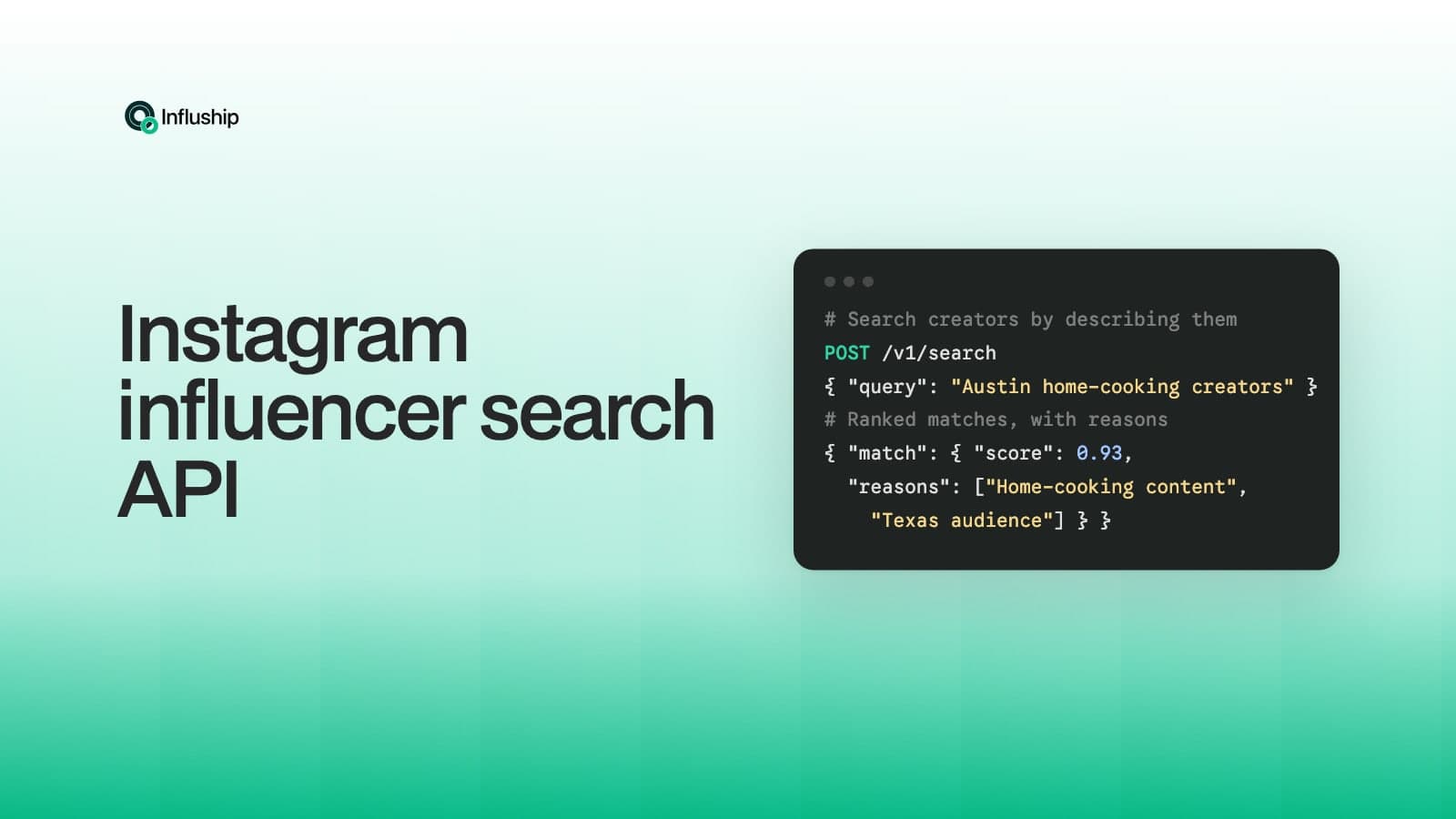
Influship is built around one idea: you should be able to describe the creator you want in plain English and get a ranked, scored shortlist back, instead of translating your brief into a stack of filters and hoping. Search across a database of 10M+ AI-analyzed creator profiles with AI-powered creator discovery, and each result comes with a match score, a decision, and the reasons behind it, plus an AI summary, audience demographics, and content analysis. Discovery, vetting, and outreach live in one platform, and lookalike discovery turns one good creator into ten more like them. For developers, the Influship API exposes the same search, scoring, and enrichment at $0.01 per credit, which is an order of magnitude cheaper than the enterprise-tier API access most platforms gate behind a five-figure contract.
The honest weaknesses: the app covers Instagram today, with YouTube and TikTok coming soon, so if either is the core of your program, check the timeline before committing or pull that data through the API, which already covers all three. And Influship is discovery and intelligence, not a full campaign-management suite with payment rails and contract e-signing built in, though the API makes it easy to wire into the tools you already use for that.
Pricing. Free tier to start, paid plans from roughly $49/month, and pay-as-you-go API credits at $0.01 each. See current pricing. Best for DTC brands, agencies, and developers who want fast, AI-native discovery and programmatic access without an annual enterprise contract.
For raw database breadth: Modash
Modash has one of the larger discovery databases on the market and clean API documentation, which is why it shows up on most shortlists. If you already know exactly who you're targeting by location, category, engagement rate, and follower band, its filter system is fast and the data is solid. The catch is that filter-only discovery puts all the translation work on you, and the pricing model asks for commitment: the Essentials plan is $199/month but billed annually at $2,388, and API plus high-volume access lives on an Enterprise tier reported to start around $14,700/year.
Pricing. $199/mo (billed annually); Enterprise from a reported $14,700/yr. Best for teams that want maximum database breadth and already know their exact targeting filters. If the annual commitment or the filter-only model is what's bothering you, we wrote a dedicated Modash alternatives comparison.
For ecommerce relationship management: GRIN, Upfluence, and Hubfluence
GRIN is the strongest creator-relationship platform for DTC ecommerce. It plugs directly into Shopify and your email stack, manages product seeding, discount codes, affiliate links, payments, and attribution, and treats creators like an owned channel rather than a media buy. The trade-off is that GRIN is built for brands that already have creators coming to them; its discovery is thinner than a dedicated search tool, and pricing is custom-only, reported to start around $25,000/year with an annual contract. We compare the two directly in Influship vs GRIN, and if the price or discovery gap is the issue, see GRIN alternatives.
Upfluence covers similar ground with a heavier lean toward affiliate and live-shopping workflows, plus a Shopify and WooCommerce integration that surfaces your own customers who are also creators. Its database is large and the campaign tooling is mature. Pricing is custom and sales-led (reported to start in the high hundreds per month and climb quickly with seats and database access), and like GRIN it's a demo-first sale, not self-serve.
Hubfluence is the TikTok Shop specialist of this group. Brands and agencies running TikTok Shop affiliate programs use it to source creators, run outreach and follow-ups at scale, and manage samples, relationships, and campaign performance in one place instead of spreadsheets. Pricing is self-serve and month to month rather than a sales-led annual contract. The limitation is deliberate: it covers TikTok Shop only, so it complements a broader discovery tool rather than replacing one.
Best for ecommerce brands running ongoing creator programs who want seeding, affiliate, and payments in one system and have the budget for an annual contract. Hubfluence is the exception on both counts: month-to-month, and only for programs that run on TikTok Shop.
For branded-content marketplaces: Aspire and Collabstr
Aspire (formerly AspireIQ) pairs a creator marketplace with full campaign management, so brands can post a brief, field inbound applications from creators who want to work with them, and run the whole relationship from there. It scales branded-content production well and the workflow tooling is solid. Pricing is custom and enterprise-leaning, and the inbound-marketplace model means your shortlist is biased toward creators already on the platform rather than the whole market.
Collabstr is the opposite end: a true marketplace where you browse creators with fixed package prices and hire on the spot, no subscription, no contract. For a quick gifting campaign or a handful of one-off posts it's the fastest path from idea to live. The limits are obvious too: no API, no deep audience analytics or fraud detection, and the roster is whoever has listed themselves, which skews toward smaller creators.
Best for Aspire: mid-market and enterprise brands running high-volume branded content. Collabstr: small teams and one-off campaigns that want speed over depth.
For enterprise campaign management: CreatorIQ, Sprout/Tagger, and Meltwater
CreatorIQ is the enterprise standard for large brands and agencies managing hundreds of creators across markets. Deep workflow, strong reporting, integrations with the rest of the martech stack, and enterprise-grade governance. It is priced to match: custom, reported to start around $36,000/year, with an implementation that assumes a dedicated team. We break down the gap for smaller buyers in Influship vs CreatorIQ.
Sprout Social Influencer Marketing (the platform formerly known as Tagger, now folded into Sprout) is the right call if you already run Sprout for social management and want influencer discovery, campaign tracking, and social listening in the same suite. The integration is the selling point; standalone, it's a heavier and pricier choice than a dedicated discovery tool.
Meltwater comes at influence from the PR and media-monitoring side. If your program sits next to earned media and brand monitoring, having influencer data in the same place as your press coverage is genuinely useful. As a pure influencer tool it's less focused than the others, and pricing is enterprise custom.
Best for large brands and agencies with the budget and headcount for an annual enterprise contract and a real implementation.
For audience fraud detection: HypeAuditor
HypeAuditor is the tool to reach for when authenticity is the priority. Its fake-follower and engagement-fraud detection is the most developed on this list, with dozens of quality metrics per creator and a large database to check them against. If your biggest risk is sending budget to a creator whose numbers don't hold up, this is where it belongs in the stack. The downside is that fraud analytics is what it's built for; discovery and campaign management are secondary, and the reported ~$399/month entry point rises fast for full access. We put it head to head in Influship vs HypeAuditor.
Best for brands and agencies who need rigorous vetting before approving spend. For the manual version of the same job, see our guide to vetting smaller creators, where fraud is most common.
Categories of influencer marketing software
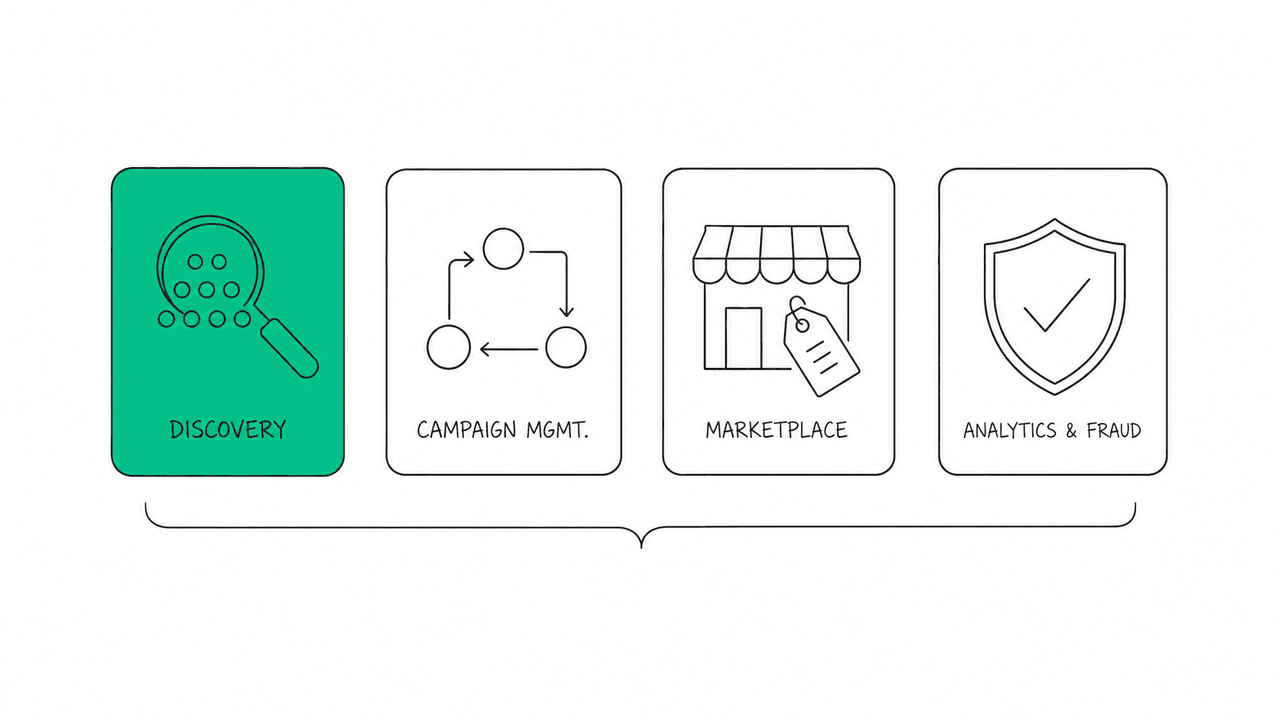
Four broad categories. Most tools lead in one and dabble in the others; the mistake is buying a tool that's strong in a category you don't actually need.
- Discovery and search tools. Find and vet creators. The job is matching the right audience to your brief. Influship, Modash, and HypeAuditor lead here.
- Campaign-management suites. Run the relationship end to end: briefs, contracts, seeding, payments, attribution. GRIN, Upfluence, CreatorIQ, Aspire, and Sprout/Tagger live here.
- Marketplaces. Browse and hire creators directly, often at fixed prices. Collabstr and, in a hybrid form, Aspire.
- Analytics and fraud tools. Verify audience quality and measure performance. HypeAuditor leads; Meltwater adds the media-monitoring angle.
How to choose
Pick by your binding constraint, the one thing that, if it's wrong, sinks the program. Everything else is secondary.
- Budget is tight. Start with a free tier and self-serve pricing. Influship and Collabstr let you start without a contract. Avoid the custom-quote enterprise tools until you've proven the channel.
- Discovery is the hard part. If finding the right creators is what keeps breaking, prioritize natural-language search and match scoring over filter banks. That's the case for Influship.
- You need an API. Confirm what tier unlocks it and the per-call cost. Influship's $0.01/credit API is self-serve; most others gate the API behind enterprise.
- You're running ecommerce at scale. Relationship and seeding tooling tied to Shopify matters more than raw search. GRIN or Upfluence.
- You're an enterprise team. Governance, integrations, and reporting justify the contract. CreatorIQ, Sprout, or Meltwater.
Four red flags worth walking away from: an annual lock-in before you can prove fit; pricing you can only get through a sales call; a database that's thin in your specific niche (ask for a sample search); and no trial of any kind. None of these is automatically disqualifying for an enterprise buyer, but for everyone else they're a reason to keep looking.
Further reading
This roundup ranks tools. If you'd rather diagnose which kind of tool your team needs before shopping, our companion piece on the best influencer marketing tools argues that feature lists don't predict success and walks through identifying your real bottleneck first. For spend benchmarks, see influencer marketing pricing, and for a deeper platform-by-platform breakdown, the influencer marketing platform comparison. If you're still defining terms, the influencer marketing platform glossary entry is a good starting point.
Frequently asked questions
What is influencer marketing software?
Influencer marketing software helps brands find, vet, manage, and measure creator partnerships. Depending on the category, it covers creator discovery and search, audience and fraud analytics, campaign workflow (briefs, contracts, seeding, payments), and performance reporting. Some tools do one of these deeply; suites try to do all of them in one place.
Is there free influencer marketing software?
Yes. Influship has a free tier for discovery, and Collabstr is free to browse and search, with payment only when you hire a creator. Most tools also offer some form of free profile check or limited report. Full discovery, analytics, and campaign management generally sit behind a paid plan.
What's the cheapest option?
For self-serve, recurring use, Influship's free tier and pay-as-you-go API ($0.01 per credit) are the lowest entry point on this list. For genuinely one-off campaigns with no subscription, a marketplace like Collabstr where you pay only per hire can come out cheaper. The expensive end is the enterprise suites (GRIN, CreatorIQ, Meltwater), which start in the tens of thousands per year.
Do I need software for micro-influencer campaigns?
For a one-off campaign with two or three creators, you can run it manually. The moment you're vetting more than a handful, comparing audiences, or running an always-on program, software pays for itself, because micro and nano creators are exactly where audience quality varies most and fraud is most common. A discovery tool with built-in vetting saves you from guessing. See the micro-influencer guide for the specifics.