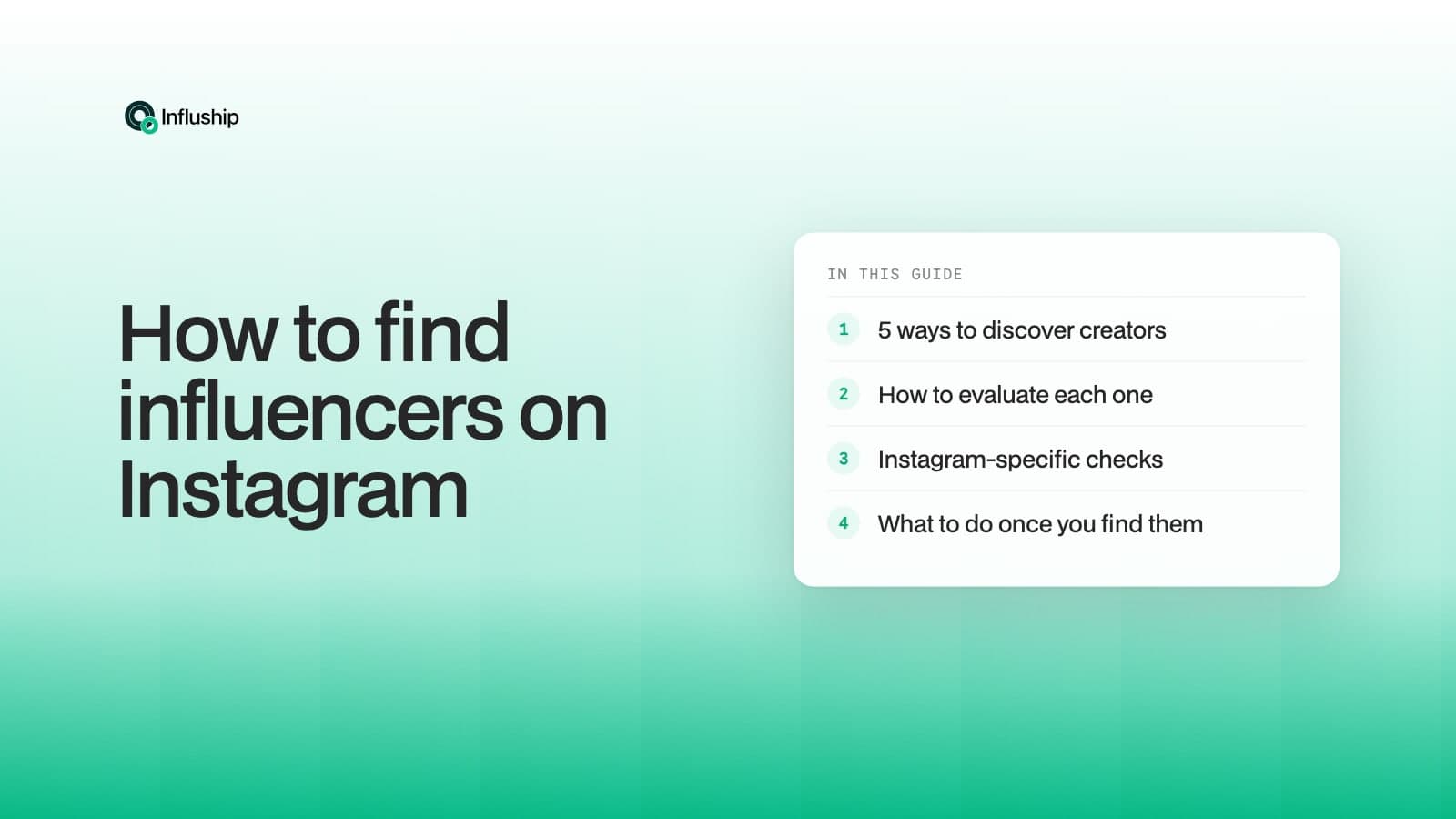
Instagram has over 500,000 active influencers. Finding one is easy. Finding the right one for your brand, budget, and campaign goals takes a structured process. This guide covers five methods ranked by effectiveness, the metrics that matter when evaluating creators, and Instagram-specific tactics most guides skip.
The 5 Best Methods to Find Instagram Influencers
Each method involves a tradeoff between speed and cost. Manual methods are free but slow. Platforms cost money but return qualified candidates in minutes. Start with the method that matches your budget and timeline.
1. Influencer Search Platforms
Influencer discovery platforms let you search databases of millions of creators using filters like audience demographics, engagement rate, location, niche, and follower count. The best platforms go further: they analyze audience data, flag fake followers, and surface creators whose followers match your customer profile.
This is the fastest way to build a qualified shortlist. Instead of scrolling through profiles for hours, you enter your criteria and get results in seconds.
Influship takes a different approach from traditional filter-based search. You describe the type of creator you need in natural language, and AI matches you with Instagram influencers based on audience composition, content context, and brand fit. This means you can find creators whose audiences match your customer profile, even if those creators have never posted in your category before.
Other platforms worth evaluating include Modash (strong filtering and audience analytics), HypeAuditor (fraud detection focus), and Upfluence (e-commerce integrations). Most offer free trials, so test two or three before committing.
Best for: Brands running multiple campaigns or managing more than five creator relationships at a time. The time savings compound fast.
2. Instagram's Native Search and Explore Page
Instagram's Explore page surfaces creators based on your account's engagement history. If your brand account interacts with content in your niche (likes, saves, follows), the Explore algorithm will start showing you relevant creators. This is free discovery, but it requires patience and active engagement.
Use Instagram's search bar with keyword searches related to your product category. Instagram now indexes caption text and spoken words in Reels, so searching "creatine review" or "summer skincare routine" returns relevant creator content, not only hashtag results.
The limitation: Instagram search shows you popular content, not necessarily the best creators for your brand. You have no audience demographic data, no engagement rate calculations, and no fraud signals. You're evaluating profiles one at a time.
Best for: Early-stage brands building initial awareness of who creates content in their space. Treat it as research, not a scalable discovery method.
3. Hashtag Research
Search 10-15 hashtags relevant to your product and note creators who appear across multiple tags. A skincare brand might search #skincareroutine, #glowingskin, #cleanbeautyproducts, and #morningroutine. Creators showing up across three or four of these tags are committed to the niche.
Focus on mid-volume hashtags (10K-500K posts) rather than the most popular ones. Tags like #beauty (500M+ posts) are too broad. Tags like #retinolbeforeandafter (50K posts) attract creators with specific expertise and engaged followers.
Skip the "Top Posts" tab for discovery. Those tend to feature large accounts you already know about. The "Recent" tab surfaces emerging creators with smaller but growing audiences.
Best for: Niche products where category-specific hashtags exist. Less effective for broad consumer brands.
4. Competitor Analysis
Visit your competitors' Instagram profiles and check their "Tagged" section. Every influencer who tags a competitor in a sponsored post shows up here. This gives you a ready-made list of creators who already work in your category, understand sponsored content expectations, and have proven they can deliver.
Go deeper: look at who comments on your competitors' posts. Creators who engage with competing brands (without being paid) are warm leads. They already care about your product category.
Also check your own tagged photos. Creators who mention your brand organically are the highest-quality prospects. They already use your product. Their endorsement is credible because it started without a paycheck.
Best for: Competitive markets where rival brands already run influencer campaigns. You inherit their research.
5. Creator Marketplaces
Instagram's own Creator Marketplace (accessible through Meta Business Suite) lets brands browse creators who have opted in to brand partnerships. Creators set their rates, list their interests, and specify the types of collaborations they accept. Brands can filter by topic, location, and audience size.
The marketplace is now available in 18+ countries. No minimum follower count is required for creators to join, which means you can find nano-influencers here. Meta added a Creator Marketplace API in late 2025, allowing third-party platforms to pull this data into their own search tools.
Third-party marketplaces like Collabstr and AspireIQ work on a similar model: creators list themselves, set pricing, and brands browse. The advantage is that every creator on these platforms is actively seeking partnerships. The disadvantage is self-selection bias. The best creators often have enough inbound demand that they skip marketplaces entirely.
Best for: Brands with smaller budgets looking for creators who are ready to collaborate immediately. Expect faster response times but a narrower talent pool.
How to Evaluate Instagram Influencers
Finding candidates is step one. Evaluating them separates successful campaigns from wasted budgets. Three factors matter most: engagement quality, audience authenticity, and content fit.
Engagement Rate Benchmarks by Tier
Engagement rate (likes + comments / followers x 100) varies by account size. Smaller accounts consistently outperform larger ones. Use these 2026 benchmarks as baseline expectations:
- Nano (1K-10K followers): 4-6% average. Some reports show nano creators averaging 5-6% on Instagram. Anything below 3% at this size warrants scrutiny.
- Micro (10K-100K followers): 2-4% average. The sweet spot for most brand campaigns. These creators balance reach with engagement quality.
- Mid-tier (100K-500K followers): 1.5-3% average. Rates drop as audiences grow, but total engaged users increase.
- Macro (500K-1M followers): 1-2% average. A 1.5% rate at 750K followers means 11,250 engaged users per post.
- Mega (1M+ followers): 0.5-1.5% average. Celebrity-level accounts often fall below 1%. You're paying for awareness, not engagement.
These numbers vary by niche. Food and travel creators tend to earn higher engagement than finance or B2B creators. Compare candidates against others in their category, not against cross-industry averages.
Audience Quality Signals (Fake Follower Red Flags)
According to recent industry reports, over 40% of Instagram influencers have at least one-third fake followers. Spotting fraud before you pay protects your budget. Watch for these patterns:
- Follower-to-engagement mismatch: An account with 200K followers and 300 likes per post has a 0.15% engagement rate. That's a purchased audience.
- Sudden follower spikes: Organic growth is gradual. A jump from 20K to 80K in a week without a viral post indicates purchased followers. Use tools like Social Blade to check growth history.
- Generic comments: Repeated comments like "Great post!", "Love this!", and strings of emojis from accounts with no profile photos signal bot engagement.
- Geographic anomalies: A US-focused lifestyle creator with 60% of followers from countries where they have no audience relevance is a red flag.
- Following-to-follower ratio: Accounts following 5,000+ people while having 50K followers likely grew through follow-for-follow schemes. Their audience has no loyalty.
For a deeper breakdown, including tool recommendations and step-by-step vetting workflows, read our guide to detecting fake followers.
Content Quality Assessment
Scroll through the creator's last 20-30 posts. You're evaluating four things:
- Production quality: Is the lighting, framing, and editing consistent? Can this creator produce content that represents your brand well?
- Caption style: Do they write captions that spark conversation, or do they post photos with no context? Captions drive comments and saves.
- Sponsored content integration: Look at their past brand deals. Does sponsored content feel natural in their feed, or does it stick out? Creators who integrate products into their existing content style deliver better results.
- Posting consistency: Creators who post 3-5 times per week maintain audience attention. Those who post once a month then go silent have a disengaged following.
Instagram-Specific Considerations
Instagram offers four primary content formats, each with different performance characteristics. The format your influencer uses matters as much as who they are.
Reels vs. Feed Posts vs. Stories vs. Carousels
Reels are Instagram's top discovery format. The average Reels reach rate is roughly 30%, more than double the reach of other formats. Over half of Reels views come from non-followers, making them the best format for reaching new audiences. If your goal is awareness and top-of-funnel exposure, Reels should be your default ask.
Carousels are the engagement workhorse. They consistently show the strongest engagement rates of any feed format because users swipe through multiple slides, spending more time on each post. Carousels work well for educational content, product comparisons, and before/after reveals.
Stories are the best format for direct response. Link stickers, polls, question boxes, and swipe-up equivalents make Stories the closest format to a DM. Brands that use Stories daily see 73% higher follower retention. Stories disappear in 24 hours, which creates urgency but means they don't contribute to long-term profile value.
Feed posts (single images) have the lowest organic reach of any format in 2026. They still matter for brand aesthetic and profile credibility, but they shouldn't be the primary format you request from influencers.
For most campaigns, ask for a Reel as the primary deliverable and a Story set as the supporting format. This combination maximizes both discovery (Reel) and direct engagement (Stories). For pricing expectations across these formats, see our influencer pricing guide.
Partnership Ads (Formerly Branded Content Ads)
Partnership Ads let brands boost an influencer's organic post as a paid ad. The ad runs from the creator's account, which preserves authenticity and social proof. Instagram data shows Partnership Ads outperform standard brand ads in engagement by roughly 36%.
To use Partnership Ads, the creator publishes their post with the "Paid Partnership" label and enables the "Allow brand partner to boost" toggle. The post then appears in your Meta Business Suite, ready for ad promotion.
Meta expanded this system in late 2025 with a Partnership Ads Hub that surfaces organic creator content mentioning or tagging your brand. You can view performance metrics (views, likes, shares, saves) and turn high-performing organic posts into ads without any additional creator coordination.
If you plan to run Partnership Ads, factor whitelisting fees into your budget. Most creators charge 25-35% of their base rate per month of ad access.
Instagram Shopping Integration
Creators with Instagram Shopping enabled can tag products in their posts, Reels, and Stories. Followers tap the tag and buy without leaving Instagram. For e-commerce brands, this shortens the path from discovery to purchase.
When evaluating influencers, check whether they have Shopping set up on their profile. If they do, you can provide them with product tags that link to your catalog. The creator tags your products in their content, and you track sales through Instagram's commerce tools.
This feature works best with nano and micro-influencers whose audiences trust their product recommendations. A product tag from a mega-influencer feels like an ad. A product tag from a creator with 15K followers who has used your product for months feels like a recommendation from a friend.
What to Do After You Find Them
Finding the right influencer is half the work. The other half is reaching out in a way that gets a response and structuring the partnership to protect both sides.
Outreach: Most influencer DMs and emails go ignored. The mistake is sending generic templates. Personalize every message by referencing specific posts, explain why their audience fits your brand, and lead with what you offer (compensation, product, creative freedom) before asking for anything. For a full breakdown on writing outreach that gets replies, read our guide on why your influencer outreach is getting ignored and how to fix it.
Contracts: Once a creator agrees to work with you, put the terms in writing. Cover deliverables, timelines, payment terms, usage rights, exclusivity, and revision limits. Skipping the contract is the most common mistake brands make with their first few partnerships. Use our free influencer contract builder to generate a professional agreement in minutes.
For a broader view of influencer discovery across all platforms (not only Instagram), see our complete guide to finding influencers for your brand. If you want a product built for this workflow, compare the process with Influship's AI influencer discovery tool.
FAQ
How many followers does an influencer need to be worth working with?
No minimum. Nano-influencers with 1,000-10,000 followers often deliver the highest engagement rates (4-6%) and the most authentic endorsements. The right follower count depends on your goals. If you need broad awareness, look at 100K+. If you need conversions in a specific niche, 5K-50K creators with high engagement will outperform larger accounts on a cost-per-acquisition basis.
How much does it cost to work with an Instagram influencer?
Rates depend on follower count, content format, and niche. Rough ranges for a single Instagram Reel: nano-influencers charge $100-500, micro-influencers charge $500-2,500, mid-tier creators charge $2,500-10,000, and macro-influencers charge $10,000-25,000. Add 20-50% for usage rights if you plan to run the content as paid ads. Our influencer pricing guide covers the full breakdown including hidden costs most brands miss.
Should I use Instagram DMs or email to contact influencers?
Email is more professional and less likely to get buried. Most creators list a business email in their bio. If no email is available, DMs work, but keep your message short and professional. Avoid voice notes or long paragraphs. State who you are, why you picked them, and what you're offering in under 100 words.
How do I know if an influencer's followers are real?
Check three things: engagement rate relative to follower count (below 1% at any size is a warning sign), follower growth history (organic growth is steady, purchased followers create sudden spikes), and comment quality (genuine comments reference the content, bot comments are generic). Tools like HypeAuditor and Influship provide audience authenticity scores that automate this analysis. Read our full fake follower detection guide for a step-by-step process.
What's the difference between Instagram's Creator Marketplace and third-party platforms?
Instagram's Creator Marketplace is free and built into Meta Business Suite. Creators opt in, set rates, and list their interests. The pool is limited to creators who actively signed up. Third-party platforms like Influship, Modash, and HypeAuditor index millions of public profiles, giving you a much larger search pool. They also provide deeper analytics: audience demographics, brand affinity data, and fraud detection. Use Instagram's marketplace for quick, budget-friendly searches. Use third-party platforms when you need precision targeting or are managing campaigns at scale.