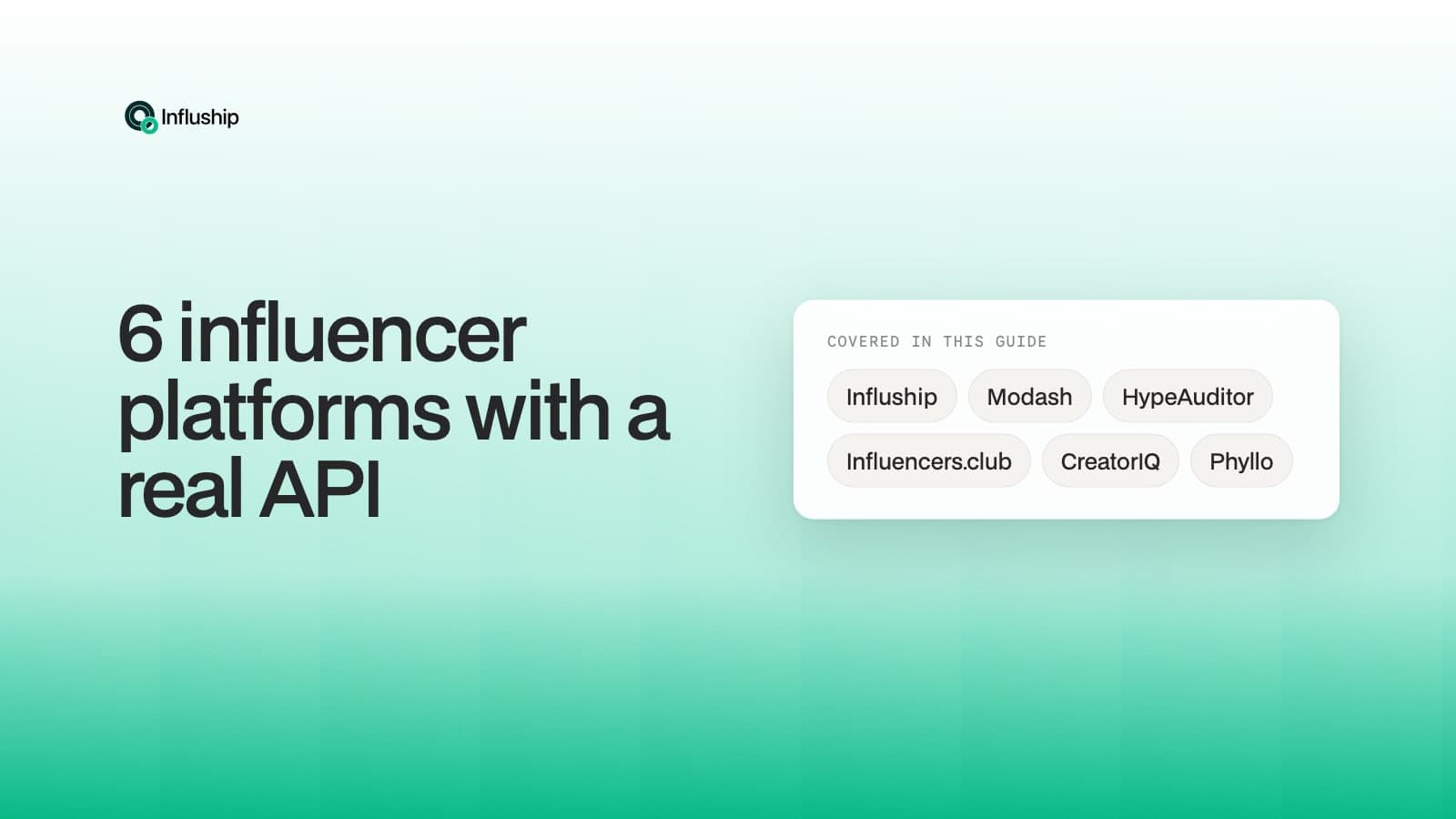
Most products that call themselves an influencer marketing API are not APIs. They are dashboards with an export button bolted to the side, or a thin endpoint that returns a fraction of the fields the marketing page implied. You sign up, read the docs, and discover the “API” is a single CSV-download route gated behind a seat-based plan.
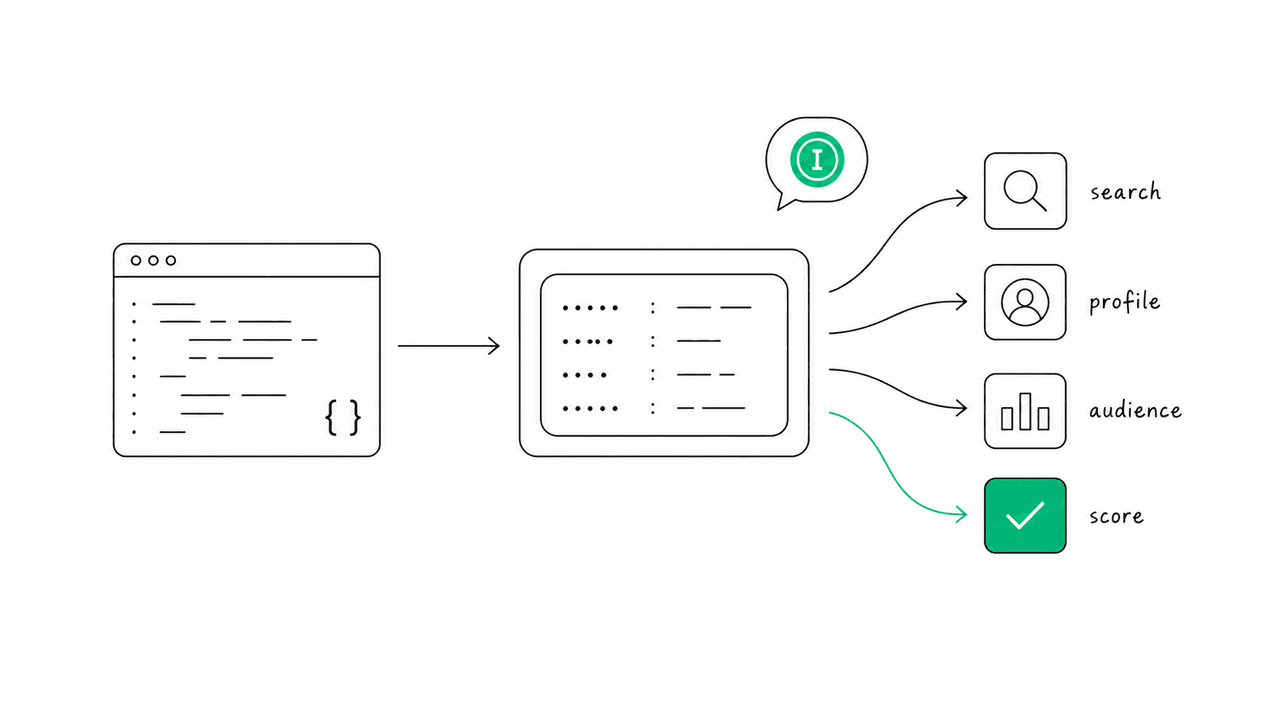
A real influencer marketing API does four jobs programmatically: it searches for creators, enriches profiles with current metrics, provides evidence for audience-quality review, and scores creators against a brief. If a vendor cannot do all four through code, you are buying a UI, not an API, and you will hit a wall the moment you try to build anything on top of it.
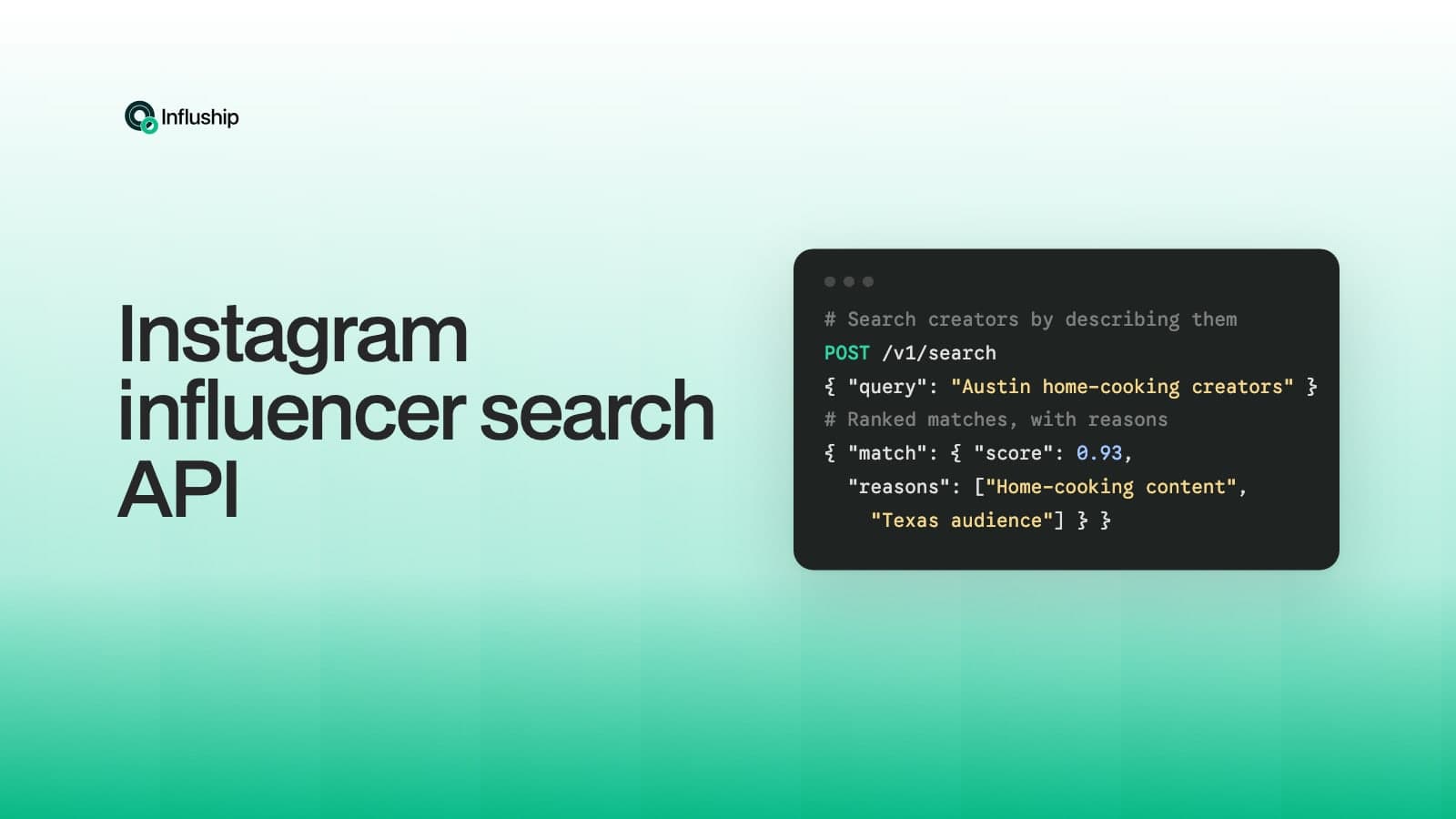
This is a vendor-neutral, code-first guide to what an influencer API actually does, the endpoints that matter, how auth and rate limits work, the pricing models you will run into, and when it makes sense to buy one versus scrape the data yourself. The code examples use the Influship SDK because that is the API we build, but the architecture applies to any provider. If you specifically need Instagram creator search, read our deeper Instagram influencer search API guide after this one — this post is the broad, multi-platform reference.
What an influencer marketing API actually is
An influencer marketing API is programmatic access to creator discovery, profile data, audience analytics, and fit scoring. The test is simple: can your code ask a question and get structured JSON back, without a human opening a browser? Three things commonly masquerade as one and fail that test:
- The dashboard with CSV export. You search in a UI, click export, and download a file. There is no endpoint your application can call on a schedule. Fine for a one-off shortlist, useless for a product or pipeline.
- The rate-limited thin endpoint. There is a real route, but it returns follower count and not much else, capped at a handful of requests per minute. You cannot build discovery on it because you cannot search — only look up handles you already know.
- The official platform API. The Meta Graph API and YouTube Data API are genuine APIs, but they are built for creators to access their own accounts, not for you to discover other people's. More on that limitation below.
A real influencer API does four jobs. Hold any vendor against these:
- Discovery and search. Find creators you do not already know, by topic, audience, or natural-language intent. See our influencer discovery glossary entry for the concept in full.
- Profile and creator enrichment. Given a handle or ID, return current profile metrics plus creator-level themes and context.
- Audience quality and authenticity. Provide more than raw counts so a developer can assess whether a 200K audience behaves like a real one.
- Matching and scoring. Take a list of creators and a brief, return a relevance score and a decision for each.
The endpoints that matter
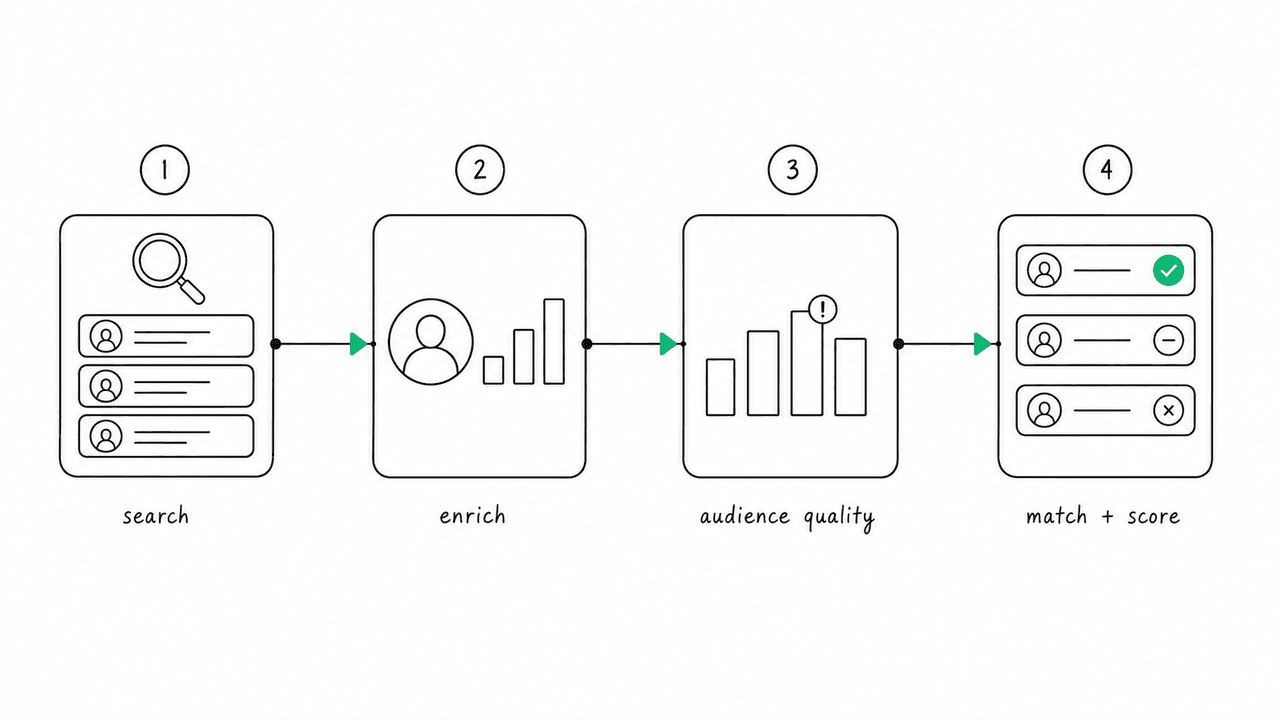
Every influencer API organises its surface differently, but the useful capabilities collapse into the same four endpoint families. Here is what each one does, what to look for, and what a request and response actually look like.
Search and discovery
There are three flavours of search, in rough order of how recently they appeared:
- Keyword and filter search. The oldest and most common. You combine a category with structured filters (follower range, engagement rate, location). Predictable, but only as good as the taxonomy behind it.
- Natural-language semantic search. The newer and smaller category. You describe what you want in plain English — “sustainable fashion micro-creators whose audience cares about ethical sourcing” — and the API ranks creators by semantic match, not keyword overlap.
- Lookalike search. You hand it a creator who already performs, and it returns others who resemble them. Useful for scaling a campaign from a known winner rather than starting cold.
A semantic search request that mixes a natural-language query with structured filters looks like this:
const search = await client.search.create({
  query: 'marathon training creators who post race-day nutrition tips',
  platforms: ['instagram'],
  filters: {
    followers: { min: 20000, max: 250000 },
    engagement_rate: { min: 3 },
  },
  limit: 25,
});A trimmed response carries a search ID, a total, and a ranked list with a match score and reasons:
{
  "search_id": "123e4567-e89b-12d3-a456-426614174000",
  "total": 25,
  "has_more": false,
  "next_cursor": null,
  "data": [
    {
      "creator": {
        "id": "223e4567-e89b-12d3-a456-426614174001",
        "name": "Dana Okafor"
      },
      "match": {
        "score": 0.91,
        "reasons": [
          "Posts weekly long-run recaps with pacing breakdowns",
          "Audience over-indexes on endurance-sport interest"
        ]
      },
      "primary_profile": { "username": "danaruns", "followers": 84200 }
    }
  ]
}Two fields earn their keep. match.reasons tells you why a creator ranked where they did, which is the difference between a black-box list and something you can defend to a client. The search_id identifies a persisted session that can be retrieved without running the search again. Its original limit, capped at 100, is the ceiling for that session.
Profile enrichment
Once you have a handle or an ID, profile enrichment returns current metrics such as followers, engagement rate, and posting cadence. A creator-level retrieve adds content themes, brand alignment, key facts, and a synthesized audience summary. Two questions decide whether an enrichment endpoint is worth using:
- Freshness. When was this profile last scraped? A follower count from three months ago is a liability on an active campaign. Good APIs expose a last-updated timestamp so you can decide whether to trust the cache or force a refresh.
- Depth. How many fields come back for a typical profile? Raw count and bio, or metrics, growth, activity, content classification, and recent post context?
Retrieving a cached profile by username is one call:
const profile = await client.profiles.get('danaruns', {
  platform: 'instagram',
});
// profile.data.metrics -> { followers, engagement_rate,
// avg_likes_recent, posts_per_week }For the richer object — AI summary, content themes, brand alignment, key facts — use the creator-level retrieve endpoint with profiles included:
const creator = await client.creators.retrieve(
  '223e4567-e89b-12d3-a456-426614174001',
  {
    include: ['profiles'],
  },
);
// creator.data -> { id, name, ai_summary, content_themes,
// audience_demographics, brand_alignment, key_facts, profiles }Audience quality and fake-follower signals
Follower count is the most gameable number in marketing. An API that returns only raw counts is hiding the number you actually need: how much of that audience is real. Bought followers, engagement pods, and bot comments inflate every headline metric, and they are common enough that you have to assume a creator is inauthentic until the data says otherwise.
A useful influencer API gives you enough evidence to evaluate authenticity: engagement-rate sanity checks, follower growth, post-level metrics, and comment context. Influship's current profile response exposes metrics and 30-day growth; it does not return a single fake-follower score. We cover the manual evaluation in how to detect fake followers, and the reason raw reach overstates real impact in calculating a creator's real audience size. The point for a developer: do not build a shortlist on follower count alone. Treat the profile and recent-post fields as inputs to a quality check, not as proof of authenticity.
Matching and scoring
Discovery finds creators you do not know. Matching evaluates creators you already have. Hand the endpoint a list and a brief, and it returns a score and a decision for each — good, neutral, or avoid — with reasons:
const result = await client.creators.match({
  creators: [
    { username: 'danaruns', platform: 'instagram' },
    { creator_id: '323e4567-e89b-12d3-a456-426614174002' },
  ],
  intent: {
    query: 'running-shoe launch for first-time marathoners',
    context: 'Mid-range price point, US audience, spring campaign',
  },
});
// result.data[].match -> { score, decision, reasons }The decision field is what makes this scriptable. You can filter up to 100 creators per request down to the ones marked good, instead of eyeballing each profile.
Auth, rate limits, and pagination
Two auth models dominate. API keys are the norm for third-party creator APIs: a secret you send in a header, scoped to your account, with no end-user involvement. OAuth shows up when an endpoint needs a specific person's consent.
That distinction is the whole story behind why the official platform APIs cannot power discovery. The Meta Graph API requires the Instagram creator to connect their own account to your app before you can read their data (Instagram Platform documentation). That makes it ideal for creator-facing analytics products, where the creator is your user, and useless for searching creators who have never heard of you. The YouTube Data API has the same shape: you can read public stats on a known channel, but there is no “find me channels like this” discovery endpoint. To search creators who have not opted in, you need a third-party API that builds its own index from public data.
On pagination, prefer cursor-based over offset-based. Offset pagination (“skip 50, take 25”) breaks when the underlying ranking shifts between requests. Influship persists each search under a search_id for one hour; retrieving that session during the window is free, but the original limit remains its total ceiling. A limit of 25 means at most 25 creators, not 25 per page.
On rate limits and quotas, read the headers, not the marketing page. Influship enforces per-minute and per-hour credit budgets, so expensive searches consume more budget than profile lookups. Retry 429 responses after the advertised delay, and cache successful enrichment results before retrying work. A batch job should deduplicate handles and persist progress because repeated successful calls are billable calls.
Pricing models you will encounter
Three pricing shapes cover almost every influencer API on the market:
- Per-credit / per-result. You pay for what you call. Search costs some credits, each result a few more, enrichment a fraction. Spend scales with usage, which suits product builders and pipelines whose volume is variable.
- Seat-based platform pricing. You pay per user for access to a SaaS tool, and the API rides along on the top tier. Common with discovery platforms that bolted an API onto an existing product. You pay for seats you may not use to get the endpoint you do.
- Flat enterprise contract. A negotiated annual minimum. Modash's API, for example, starts in the five figures per year, billed annually — reasonable for a large agency, prohibitive for a team testing whether creator matching belongs in their product at all.
For developers, credit-based pricing almost always wins, because your cost tracks your actual usage instead of a seat count or a contract minimum. A discovery run that searches 40 candidates, enriches them, and scores them lands around one to two dollars at typical per-credit rates; at Influship's current 0.1-credit profile price, refreshing 5,000 profiles costs $5. Compare that to a five-figure annual floor before you have made a single call. We break the model down further in influencer marketing platforms with an API and on the Influship pricing page.
Build vs buy: when to use an API
The alternative to buying an influencer API is scraping Instagram, TikTok, and YouTube yourself. It looks cheaper until you do it. Instagram and TikTok run aggressive anti-bot systems, rotate their internal endpoints without notice, and gate the interesting data behind login walls. You end up maintaining proxy pools, fingerprint evasion, and selectors that break every few weeks — an arms race that has nothing to do with your product. An API abstracts that maintenance away: you write business logic against a documented interface while someone else absorbs the scraping churn.
Buy the API when you are doing any of these:
- Enriching a CRM. You have creator handles and want current metrics attached. See the concept in our influencer CRM glossary entry.
- Building a discovery feature. Search, filtering, and shortlisting inside your own product, without becoming a scraping company by accident.
- Powering an AI agent. Giving an assistant typed, deterministic tools to run discovery, vetting, and scoring. This is what our AI agents endpoint is built for.
Scrape it yourself only if creator data is your core product and you can fund a team to fight the anti-bot arms race indefinitely. For everyone else, the API is the cheaper line item once you count engineering time.
How Influship's API maps to these jobs
Influship covers the workflow with a small set of endpoints, so discovery, enrichment, the inputs to a quality review, and scoring can share one client and one billing account.
- Discovery →
client.search.create(natural-language query plus structured filters) - Enrichment →
client.profiles.getandclient.creators.retrieve - Audience-quality inputs → profile metrics, 30-day growth, and recent posts. The API does not return a single fake-follower score.
- Matching and scoring →
client.creators.matchwith a good/neutral/avoid decision
End to end, a minimal pipeline is three calls — search, retrieve, match:
// 1. Discover
const search = await client.search.create({
  query: 'race-day nutrition creators for a marathon shoe launch',
  filters: { followers: { min: 20000, max: 250000 } },
  limit: 25,
});

// 2. Enrich the top candidates
const top = search.data.slice(0, 10);
const enriched = await Promise.all(
  top.map((row) => client.creators.retrieve(row.creator.id, { include: ['profiles'] })),
);

// 3. Score against the brief
const scored = await client.creators.match({
  creators: top.map((row) => ({ creator_id: row.creator.id })),
  intent: { query: 'first-time-marathoner running shoe, US, spring' },
});

const shortlist = scored.data.filter((c) => c.match.decision === 'good');That is a complete shortlist workflow: discover, enrich, score, filter. The same operations are available as MCP tools for AI assistants. To try it, the Influship influencer marketing API gives new accounts 500 free starter credits; grab credentials at developers.influship.com.
Frequently asked questions
Is there a free influencer API? Most providers offer a free trial or sandbox credits rather than a permanently free tier — creator data is expensive to collect and maintain. Influship gives new API accounts 500 one-time starter credits for real data, with no expiry, so you can build and test before you spend.
Can I get TikTok and YouTube creator data via API? YouTube data is widely available since much of it is public through the official YouTube Data API (for known channels) and through third-party indexes. TikTok is harder because its data is more locked down; coverage varies by provider. Influship covers all three: public creator discovery runs on Instagram, and raw endpoints cover YouTube channels, transcripts, and search plus TikTok profiles, videos, comments, and transcripts.
How fresh is the data? It depends on the provider and the field. Good APIs expose a last-updated timestamp so you can decide whether to trust the cached value or force a refresh. Treat follower counts and engagement rates older than a few weeks as stale for an active campaign.
Do I need the official Instagram API? Only if you are building a creator-facing product where the creator connects their own account — the Meta Graph API requires that consent and cannot search creators who have not opted in. For brand-side discovery, you need a third-party API that indexes public data.
How is an influencer API priced? Three models: per-credit/per-result, seat-based platform pricing, and flat enterprise contracts. Credit-based pricing suits developers because cost scales with usage instead of seats or annual minimums.
Sources and further reading
- Meta for Developers — Instagram Platform documentation (account-connection requirement that makes the Graph API unsuitable for third-party discovery). developers.facebook.com/docs/instagram-platform.
- Influship API reference — endpoint, response-shape, and credit details. docs.influship.com.
- Influship developer portal — API keys and starter credits. developers.influship.com.
- Influship influencer marketing API overview — influship.com/developers/api.
- Comparison of influencer-platform API pricing (Modash, Upfluence, HypeAuditor, NeoReach) — influencer marketing platforms with an API.