This is a research-ready index of 58 influencer marketing and creator economy statistics. Every entry links to the underlying study, dataset, paper, or platform disclosure and records the evidence an editor needs before citing it.
The ledger covers market spend, campaign ROI, creator pricing, consumer purchase behavior, platform scale, creator selection, partnerships, and AI adoption. Search it on the page or download the full CSV. The figures come from 11 direct primary sources rather than statistics roundups.
12 useful influencer marketing statistics
Start with these figures for market sizing, budgets, ROI, pricing, consumer influence, creator selection, platforms, and AI adoption. Each links to its full evidence record.
Market and investment
ROI and measurement
Pricing and selection
Consumers and platforms
What changed in the latest data
Comparable change is limited to figures reported by the same producer under the same definition. Two current series meet that standard, while the new creator-pricing dataset adds a stronger benchmark rather than a time trend.
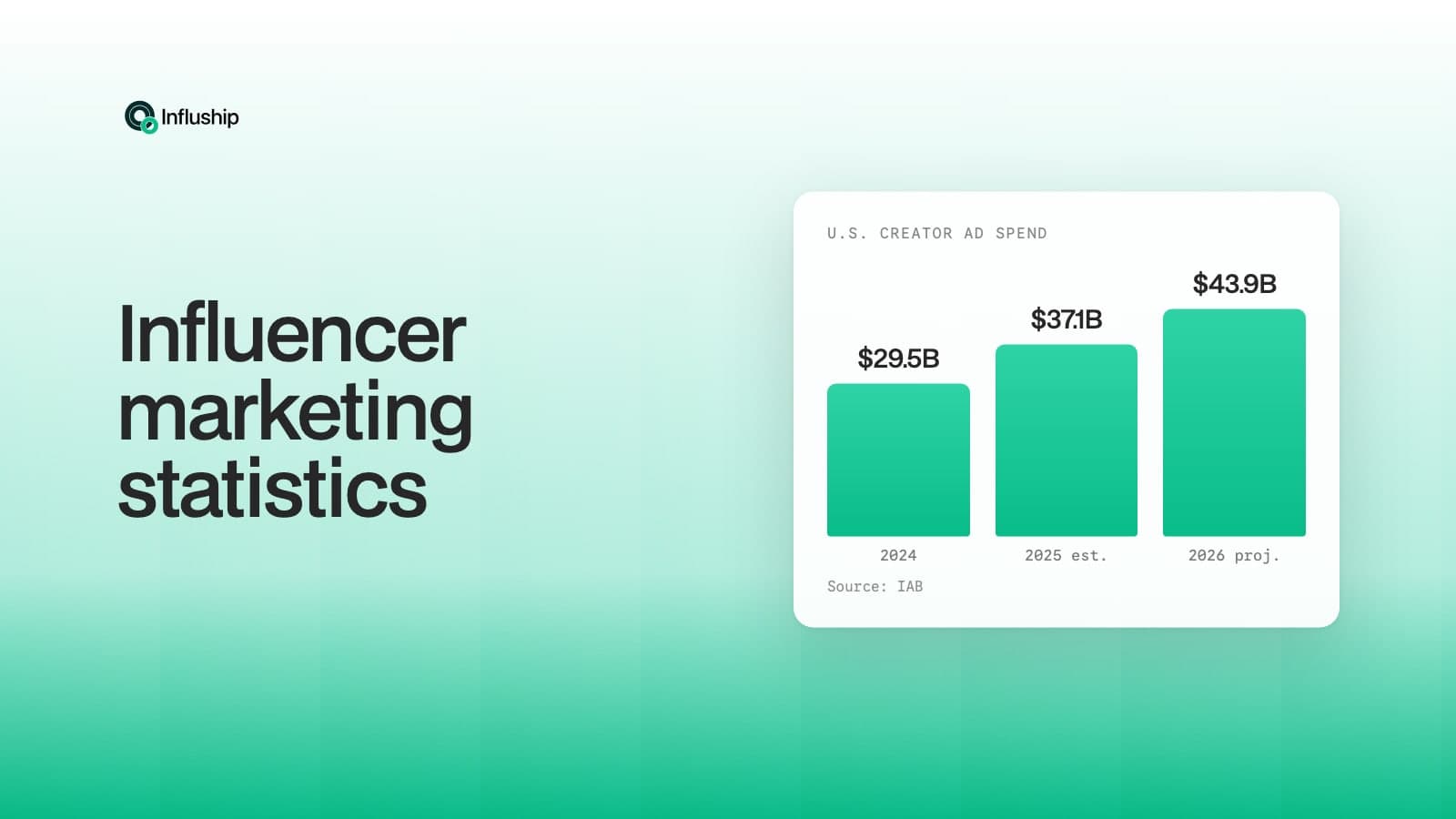
- U.S. creator ad spend increased. IAB reported $29.5 billion for 2024, estimated $37.1 billion for 2025, and forecast $43.9 billion for 2026. The 2025 estimate represents 26% annual growth.
- YouTube replaced its Shorts scale figure. The official platform total moved from more than 70 billion daily views in March 2024 to more than 200 billion in June 2025. Both are self-reported averages.
- Creator pricing gained a large disclosed sample. 1stCollab published median asking prices from 100,000 creators across 100 brands. These are initial asks for one video, not negotiated payments.
Three source-backed charts
Each chart links back to the exact claim records and includes a downloadable SVG. Keep the source line intact when using a chart in another publication.
U.S. creator-economy ad spend
Annual spend reported or estimated by IAB, in billions of U.S. dollars.
The 2025 and 2026 values are estimates. This series measures U.S. creator ad spend, not the global influencer marketing market.
Source: Interactive Advertising Bureau. Keep this source line intact when republishing the chart.
YouTube Shorts daily views
Average daily views reported in official YouTube platform updates.
Median creator asking price for one video
Initial asking price by follower band in 1stCollab's 100,000-creator dataset.
These are initial asking prices, not paid rates. One posted video is included; usage rights, exclusivity, cross-posting, UGC, and long-term work are excluded.
Source: 1stCollab. Keep this source line intact when republishing the chart.
Influencer marketing statistics FAQ
How big is influencer marketing in 2026?
IAB forecasts $43.9 billion in U.S. creator-economy ad spend for 2026. That figure covers U.S. creator advertising under IAB’s definition, so it should not be cited as the size of the global influencer marketing market.
Supporting claim: us-creator-ad-spend-2026
What is the average ROI of influencer marketing?
No current primary source in this ledger establishes a universal average ROI. CreatorIQ found that 94% of surveyed organizations believed creator content delivered more ROI than traditional digital advertising, while peer-reviewed research found higher ROI for low-followership influencers in the campaigns it studied. These findings use different methods and should be cited separately.
Supporting claims: creator-content-higher-roi, low-followership-higher-roi
How much does an influencer post cost?
In 1stCollab’s dataset, the median initial asking price for one video was $300 for creators under 10,000 followers, $750 for creators with 25,000 to 100,000 followers, and $7,000 for creators over one million followers. These are asking prices, not negotiated payments, and exclude usage rights and exclusivity.
Supporting claims: creator-price-under-10k, creator-price-25k-100k, creator-price-over-1m
Which platform is used most for influencer marketing?
Instagram ranked first in CreatorIQ’s 2025 survey, used by 85% of brand respondents for creator marketing. The same research found that organizations used an average of five social platforms, so the leading platform was usually part of a broader mix.
Supporting claims: instagram-brand-use, average-platform-count
How many consumers buy because of influencers?
Sprout Social found that 49% of its sampled consumers made purchases at least monthly because of influencer posts. Pew Research Center found that 30% of U.S. social media users had ever purchased after seeing an influencer or creator post. The samples, dates, and question wording differ, so these percentages should not be combined.
Supporting claims: monthly-influencer-purchases, us-social-users-purchased-from-creators
How to use and cite this ledger
- Check the population. A U.S. enterprise buyer survey cannot describe all marketers, and a social media user survey cannot describe every consumer.
- Keep the study date with the number. Historical observations remain useful when the date is explicit. Forecasts and replaced platform totals carry separate labels.
- Use the stable claim URL. Each entry has a permanent anchor plus buttons to copy its link or a compact citation.
- Open the direct source. The source link goes to the study, official release, paper, or dataset owner that produced the figure.
Search all influencer marketing statistics
Search by figure, topic, source, geography, or method. Filter out historical snapshots when you need only current studies and forward estimates.
Showing 58 of 58 citable entries
$29.5B
U.S. creator-economy ad spend reached $29.5 billion in 2024.
Show study detailsHide study details
- Collection period
- 28 July to 12 August 2025
- Sample
- 453 verified U.S. brand and agency ad-spend decision-makers
- Geography
- United States
- Method
- A 15-minute anonymous online survey, qualitative interviews, company financial statements, public financial data, and Advertiser Perceptions market research.
- Use with care
- Survey respondents planned at least $1 million in 2025 advertising spend and at least $100,000 in creator spend. Market totals are estimates. IAB creator ad spend includes direct partnerships, paid amplification, and intentional creator-content adjacencies.
$37.1B
IAB estimated U.S. creator-economy ad spend at $37.1 billion in 2025.
Show study detailsHide study details
- Collection period
- 28 July to 12 August 2025
- Sample
- 453 verified U.S. brand and agency ad-spend decision-makers
- Geography
- United States
- Method
- A 15-minute anonymous online survey, qualitative interviews, company financial statements, public financial data, and Advertiser Perceptions market research.
- Use with care
- Survey respondents planned at least $1 million in 2025 advertising spend and at least $100,000 in creator spend. Market totals are estimates. IAB creator ad spend includes direct partnerships, paid amplification, and intentional creator-content adjacencies.
+26%
Estimated U.S. creator ad spend grew 26% from 2024 to 2025.
Show study detailsHide study details
- Collection period
- 28 July to 12 August 2025
- Sample
- 453 verified U.S. brand and agency ad-spend decision-makers
- Geography
- United States
- Method
- A 15-minute anonymous online survey, qualitative interviews, company financial statements, public financial data, and Advertiser Perceptions market research.
- Use with care
- Survey respondents planned at least $1 million in 2025 advertising spend and at least $100,000 in creator spend. Market totals are estimates. IAB creator ad spend includes direct partnerships, paid amplification, and intentional creator-content adjacencies.
$43.9B
IAB projected U.S. creator-economy ad spend to reach $43.9 billion in 2026.
Show study detailsHide study details
- Collection period
- 28 July to 12 August 2025
- Sample
- 453 verified U.S. brand and agency ad-spend decision-makers
- Geography
- United States
- Method
- A 15-minute anonymous online survey, qualitative interviews, company financial statements, public financial data, and Advertiser Perceptions market research.
- Use with care
- Survey respondents planned at least $1 million in 2025 advertising spend and at least $100,000 in creator spend. Market totals are estimates. IAB creator ad spend includes direct partnerships, paid amplification, and intentional creator-content adjacencies.
48%
48% of surveyed creator ad buyers considered creators a necessary “must buy” for their media plan.
Show study detailsHide study details
- Collection period
- 28 July to 12 August 2025
- Sample
- 453 verified U.S. brand and agency ad-spend decision-makers
- Geography
- United States
- Method
- A 15-minute anonymous online survey, qualitative interviews, company financial statements, public financial data, and Advertiser Perceptions market research.
- Use with care
- Survey respondents planned at least $1 million in 2025 advertising spend and at least $100,000 in creator spend. Market totals are estimates. IAB creator ad spend includes direct partnerships, paid amplification, and intentional creator-content adjacencies.
$2.9M
Brand respondents reported spending an average of $2.9 million annually on influencer marketing.
The report calculates an absolute average from spend bands and warns that expanded high-end answer options affect year-over-year comparison.
Show study detailsHide study details
- Collection period
- July 2025, with additional CreatorIQ research in August 2025
- Sample
- 1,723 respondents: 747 brands, 676 agencies, and 300 creators
- Geography
- Nine or more regions, led by the United States and United Kingdom
- Method
- Global survey conducted by Sapio Research, supplemented with CreatorIQ survey history and clearly labelled H1 2025 platform data.
- Use with care
- Vendor-commissioned and self-reported. Organization respondents skew toward mid-market and enterprise teams. Budget answer bands changed from the prior year, so year-over-year budget averages are not directly comparable.
$4.4M
Agency respondents reported an average annual influencer marketing budget of $4.4 million.
Show study detailsHide study details
- Collection period
- July 2025, with additional CreatorIQ research in August 2025
- Sample
- 1,723 respondents: 747 brands, 676 agencies, and 300 creators
- Geography
- Nine or more regions, led by the United States and United Kingdom
- Method
- Global survey conducted by Sapio Research, supplemented with CreatorIQ survey history and clearly labelled H1 2025 platform data.
- Use with care
- Vendor-commissioned and self-reported. Organization respondents skew toward mid-market and enterprise teams. Budget answer bands changed from the prior year, so year-over-year budget averages are not directly comparable.
71%
71% of surveyed organizations increased influencer marketing investment year over year.
Show study detailsHide study details
- Collection period
- July 2025, with additional CreatorIQ research in August 2025
- Sample
- 1,723 respondents: 747 brands, 676 agencies, and 300 creators
- Geography
- Nine or more regions, led by the United States and United Kingdom
- Method
- Global survey conducted by Sapio Research, supplemented with CreatorIQ survey history and clearly labelled H1 2025 platform data.
- Use with care
- Vendor-commissioned and self-reported. Organization respondents skew toward mid-market and enterprise teams. Budget answer bands changed from the prior year, so year-over-year budget averages are not directly comparable.
80%
80% of enterprise organizations increased influencer marketing investment year over year.
Show study detailsHide study details
- Collection period
- July 2025, with additional CreatorIQ research in August 2025
- Sample
- 1,723 respondents: 747 brands, 676 agencies, and 300 creators
- Geography
- Nine or more regions, led by the United States and United Kingdom
- Method
- Global survey conducted by Sapio Research, supplemented with CreatorIQ survey history and clearly labelled H1 2025 platform data.
- Use with care
- Vendor-commissioned and self-reported. Organization respondents skew toward mid-market and enterprise teams. Budget answer bands changed from the prior year, so year-over-year budget averages are not directly comparable.
98%
98% of brand respondents repurpose creator content across other channels.
Show study detailsHide study details
- Collection period
- July 2025, with additional CreatorIQ research in August 2025
- Sample
- 1,723 respondents: 747 brands, 676 agencies, and 300 creators
- Geography
- Nine or more regions, led by the United States and United Kingdom
- Method
- Global survey conducted by Sapio Research, supplemented with CreatorIQ survey history and clearly labelled H1 2025 platform data.
- Use with care
- Vendor-commissioned and self-reported. Organization respondents skew toward mid-market and enterprise teams. Budget answer bands changed from the prior year, so year-over-year budget averages are not directly comparable.
64%
64% of brands increased their use of creator content over the preceding year.
Show study detailsHide study details
- Collection period
- July 2025, with additional CreatorIQ research in August 2025
- Sample
- 1,723 respondents: 747 brands, 676 agencies, and 300 creators
- Geography
- Nine or more regions, led by the United States and United Kingdom
- Method
- Global survey conducted by Sapio Research, supplemented with CreatorIQ survey history and clearly labelled H1 2025 platform data.
- Use with care
- Vendor-commissioned and self-reported. Organization respondents skew toward mid-market and enterprise teams. Budget answer bands changed from the prior year, so year-over-year budget averages are not directly comparable.
40%
Overall ROI was the most selected creator-campaign KPI, chosen by 40% of surveyed buyers as a top-three KPI.
Show study detailsHide study details
- Collection period
- 28 July to 12 August 2025
- Sample
- 453 verified U.S. brand and agency ad-spend decision-makers
- Geography
- United States
- Method
- A 15-minute anonymous online survey, qualitative interviews, company financial statements, public financial data, and Advertiser Perceptions market research.
- Use with care
- Survey respondents planned at least $1 million in 2025 advertising spend and at least $100,000 in creator spend. Market totals are estimates. IAB creator ad spend includes direct partnerships, paid amplification, and intentional creator-content adjacencies.
39%
39% of creator ad buyers named proving ROI as a top-three measurement and attribution challenge.
Show study detailsHide study details
- Collection period
- 28 July to 12 August 2025
- Sample
- 453 verified U.S. brand and agency ad-spend decision-makers
- Geography
- United States
- Method
- A 15-minute anonymous online survey, qualitative interviews, company financial statements, public financial data, and Advertiser Perceptions market research.
- Use with care
- Survey respondents planned at least $1 million in 2025 advertising spend and at least $100,000 in creator spend. Market totals are estimates. IAB creator ad spend includes direct partnerships, paid amplification, and intentional creator-content adjacencies.
34%
34% selected attributing sales to creators as a top-three measurement challenge.
Show study detailsHide study details
- Collection period
- 28 July to 12 August 2025
- Sample
- 453 verified U.S. brand and agency ad-spend decision-makers
- Geography
- United States
- Method
- A 15-minute anonymous online survey, qualitative interviews, company financial statements, public financial data, and Advertiser Perceptions market research.
- Use with care
- Survey respondents planned at least $1 million in 2025 advertising spend and at least $100,000 in creator spend. Market totals are estimates. IAB creator ad spend includes direct partnerships, paid amplification, and intentional creator-content adjacencies.
94%
94% of surveyed organizations said creator content drives more ROI than traditional digital advertising.
This is a self-reported comparison, not an independently calculated return multiple.
Show study detailsHide study details
- Collection period
- July 2025, with additional CreatorIQ research in August 2025
- Sample
- 1,723 respondents: 747 brands, 676 agencies, and 300 creators
- Geography
- Nine or more regions, led by the United States and United Kingdom
- Method
- Global survey conducted by Sapio Research, supplemented with CreatorIQ survey history and clearly labelled H1 2025 platform data.
- Use with care
- Vendor-commissioned and self-reported. Organization respondents skew toward mid-market and enterprise teams. Budget answer bands changed from the prior year, so year-over-year budget averages are not directly comparable.
74%
74% of enterprise brands reported that creator marketing ROI increased year over year.
Show study detailsHide study details
- Collection period
- July 2025, with additional CreatorIQ research in August 2025
- Sample
- 1,723 respondents: 747 brands, 676 agencies, and 300 creators
- Geography
- Nine or more regions, led by the United States and United Kingdom
- Method
- Global survey conducted by Sapio Research, supplemented with CreatorIQ survey history and clearly labelled H1 2025 platform data.
- Use with care
- Vendor-commissioned and self-reported. Organization respondents skew toward mid-market and enterprise teams. Budget answer bands changed from the prior year, so year-over-year budget averages are not directly comparable.
10× scale
Low-followership targeting outperformed high-followership targeting by an order of magnitude across three ROI measures.
The measures were revenue per follower, revenue per reached follower, and return on influencer spend.
Show study detailsHide study details
- Collection period
- Observational Instagram dataset: 2018 to 2021; field-study timing is detailed in the paper appendix
- Sample
- 1,881,533 purchases, 2,808 Instagram posts, 1,698 influencers, and three field studies with 319 paid endorsements
- Geography
- Secondary sales data from a leading European direct-to-consumer company; field studies spanned Instagram, YouTube, and TikTok
- Method
- Peer-reviewed analysis of attributed purchases and endorsement costs, followed by three randomized field studies. Outcomes included revenue per follower, revenue per reach, and return on influencer spend.
- Use with care
- The main observational dataset came from one direct-to-consumer company. The results concern immediate, attributable revenue and should not be treated as proof about brand lift or every category.
1,881,533
The peer-reviewed revenue study analysed 1,881,533 attributed purchases worth more than €17 million.
Show study detailsHide study details
- Collection period
- Observational Instagram dataset: 2018 to 2021; field-study timing is detailed in the paper appendix
- Sample
- 1,881,533 purchases, 2,808 Instagram posts, 1,698 influencers, and three field studies with 319 paid endorsements
- Geography
- Secondary sales data from a leading European direct-to-consumer company; field studies spanned Instagram, YouTube, and TikTok
- Method
- Peer-reviewed analysis of attributed purchases and endorsement costs, followed by three randomized field studies. Outcomes included revenue per follower, revenue per reach, and return on influencer spend.
- Use with care
- The main observational dataset came from one direct-to-consumer company. The results concern immediate, attributable revenue and should not be treated as proof about brand lift or every category.
319
Three follow-up field studies tested 319 paid influencer endorsements across Instagram, YouTube, and TikTok.
Show study detailsHide study details
- Collection period
- Observational Instagram dataset: 2018 to 2021; field-study timing is detailed in the paper appendix
- Sample
- 1,881,533 purchases, 2,808 Instagram posts, 1,698 influencers, and three field studies with 319 paid endorsements
- Geography
- Secondary sales data from a leading European direct-to-consumer company; field studies spanned Instagram, YouTube, and TikTok
- Method
- Peer-reviewed analysis of attributed purchases and endorsement costs, followed by three randomized field studies. Outcomes included revenue per follower, revenue per reach, and return on influencer spend.
- Use with care
- The main observational dataset came from one direct-to-consumer company. The results concern immediate, attributable revenue and should not be treated as proof about brand lift or every category.
43%
Building brand awareness was the most selected creator-marketing goal, chosen by 43% as a top-three objective.
Show study detailsHide study details
- Collection period
- 28 July to 12 August 2025
- Sample
- 453 verified U.S. brand and agency ad-spend decision-makers
- Geography
- United States
- Method
- A 15-minute anonymous online survey, qualitative interviews, company financial statements, public financial data, and Advertiser Perceptions market research.
- Use with care
- Survey respondents planned at least $1 million in 2025 advertising spend and at least $100,000 in creator spend. Market totals are estimates. IAB creator ad spend includes direct partnerships, paid amplification, and intentional creator-content adjacencies.
32%
Driving online sales or conversions was a top-three creator-marketing goal for 32% of surveyed buyers.
Show study detailsHide study details
- Collection period
- 28 July to 12 August 2025
- Sample
- 453 verified U.S. brand and agency ad-spend decision-makers
- Geography
- United States
- Method
- A 15-minute anonymous online survey, qualitative interviews, company financial statements, public financial data, and Advertiser Perceptions market research.
- Use with care
- Survey respondents planned at least $1 million in 2025 advertising spend and at least $100,000 in creator spend. Market totals are estimates. IAB creator ad spend includes direct partnerships, paid amplification, and intentional creator-content adjacencies.
58%
58% of creator ad buyers rated creator reputation as very important when selecting partners.
Show study detailsHide study details
- Collection period
- 28 July to 12 August 2025
- Sample
- 453 verified U.S. brand and agency ad-spend decision-makers
- Geography
- United States
- Method
- A 15-minute anonymous online survey, qualitative interviews, company financial statements, public financial data, and Advertiser Perceptions market research.
- Use with care
- Survey respondents planned at least $1 million in 2025 advertising spend and at least $100,000 in creator spend. Market totals are estimates. IAB creator ad spend includes direct partnerships, paid amplification, and intentional creator-content adjacencies.
56%
56% rated audience alignment as very important when selecting a creator.
Show study detailsHide study details
- Collection period
- 28 July to 12 August 2025
- Sample
- 453 verified U.S. brand and agency ad-spend decision-makers
- Geography
- United States
- Method
- A 15-minute anonymous online survey, qualitative interviews, company financial statements, public financial data, and Advertiser Perceptions market research.
- Use with care
- Survey respondents planned at least $1 million in 2025 advertising spend and at least $100,000 in creator spend. Market totals are estimates. IAB creator ad spend includes direct partnerships, paid amplification, and intentional creator-content adjacencies.
8%
Follower count was selected by 8% as the single most important creator-selection criterion.
Show study detailsHide study details
- Collection period
- July 2025, with additional CreatorIQ research in August 2025
- Sample
- 1,723 respondents: 747 brands, 676 agencies, and 300 creators
- Geography
- Nine or more regions, led by the United States and United Kingdom
- Method
- Global survey conducted by Sapio Research, supplemented with CreatorIQ survey history and clearly labelled H1 2025 platform data.
- Use with care
- Vendor-commissioned and self-reported. Organization respondents skew toward mid-market and enterprise teams. Budget answer bands changed from the prior year, so year-over-year budget averages are not directly comparable.
$300 median
Creators below 10,000 followers had a median asking price of $300 for one posted video.
Show study detailsHide study details
- Collection period
- 2025; exact dates not disclosed
- Sample
- 100,000 unique creators across campaigns for 100 brands
- Geography
- Global, with a strong English-speaking creator bias
- Method
- Initial creator asking prices for one video posted to one account, excluding usage rights, exclusivity, cross-posting, long-term work, and UGC. Every reported bucket included at least 250 creators.
- Use with care
- These are asking prices, not negotiated or paid rates. The dataset is platform-owned, English-skewed, and does not control for niche, audience quality, or expected performance.
$350 median
Creators with 10,000 to 25,000 followers had a median asking price of $350.
Show study detailsHide study details
- Collection period
- 2025; exact dates not disclosed
- Sample
- 100,000 unique creators across campaigns for 100 brands
- Geography
- Global, with a strong English-speaking creator bias
- Method
- Initial creator asking prices for one video posted to one account, excluding usage rights, exclusivity, cross-posting, long-term work, and UGC. Every reported bucket included at least 250 creators.
- Use with care
- These are asking prices, not negotiated or paid rates. The dataset is platform-owned, English-skewed, and does not control for niche, audience quality, or expected performance.
$750 median
Creators with 25,000 to 100,000 followers had a median asking price of $750.
Show study detailsHide study details
- Collection period
- 2025; exact dates not disclosed
- Sample
- 100,000 unique creators across campaigns for 100 brands
- Geography
- Global, with a strong English-speaking creator bias
- Method
- Initial creator asking prices for one video posted to one account, excluding usage rights, exclusivity, cross-posting, long-term work, and UGC. Every reported bucket included at least 250 creators.
- Use with care
- These are asking prices, not negotiated or paid rates. The dataset is platform-owned, English-skewed, and does not control for niche, audience quality, or expected performance.
$1,500 median
Creators with 100,000 to 250,000 followers had a median asking price of $1,500.
Show study detailsHide study details
- Collection period
- 2025; exact dates not disclosed
- Sample
- 100,000 unique creators across campaigns for 100 brands
- Geography
- Global, with a strong English-speaking creator bias
- Method
- Initial creator asking prices for one video posted to one account, excluding usage rights, exclusivity, cross-posting, long-term work, and UGC. Every reported bucket included at least 250 creators.
- Use with care
- These are asking prices, not negotiated or paid rates. The dataset is platform-owned, English-skewed, and does not control for niche, audience quality, or expected performance.
$2,500 median
Creators with 250,000 to 500,000 followers had a median asking price of $2,500.
Show study detailsHide study details
- Collection period
- 2025; exact dates not disclosed
- Sample
- 100,000 unique creators across campaigns for 100 brands
- Geography
- Global, with a strong English-speaking creator bias
- Method
- Initial creator asking prices for one video posted to one account, excluding usage rights, exclusivity, cross-posting, long-term work, and UGC. Every reported bucket included at least 250 creators.
- Use with care
- These are asking prices, not negotiated or paid rates. The dataset is platform-owned, English-skewed, and does not control for niche, audience quality, or expected performance.
$3,999 median
Creators with 500,000 to 1 million followers had a median asking price of $3,999.
Show study detailsHide study details
- Collection period
- 2025; exact dates not disclosed
- Sample
- 100,000 unique creators across campaigns for 100 brands
- Geography
- Global, with a strong English-speaking creator bias
- Method
- Initial creator asking prices for one video posted to one account, excluding usage rights, exclusivity, cross-posting, long-term work, and UGC. Every reported bucket included at least 250 creators.
- Use with care
- These are asking prices, not negotiated or paid rates. The dataset is platform-owned, English-skewed, and does not control for niche, audience quality, or expected performance.
$7,000 median
Creators above 1 million followers had a median asking price of $7,000.
Show study detailsHide study details
- Collection period
- 2025; exact dates not disclosed
- Sample
- 100,000 unique creators across campaigns for 100 brands
- Geography
- Global, with a strong English-speaking creator bias
- Method
- Initial creator asking prices for one video posted to one account, excluding usage rights, exclusivity, cross-posting, long-term work, and UGC. Every reported bucket included at least 250 creators.
- Use with care
- These are asking prices, not negotiated or paid rates. The dataset is platform-owned, English-skewed, and does not control for niche, audience quality, or expected performance.
49%
49% of surveyed consumers made purchases at least monthly because of influencer posts.
Show study detailsHide study details
- Collection period
- 13 to 20 February 2024
- Sample
- 2,000 consumers and 300 professional influencers
- Geography
- United States and United Kingdom
- Method
- Online consumer and influencer surveys collected by Cint for Sprout Social.
- Use with care
- Consumers had at least one social account and followed at least five brands. Influencers had at least 10,000 followers and earned at least half of annual income from social brand partnerships.
30%
30% of surveyed consumers trusted influencers more than they had six months earlier.
Show study detailsHide study details
- Collection period
- 13 to 20 February 2024
- Sample
- 2,000 consumers and 300 professional influencers
- Geography
- United States and United Kingdom
- Method
- Online consumer and influencer surveys collected by Cint for Sprout Social.
- Use with care
- Consumers had at least one social account and followed at least five brands. Influencers had at least 10,000 followers and earned at least half of annual income from social brand partnerships.
80%
80% were more willing to buy from brands that partner with influencers beyond social media content.
Show study detailsHide study details
- Collection period
- 13 to 20 February 2024
- Sample
- 2,000 consumers and 300 professional influencers
- Geography
- United States and United Kingdom
- Method
- Online consumer and influencer surveys collected by Cint for Sprout Social.
- Use with care
- Consumers had at least one social account and followed at least five brands. Influencers had at least 10,000 followers and earned at least half of annual income from social brand partnerships.
77%
77% of U.S. social media users found influencer content more compelling than professionally scripted advertising.
Show study detailsHide study details
- Collection period
- 21 to 22 October 2024
- Sample
- 1,114 U.S. social media users
- Geography
- United States
- Method
- Online survey of internet-connected social media users, segmented by age and sex.
- Use with care
- The report does not disclose recruitment, weighting, response rate, or margin of error. Results describe social media users, not all U.S. adults.
86%
86% said they were at least somewhat likely to search social platforms before a purchase.
Show study detailsHide study details
- Collection period
- 21 to 22 October 2024
- Sample
- 1,114 U.S. social media users
- Geography
- United States
- Method
- Online survey of internet-connected social media users, segmented by age and sex.
- Use with care
- The report does not disclose recruitment, weighting, response rate, or margin of error. Results describe social media users, not all U.S. adults.
79%
79% said they had purchased a product after seeing it used by an influencer.
Show study detailsHide study details
- Collection period
- 21 to 22 October 2024
- Sample
- 1,114 U.S. social media users
- Geography
- United States
- Method
- Online survey of internet-connected social media users, segmented by age and sex.
- Use with care
- The report does not disclose recruitment, weighting, response rate, or margin of error. Results describe social media users, not all U.S. adults.
77%
77% had purchased through a social platform’s shopping feature at least once.
Show study detailsHide study details
- Collection period
- 21 to 22 October 2024
- Sample
- 1,114 U.S. social media users
- Geography
- United States
- Method
- Online survey of internet-connected social media users, segmented by age and sex.
- Use with care
- The report does not disclose recruitment, weighting, response rate, or margin of error. Results describe social media users, not all U.S. adults.
85%
85% were more likely to trust a sponsored post from an influencer than from an A-list celebrity.
Show study detailsHide study details
- Collection period
- 21 to 22 October 2024
- Sample
- 1,114 U.S. social media users
- Geography
- United States
- Method
- Online survey of internet-connected social media users, segmented by age and sex.
- Use with care
- The report does not disclose recruitment, weighting, response rate, or margin of error. Results describe social media users, not all U.S. adults.
40%
40% of U.S. social media users said they followed influencers or content creators.
Show study detailsHide study details
- Collection period
- 5 to 17 July 2022
- Sample
- 6,034 U.S. adults; influencer questions used 4,628 social media users
- Geography
- United States
- Method
- Nationally representative American Trends Panel survey with probability-based recruitment and weighting. The margin of sampling error for all adults was plus or minus 2.0 percentage points.
- Use with care
- The influencer findings are from 2022 and apply to the social media user subsample. Subgroup margins of error are larger than the all-adult margin.
30%
30% had purchased something after seeing an influencer or creator post about it.
Show study detailsHide study details
- Collection period
- 5 to 17 July 2022
- Sample
- 6,034 U.S. adults; influencer questions used 4,628 social media users
- Geography
- United States
- Method
- Nationally representative American Trends Panel survey with probability-based recruitment and weighting. The margin of sampling error for all adults was plus or minus 2.0 percentage points.
- Use with care
- The influencer findings are from 2022 and apply to the social media user subsample. Subgroup margins of error are larger than the all-adult margin.
39%
39% said influencers affected their purchase decisions at least a little.
Show study detailsHide study details
- Collection period
- 5 to 17 July 2022
- Sample
- 6,034 U.S. adults; influencer questions used 4,628 social media users
- Geography
- United States
- Method
- Nationally representative American Trends Panel survey with probability-based recruitment and weighting. The margin of sampling error for all adults was plus or minus 2.0 percentage points.
- Use with care
- The influencer findings are from 2022 and apply to the social media user subsample. Subgroup margins of error are larger than the all-adult margin.
54%
54% of social media users aged 18 to 29 said influencers affected what they purchased at least a little.
Show study detailsHide study details
- Collection period
- 5 to 17 July 2022
- Sample
- 6,034 U.S. adults; influencer questions used 4,628 social media users
- Geography
- United States
- Method
- Nationally representative American Trends Panel survey with probability-based recruitment and weighting. The margin of sampling error for all adults was plus or minus 2.0 percentage points.
- Use with care
- The influencer findings are from 2022 and apply to the social media user subsample. Subgroup margins of error are larger than the all-adult margin.
62%
62% of female social media users aged 18 to 29 said influencers affected their purchases at least a little.
Show study detailsHide study details
- Collection period
- 5 to 17 July 2022
- Sample
- 6,034 U.S. adults; influencer questions used 4,628 social media users
- Geography
- United States
- Method
- Nationally representative American Trends Panel survey with probability-based recruitment and weighting. The margin of sampling error for all adults was plus or minus 2.0 percentage points.
- Use with care
- The influencer findings are from 2022 and apply to the social media user subsample. Subgroup margins of error are larger than the all-adult margin.
85%
85% of brand respondents used Instagram for creator marketing, the highest share among measured platforms.
Show study detailsHide study details
- Collection period
- July 2025, with additional CreatorIQ research in August 2025
- Sample
- 1,723 respondents: 747 brands, 676 agencies, and 300 creators
- Geography
- Nine or more regions, led by the United States and United Kingdom
- Method
- Global survey conducted by Sapio Research, supplemented with CreatorIQ survey history and clearly labelled H1 2025 platform data.
- Use with care
- Vendor-commissioned and self-reported. Organization respondents skew toward mid-market and enterprise teams. Budget answer bands changed from the prior year, so year-over-year budget averages are not directly comparable.
5 platforms
Organizations used an average of five social platforms for influencer campaigns.
Show study detailsHide study details
- Collection period
- July 2025, with additional CreatorIQ research in August 2025
- Sample
- 1,723 respondents: 747 brands, 676 agencies, and 300 creators
- Geography
- Nine or more regions, led by the United States and United Kingdom
- Method
- Global survey conducted by Sapio Research, supplemented with CreatorIQ survey history and clearly labelled H1 2025 platform data.
- Use with care
- Vendor-commissioned and self-reported. Organization respondents skew toward mid-market and enterprise teams. Budget answer bands changed from the prior year, so year-over-year budget averages are not directly comparable.
70B+
YouTube reported more than 70 billion average daily Shorts views in March 2024.
Show study detailsHide study details
- Collection period
- Average reported as of March 2024
- Sample
- All YouTube Shorts views included in YouTube’s internal platform measure
- Geography
- Global
- Method
- Official platform-reported average; calculation details were not disclosed.
- Use with care
- Self-reported platform metric with no public denominator, audit, or calculation notes.
200B+
YouTube reported more than 200 billion average daily Shorts views in June 2025.
Show study detailsHide study details
- Collection period
- Average reported as of June 2025
- Sample
- All YouTube Shorts views included in YouTube’s internal platform measure
- Geography
- Global
- Method
- Official platform-reported average; calculation details were not disclosed.
- Use with care
- Self-reported platform metric with no public denominator, audit, or calculation notes.
20M+
More than 20 million videos were uploaded to YouTube on an average day in 2025.
Show study detailsHide study details
- Collection period
- Average reported for YouTube’s twentieth anniversary in April 2025
- Sample
- All daily uploads included in YouTube’s internal platform measure
- Geography
- Global
- Method
- Official platform-reported average; calculation details were not disclosed.
- Use with care
- The upload count covers all YouTube videos, not sponsored or influencer content alone.
$55B
Oxford Economics estimated that YouTube’s creative ecosystem contributed $55 billion to U.S. GDP in 2024.
Show study detailsHide study details
- Collection period
- Calendar year 2024
- Sample
- Economic model and survey inputs; detailed sample is in the linked impact report
- Geography
- United States
- Method
- Oxford Economics economic-impact modelling commissioned by YouTube.
- Use with care
- Economic contribution and supported-job estimates cover the full YouTube creative ecosystem. They are not influencer marketing revenue or ad-spend figures.
490,000
The same study estimated that YouTube’s U.S. creative ecosystem supported the equivalent of 490,000 full-time jobs in 2024.
Show study detailsHide study details
- Collection period
- Calendar year 2024
- Sample
- Economic model and survey inputs; detailed sample is in the linked impact report
- Geography
- United States
- Method
- Oxford Economics economic-impact modelling commissioned by YouTube.
- Use with care
- Economic contribution and supported-job estimates cover the full YouTube creative ecosystem. They are not influencer marketing revenue or ad-spend figures.
44%
44% of creator respondents said better communication would make brand partnerships more successful.
Show study detailsHide study details
- Collection period
- July 2025, with additional CreatorIQ research in August 2025
- Sample
- 1,723 respondents: 747 brands, 676 agencies, and 300 creators
- Geography
- Nine or more regions, led by the United States and United Kingdom
- Method
- Global survey conducted by Sapio Research, supplemented with CreatorIQ survey history and clearly labelled H1 2025 platform data.
- Use with care
- Vendor-commissioned and self-reported. Organization respondents skew toward mid-market and enterprise teams. Budget answer bands changed from the prior year, so year-over-year budget averages are not directly comparable.
43%
43% said more creative input would improve brand partnerships.
Show study detailsHide study details
- Collection period
- July 2025, with additional CreatorIQ research in August 2025
- Sample
- 1,723 respondents: 747 brands, 676 agencies, and 300 creators
- Geography
- Nine or more regions, led by the United States and United Kingdom
- Method
- Global survey conducted by Sapio Research, supplemented with CreatorIQ survey history and clearly labelled H1 2025 platform data.
- Use with care
- Vendor-commissioned and self-reported. Organization respondents skew toward mid-market and enterprise teams. Budget answer bands changed from the prior year, so year-over-year budget averages are not directly comparable.
41%
41% said consistent or long-term collaboration would make partnerships more successful.
Show study detailsHide study details
- Collection period
- July 2025, with additional CreatorIQ research in August 2025
- Sample
- 1,723 respondents: 747 brands, 676 agencies, and 300 creators
- Geography
- Nine or more regions, led by the United States and United Kingdom
- Method
- Global survey conducted by Sapio Research, supplemented with CreatorIQ survey history and clearly labelled H1 2025 platform data.
- Use with care
- Vendor-commissioned and self-reported. Organization respondents skew toward mid-market and enterprise teams. Budget answer bands changed from the prior year, so year-over-year budget averages are not directly comparable.
75%
75% of creator ad buyers were using AI or planned to use it within the next 12 months.
46% were currently using AI and 29% planned to use it within 12 months.
Show study detailsHide study details
- Collection period
- 28 July to 12 August 2025
- Sample
- 453 verified U.S. brand and agency ad-spend decision-makers
- Geography
- United States
- Method
- A 15-minute anonymous online survey, qualitative interviews, company financial statements, public financial data, and Advertiser Perceptions market research.
- Use with care
- Survey respondents planned at least $1 million in 2025 advertising spend and at least $100,000 in creator spend. Market totals are estimates. IAB creator ad spend includes direct partnerships, paid amplification, and intentional creator-content adjacencies.
49%
49% of AI-using creator marketers used it for content editing.
Show study detailsHide study details
- Collection period
- 28 July to 12 August 2025
- Sample
- 453 verified U.S. brand and agency ad-spend decision-makers
- Geography
- United States
- Method
- A 15-minute anonymous online survey, qualitative interviews, company financial statements, public financial data, and Advertiser Perceptions market research.
- Use with care
- Survey respondents planned at least $1 million in 2025 advertising spend and at least $100,000 in creator spend. Market totals are estimates. IAB creator ad spend includes direct partnerships, paid amplification, and intentional creator-content adjacencies.
46%
46% of AI-using creator marketers used it to develop creator briefs.
Show study detailsHide study details
- Collection period
- 28 July to 12 August 2025
- Sample
- 453 verified U.S. brand and agency ad-spend decision-makers
- Geography
- United States
- Method
- A 15-minute anonymous online survey, qualitative interviews, company financial statements, public financial data, and Advertiser Perceptions market research.
- Use with care
- Survey respondents planned at least $1 million in 2025 advertising spend and at least $100,000 in creator spend. Market totals are estimates. IAB creator ad spend includes direct partnerships, paid amplification, and intentional creator-content adjacencies.
35%
35% of AI-using creator marketers used it for creator selection.
Show study detailsHide study details
- Collection period
- 28 July to 12 August 2025
- Sample
- 453 verified U.S. brand and agency ad-spend decision-makers
- Geography
- United States
- Method
- A 15-minute anonymous online survey, qualitative interviews, company financial statements, public financial data, and Advertiser Perceptions market research.
- Use with care
- Survey respondents planned at least $1 million in 2025 advertising spend and at least $100,000 in creator spend. Market totals are estimates. IAB creator ad spend includes direct partnerships, paid amplification, and intentional creator-content adjacencies.
Methodology and definitions
We retained a figure only when its direct producer published enough evidence to identify the claim and its scope. Priority went to trade-body research, nationally representative surveys, peer-reviewed work, official platform disclosures, and first-party datasets with a stated sample. Secondary articles that merely repeated another source were removed.
“Influencer marketing,” “creator marketing,” and “creator economy ad spend” are not interchangeable market definitions. The IAB market totals on this page cover U.S. direct creator partnerships, paid amplification, and intentional creator-content adjacencies. They should not be described as the size of the global influencer marketing industry.
Survey percentages describe their stated respondent population. Pricing figures are median initial asking prices for one posted video with no usage rights or exclusivity. They are not guaranteed paid rates. ROI findings identify whether the source used calculated revenue, respondent opinion, or campaign measurement.
The ledger was checked on 19 July 2026. Entries are marked current source, estimate or forecast, historical snapshot, or superseded. A superseded entry remains visible when it documents a useful change over time, such as YouTube Shorts moving from 70 billion to more than 200 billion reported daily views.
Update log
Replaced the original 64-claim roundup with a primary-source ledger, added per-claim provenance, stable anchors, search, status labels, three downloadable charts, and a generated CSV.
Original statistics article published. Its claim-by-claim disposition is recorded in the repository audit.
Put the benchmarks to work
Use the pricing observations with our influencer pricing guide, then compare smaller and larger creator economics in the macro vs. micro influencer analysis. Teams building a roster can move from benchmark to shortlist with the influencer discovery workflow.
Developers and analysts can query creator data through the Influship API. Campaign teams can turn a selected partnership into a working agreement with the influencer contract builder.