UGC video is the default creative for paid social now. Meta's own creative guidance pushes vertical, native-feeling video over polished studio spots, and TikTok's entire pitch to advertisers is "don't make ads, make TikToks." For a performance marketer that changes the buying question. You are not shopping for a creator marketplace anymore. You are shopping for a creative supply chain: a way to get fresh, on-brief vertical video into your ad account fast enough to keep testing.
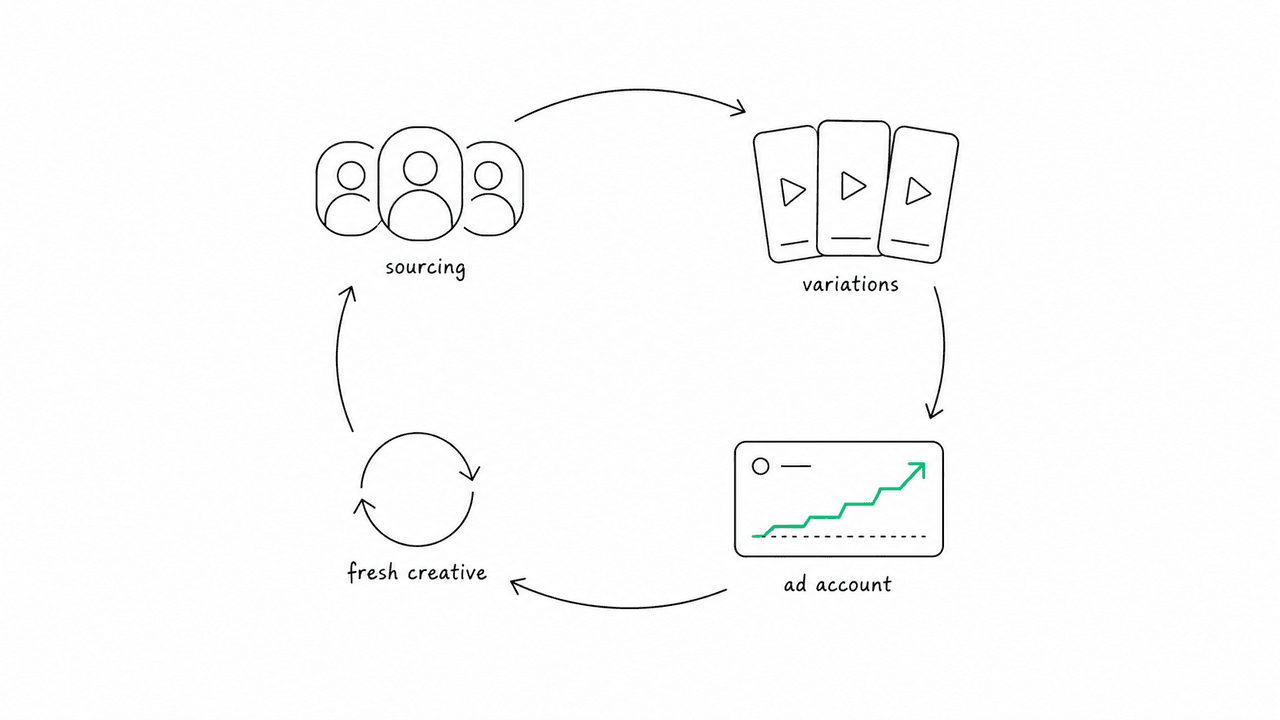
That is a different lens than a general UGC roundup. The bottleneck on paid social is rarely the ad account, the targeting, or the budget. It is creative volume. The accounts that win on Meta and TikTok do not find one great ad and ride it; they test continuously, kill losers fast, and feed the algorithm fresh creative before fatigue sets in. UGC video platforms exist to keep that flywheel spinning, and the right one depends on where your real constraint sits.
This guide is written for performance marketers, not brand managers. It ranks platforms and approaches specifically for the job paid marketers care about: creative throughput, hook quality, paid-usage rights, and sourcing speed. If you want the broad, format-agnostic view of UGC tooling, read our best UGC platforms breakdown. This piece stays narrow on video ad creative for performance marketers running paid social.
UGC video for ads is a different category than influencer marketing
The confusion costs marketers money, so it's worth being precise. UGC video creative means content made by a creator that you license and run as your own ad. The creator's audience is irrelevant. You're buying the asset, not the distribution. A creator with 800 followers can produce a video that outperforms your studio reel in a paid environment, because it looks like something a real person filmed in their kitchen, not a brand trying to sell you something.
Influencer marketing is the opposite trade: you pay for the creator's reach and the trust they have with their own audience, and the post lives on their account. Both are legitimate, but they require different sourcing logic. For UGC video ads you want camera-confident creators who can act, edit, and hit a hook in the first two seconds. You do not care about their follower count, their engagement rate, or whether their audience matches your customer. You care about whether they can produce a scroll-stopping vertical video that passes your usage-rights requirements.
What digital marketers should actually evaluate
Most UGC platform comparisons score on database size and price per video. Those matter, but they are not what makes or breaks a paid program. Here is what does.
Creative throughput
Paid social runs on volume. If a platform can only get you three videos a month, it is a content vendor, not a testing engine. You want a source that can produce 10 to 30 net-new variations a month without renegotiating every brief.
Vertical video and hook quality
The first two seconds decide everything. Both TikTok and Meta hammer the same advice: hook in the opening moments, because that is where most view drop-off happens. A platform is only useful if it routes you to creators fluent in vertical, sound-on, hook-first video, not landscape talking-head footage repurposed for the feed.
Paid-usage and whitelisting rights
This is the line that separates a UGC platform from a content shop. If you cannot legally run the video as an ad, boost it, or run it through the creator's own handle, the asset is worthless for paid. Check three things on every platform: paid ad usage rights, the license duration, and whether Spark Ads (TikTok) or Partnership Ads / whitelisting (Meta) are supported.
Sourcing speed and vetting
Speed from brief to first cut is the metric nobody advertises and everybody feels. Marketplaces that auto-match get you creators in hours; managed services take a week or more. Vetting matters in the other direction: you do not want to brief 20 creators and get 20 unusable cuts. The best platforms pre-filter for people who can actually shoot for ads.
Best UGC video platforms for digital marketers, compared
The table below is directional. Categories and approximate entry points are summarized to help you triage, not to quote exact prices. UGC pricing changes constantly and most vendors gate it behind a sales call, so verify current numbers on each vendor's site before you commit budget.
| Platform | Category | Video Model | Approx. Entry Point | Best For |
|---|---|---|---|---|
| Influship | Creator discovery | Source creators you brief directly | See pricing | Sourcing ad-native video creators at scale, via API |
| Insense | Creator marketplace | Custom video + paid amplification | Subscription, mid hundreds/mo | Spark Ads and whitelisting handled in one place |
| Billo | Creator marketplace | Custom product video | ~$99/video | High-volume, low-cost testing fuel for DTC |
| Trend.io | Creator marketplace | Curated creator video | Per-project, low hundreds | Higher-craft, hand-picked UGC |
| Cohley | Enterprise content | Multi-format content + rights mgmt | Enterprise pricing | Larger brands with governance needs |
| Arcads / AI tools | AI UGC generator | AI avatar video | Subscription, low hundreds/mo | Rapid hook/script variation and localization |
| Fiverr | Freelance marketplace | One-off creator gigs | Lowest, high variance | Cheap one-off tests before committing |
A few honest caveats. Marketplace per-video prices climb fast once you add editing, multiple revisions, raw-footage delivery, or extended usage rights, so the headline figure rarely survives contact with a real brief. AI tools quote low monthly costs but the output quality varies enough that you'll burn ad spend learning which prompts work. And every platform in the table handles a slice of the workflow, not the whole thing, which is why most serious UGC programs combine a sourcing layer, a creator layer, and an editing layer.
Influship — best for sourcing UGC video creators at scale
Instead of a closed marketplace of opted-in UGC sellers, Influship lets you search the open creator graph with natural language and pull a shortlist of people who already make the kind of vertical video you want to run. Search "skincare creators who post sound-on routines with strong hooks" or "Reels-native food creators who film fast-cut recipe content," then reach out and brief them directly. Because Influship's influencer discovery works against public Instagram creators rather than a sign-up pool, your supply of fresh faces never runs dry, which is exactly what a high-throughput testing program needs. YouTube and TikTok search are coming soon. For the format-agnostic walkthrough of sourcing this way, see our guide to finding UGC creators.
Insense — best for Spark Ads and licensing inside Meta and TikTok
Insense is built for performance marketers. Its core strength is connecting you to UGC creators and then handling the parts that usually break: TikTok Spark Ads code generation, Meta Partnership Ads / whitelisting access, and content licensing terms baked into the workflow. It closes the gap between "I have a great clip" and "I can run this as a Spark Ad through the creator's handle" faster than almost anything else.
Billo — best for high-volume, low-cost product video
Billo is content-on-demand. You ship product, brief the order, and get vertical video back at a low per-asset price with full commercial usage included. It is not a place to build creator relationships; it is a place to manufacture testing fuel. For a DTC brand burning through ad creative, that trade is often correct, with the caveat that creators are competent rather than standout, so your hooks have to carry the work.
Trend.io, Cohley, and the AI tier
Trend.io curates its creator pool more tightly, so the baseline quality is higher and you get fewer unusable cuts per brief, at a higher sticker price. Cohley sits at the enterprise end, generating UGC video alongside reviews and photography with the reporting and rights management bigger teams require. AI UGC generators (Arcads and similar) spin up dozens of script and hook variations cheaply, but the output still reads as synthetic to many viewers and disclosure rules around synthetic media are tightening. Treat AI as a testing multiplier, not your hero creative.
Why sourcing is the real constraint
Once a paid-social program matures, the limiting factor stops being "can I get a video" and becomes "can I get enough good, varied videos cheaply and on a schedule." Managed marketplaces are excellent for your first 10 or 20 videos. They get expensive and slow when you need 50 fresh variations a month across multiple products and angles, because you're paying a markup on every asset and re-explaining your brand to a new creator each time.
The brands that scale UGC efficiently build their own roster of UGC creators they can re-brief on demand, paying creators directly and cutting the marketplace out of the repeat business. The hard part of doing that yourself is finding creators whose content style actually fits ad creative: people who already shoot tight vertical video, hit a hook fast, and look natural on camera. Filtering a generic database by follower count won't surface them, because follower count has nothing to do with whether someone can make a good ad. Style-based creator discovery solves exactly that sourcing problem, and it is the layer that feeds everything else in the stack.
UGC video for Meta vs TikTok ads
The same clip rarely performs equally across both. Brief for the platform.
TikTok rewards native, fast, slightly raw video. Spark Ads run the creative through the creator's own handle, so the content has to read as something that creator would post organically. Hooks lean into trends, on-screen text, and a strong first-frame pattern interrupt. Brief creators who live on TikTok and understand its cadence.
Meta (Reels, Feed, Stories) tolerates a slightly more produced feel and leans harder on the problem-solution structure and a clear CTA. Captions matter because a large share of viewing is sound-off. Partnership Ads let you run through a creator's handle the way Spark Ads do on TikTok — use it.
How to choose a UGC video platform
There's no single best tool, only the best tool for where your constraint sits right now. Work through these in order.
- Diagnose your actual bottleneck first. Is it that you can't get any UGC at all, that you can't get enough of it cheaply, or that you have raw footage but can't cut enough variants? Sourcing, scaling, and editing are three different problems with three different tools. Buying the wrong category is the most common mistake.
- Confirm usage rights are built in, in writing. Make sure the platform or your direct creator agreement grants paid ad usage (not just organic), for the duration and platforms you need, including whitelisting or Spark Ads if you run creator-handle ads. Rights are where cheap UGC turns into a legal problem.
- Match the model to your volume. Per-video marketplaces are right for low volume and validation. If you need 30-plus fresh videos a month on an ongoing basis, per-video pricing will hurt, and a self-sourced roster via discovery plus direct payment is usually the cheaper, faster path.
- Judge creators on ad-craft, not reach. The metric that matters is whether they can shoot a native, hook-forward vertical video, not their follower count. Ask for ad-specific samples, not their best organic post.
- Be skeptical of AI for hero creative. Use it for rapid hook testing, script variants, and localization. It is not yet a reliable replacement for human-filmed creative as your core library.
- Plan for the editing layer. One raw UGC clip should become many ads: different hooks, captions, intros, and aspect ratios. Whatever you source, make sure you can turn each asset into a dozen testable variants, or your creative volume will stall no matter how good your sourcing is.
How to brief UGC video creators for ads
A great platform with a vague brief produces mediocre video. The brief is where most paid UGC programs leak performance. Keep it tight and test-oriented.
- Lead with the hook. Specify two or three opening lines or visual patterns you want tested. The hook is the single biggest performance lever; do not leave it to the creator's instinct alone.
- Use a problem-solution spine. Name the pain, show the product solving it, show the result. This structure converts because it mirrors how people actually decide.
- Order multiple variations per creator. Ask for three to five hook variants on the same base script. You are buying test cells, not a single ad.
- Request B-roll separately. Clean product shots and ambient footage let your editor recut winners into new variations without re-briefing.
- Specify the CTA. Tell the creator exactly what to say and show at the end, matched to the platform (Spark Ad vs Reels CTA differ).
For the full structure, use our influencer brief guide and the deeper campaign brief walkthrough. The principle that carries over to paid UGC: give creators a clear spine and a fixed hook test, then let them own the execution.
The bottom line for performance marketers
There is no single "best UGC video platform." There's a marketplace for validation, a discovery tool for scaling sourcing, an editing suite for multiplying variants, and AI for cheap hook tests, and a mature paid-social program uses several at once. The mistake is treating UGC video like influencer marketing and buying for reach, or treating one category as if it solves the whole workflow. Start by naming your real constraint, then pick the tool that attacks it. If your constraint is finding ad-native creators to brief directly, that's a discovery problem, and it's worth checking pricing or seeing a demo before you default to paying a marketplace markup on every video forever.
UGC video platform FAQ
What is the difference between a UGC platform and an influencer platform?
A UGC platform helps you source video creative that you license and run as your own ad; the creator's audience is irrelevant because you're buying the asset, not their reach. An influencer platform helps you find creators with audiences so you can pay for distribution on their accounts. For paid social, you usually want UGC: native, hook-forward video you control and run as ads.
Which platform is best for Facebook and TikTok ads?
For ad-rights plumbing (Spark Ads, whitelisting), Insense is purpose-built. For sourcing a constant supply of vertical-video creators to brief at scale, Influship's discovery keeps the pipeline full. For cheap, high-volume product video to test, Billo. Most performance teams end up combining a sourcing layer with a rights and licensing layer.
How much does a UGC video cost?
Directionally, creator-marketplace UGC videos run from roughly $70 to a few hundred dollars each, with price climbing for editing, revisions, raw footage, and extended ad-usage rights. Self-sourcing creators directly through discovery and negotiating per-video rates is typically cheaper at volume because you skip the marketplace markup. Always verify current pricing on the vendor's site, since UGC rates change often and are frequently gated behind a quote.
Is AI-generated UGC good enough for paid ads?
It depends on the job. AI UGC is genuinely useful for rapid hook and script testing, localization, and generating many cheap variants. It's weaker as your core library of scroll-stopping creative because AI avatars still read as synthetic to many viewers and performance is inconsistent. Platforms are also tightening rules on undisclosed synthetic media. Use it as a testing multiplier, not a replacement for human-filmed hero creative.
How many UGC video variations should I test?
Test in batches, not singles. A reasonable starting cadence is 10 to 15 net-new variations a month, built from a handful of base concepts with multiple hook variants each. The exact number scales with budget. The principle is to always have fresh creative entering the account before your current winners fatigue, and sourcing speed is usually what caps it.
Sources and further reading
- Meta Business Help Center — About creative best practices for ads (creative diversity and volume as a performance lever).
- TikTok for Business — Don't Make Ads, Make TikToks (native, creator-style video outperforms produced ads).
- Federal Trade Commission — Disclosures 101 for Social Media Influencers (disclosure rules that apply to paid and licensed creator content).
- Influship — Best UGC Platforms for 2026 (the format-agnostic companion guide to UGC tooling).