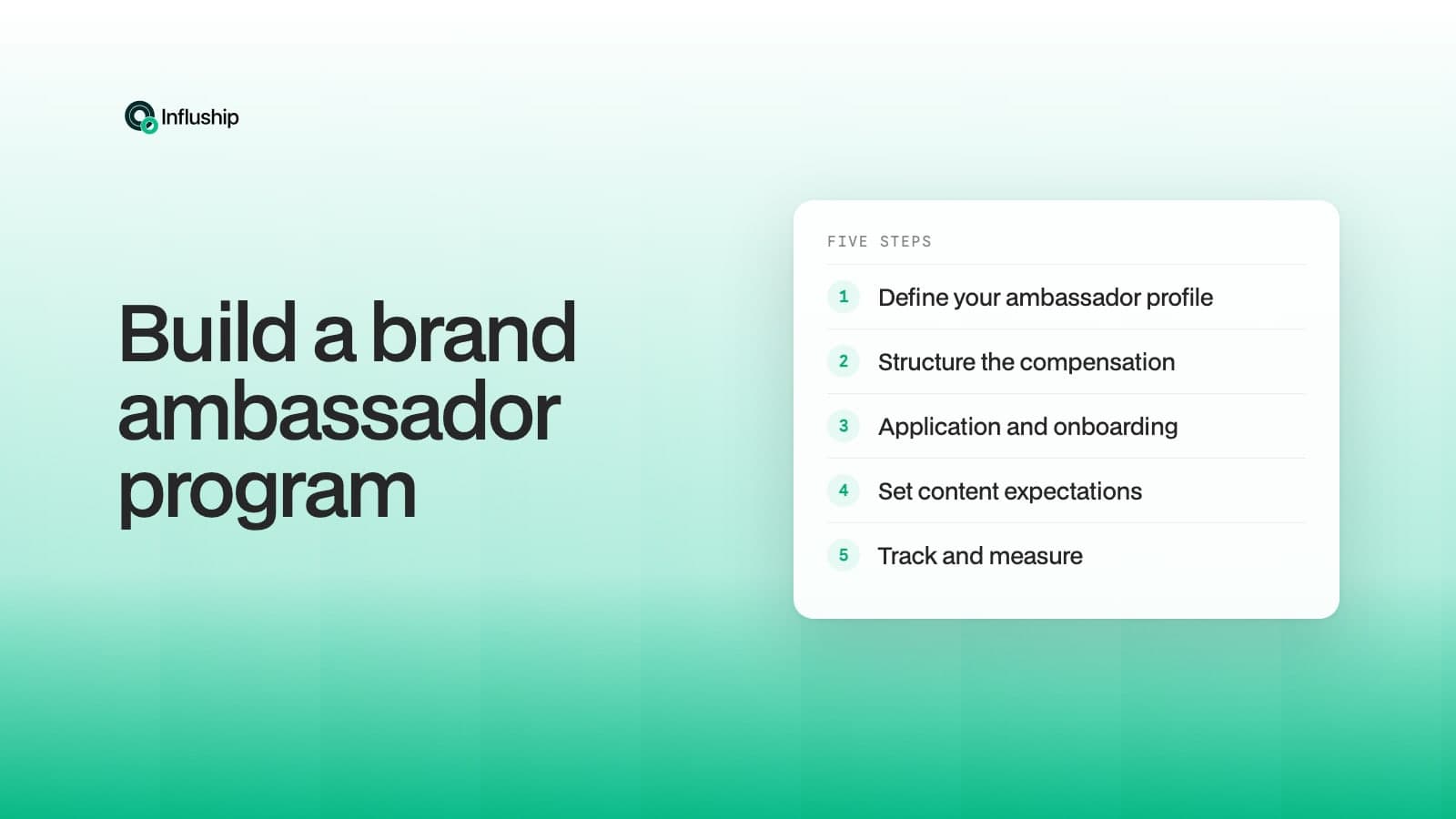
One-off influencer campaigns can move product. But the brands getting the most out of creator partnerships are building ambassador programs: long-term, ongoing relationships with creators who know the product, believe in it, and talk about it without being asked. This guide walks through how to build one from scratch, step by step.
Ambassador Programs vs. Influencer Campaigns
The distinction matters because it changes how you recruit, how you pay, and how you measure results. An influencer campaign is a transaction. You hire a creator, they post, you track performance, and the relationship ends. An ambassador program is a partnership. The creator represents your brand over months or years, builds familiarity with the product, and becomes a trusted voice to their audience.
Duration. Influencer campaigns last days or weeks. Ambassador contracts run 6 to 12 months, often with renewal clauses.
Depth of relationship. Campaign creators receive a brief, produce content, and move on. Ambassadors get product access, attend events, provide feedback on new launches, and co-create with the brand over time. The audience sees the difference. Repeated mentions from the same creator build trust in a way that a single sponsored post cannot.
Compensation. Campaigns use flat fees or per-post rates. Ambassador programs tend toward hybrid models: product, commission on sales, and sometimes a monthly retainer. The per-post cost is often lower, but the total investment is higher because the relationship runs longer.
When each makes sense. Campaigns work for product launches, seasonal pushes, and short-term awareness plays. Ambassador programs work when you want sustained visibility, community credibility, and content you can repurpose across channels. Most brands benefit from running both. Campaigns for spikes, ambassadors for the baseline.
Step 1: Define Your Ambassador Profile
Before you recruit anyone, get specific about who you want. "Influencers in our niche" is not a profile. A profile includes audience demographics, content style, posting frequency, engagement quality, and brand alignment.
Look Beyond Follower Count
Follower count is the worst predictor of ambassador success. What matters more: Does their audience match your customer? Do they post about topics adjacent to your product without being paid to? Do their followers leave real comments, or is it all fire emojis and "nice pic"?
For a detailed breakdown of how to evaluate creators on these dimensions, see our guide on how to find influencers for your brand.
Start with Existing Customers
Your best ambassadors are people who already use and like your product. They don't need to be convinced. Their enthusiasm is real, and their audience can tell the difference between a creator who discovered a product through a sponsorship email and one who bought it themselves.
Check your tagged posts, customer reviews, and DMs. Look for people who are already talking about you. Lululemon built its entire ambassador model on this idea: instead of paying celebrities, they partnered with over 1,000 local yoga teachers and fitness instructors who already wore the gear. These people had small followings but real credibility in their communities.
Engagement and Brand Alignment
Engagement rate tells you whether the audience pays attention. But engagement alone is not enough. You also need alignment. Does the creator's content tone match your brand? Would their audience find your product relevant? If you sell premium skincare and the creator's audience engages with budget beauty hacks, the fit is off regardless of the engagement numbers.
Screen for values too. An ambassador will represent your brand publicly for months. Their past content, opinions, and online behavior become associated with you. Do the homework before you sign anyone.
Step 2: Structure the Compensation
Compensation is where most programs either attract great ambassadors or lose them to competitors. Underpay and you get half-hearted content. Overpay without performance incentives and you get complacency. The right structure balances guaranteed value with upside for results.
Common Compensation Models
Product only. The ambassador receives free product in exchange for content. This works for early-stage brands with limited budgets and for creators who are genuine fans. It does not work for creators with established audiences who can command paid deals elsewhere. If the product costs you $30 to ship but retails for $120, the perceived value is higher than the cost to you. Use that.
Product + commission. Free product plus a percentage of sales driven through their unique link or discount code. Commission rates for ambassador programs range from 5% to 30%, with most falling between 10% and 20%. This model aligns incentives: the creator earns more when they perform well.
Product + flat fee. Free product plus a fixed monthly or per-post payment. This gives creators income predictability and works well for content-heavy programs where you need a guaranteed number of posts per month. For rate benchmarks, see our influencer pricing guide.
Retainer (hybrid). A monthly base payment plus commission plus product. This is the model most established programs use. The retainer signals commitment, the commission rewards performance, and the product keeps the creator actively using what they promote. Gymshark athletes, for example, receive a monthly retainer, commission on sales through their personal codes, and regular apparel shipments.
Perks Beyond Money
Money matters, but it is not the only thing ambassadors value. The best programs offer a combination of:
- Early access to new products before public launch
- Invitations to brand events, retreats, or photo shoots
- Co-creation opportunities (designing a product, naming a colorway, input on campaigns)
- Professional development (workshops, masterclasses, networking with other creators)
- Content features on the brand's own channels
Sephora's Squad program stands out here. Beyond product, Squad members get masterclasses with professional makeup artists, early access to product launches, professional photo shoots, and workshops with beauty industry leaders. The program received over 16,000 applications in a single year because the non-monetary value is that compelling.
Step 3: Create the Application and Onboarding
A strong application process filters for quality. A strong onboarding process sets ambassadors up to succeed. Skip either one and the program underperforms.
Application Form Essentials
Your application should collect the information you need to evaluate fit without being so long that good candidates abandon it. Include:
- Social media handles and links to profiles
- A short answer on why they want to represent your brand
- Their audience demographics (most creators know their top countries, age range, and gender split)
- Content examples or links to past brand collaborations
- How they already use or interact with your product
Put the application on a dedicated landing page. Link to it from your website footer, email newsletter, social profiles, and packaging inserts. The goal is to let your most enthusiastic customers come to you instead of cold-recruiting creators who have never heard of you.
For candidates who pass the initial screen, consider a short video call. Ten minutes on a call tells you more about someone's communication style and enthusiasm than any written application can.
Onboarding Materials
Once someone is accepted, send them everything they need to start creating within a week. The onboarding package should include:
- Brand guidelines. Logo usage, brand colors, tone of voice, key messaging points. Keep it concise. A 2-page PDF beats a 30-page brand bible that nobody reads.
- Content dos and don'ts. What you want to see (product in use, honest reviews, lifestyle integration) and what to avoid (competitor mentions, off-brand language, unsubstantiated claims).
- Product shipment. Send their first product box immediately. The faster they have product in hand, the faster they start creating.
- Unique tracking links and discount codes. Set these up before onboarding so they're ready on day one.
- Program terms. Put the formal expectations in a written contract. Cover content requirements, usage rights, exclusivity, and termination terms. For guidance on what to include, see our post on how to write an influencer contract.
Communication Channels
Pick one channel and make it the default. Slack, Discord, WhatsApp groups, or a dedicated community platform. Avoid email threads with 40 ambassadors. The channel serves two purposes: operational updates from you (new product launches, campaign briefs, deadline reminders) and community among the ambassadors themselves. When ambassadors know and support each other, they stay engaged longer.
Step 4: Set Content Expectations
Unclear expectations are the top reason ambassador programs produce inconsistent results. You need to tell people what you want without scripting every word.
Posting Frequency and Formats
Specify minimums, not maximums. A typical structure: 2 to 4 posts per month across Instagram and TikTok, with at least one Reel or TikTok per month. This gives the creator flexibility on timing and format while ensuring a baseline output.
Be specific about what counts as a "post." Does a Story count? Does a carousel count as one post or multiple? Spell it out. Ambiguity here leads to disagreements later.
Content Approval Process
Decide upfront whether you review content before it goes live. Two common approaches:
Pre-approval. The ambassador submits drafts for review before posting. This gives you quality control but slows down the process. It can also stifle the creator's natural voice if you over-edit.
Post-review. The ambassador posts at their discretion and you review after the fact. This is faster, preserves authenticity, and works well once you trust the creator's judgment. If something misses the mark, you address it for future content rather than pulling down the post.
Most programs start with pre-approval for the first month, then shift to post-review once the ambassador demonstrates they understand the brand voice.
Hashtags and Disclosure Requirements
The FTC requires clear disclosure on all sponsored content, including ambassador posts. The disclosure must be obvious and unambiguous. #ad or #sponsored works. #ambassador alone does not. The FTC has stated that standalone terms like "ambassador" or "partner" are too vague.
Best practice: require ambassadors to use your branded hashtag plus #ad. Example: #YourBrandPartner #ad. Place the disclosure at the beginning of the caption, not buried under a wall of hashtags. For video content, the disclosure should appear in the video itself, not only in the caption.
Include your disclosure requirements in the onboarding materials and in the contract. Make it non-negotiable. A single FTC violation can result in fines up to $51,744 per incident as of 2024.
Step 5: Track and Measure
Ambassador programs need different metrics than one-off campaigns. A campaign is measured in days or weeks. An ambassador relationship is measured in quarters and years. The KPIs should reflect that longer time horizon.
KPIs for Ambassador Programs
Content output. Are ambassadors meeting their posting minimums? Track quantity, format mix, and consistency over time. A creator who posts four times in month one and zero times in month three is showing a pattern.
Engagement rate on sponsored content. Compare their ambassador posts to their organic (non-sponsored) average. A healthy program shows ambassador content performing within 80% to 100% of their organic engagement. If sponsored posts consistently underperform organic by 50% or more, the content approach needs adjustment.
Revenue attribution. Track sales through unique discount codes, affiliate links, or UTM parameters assigned to each ambassador. This is the clearest measure of direct impact.
Customer acquisition cost via ambassadors. Total program cost (product, payments, management time) divided by customers acquired through ambassador channels. Compare this to your other acquisition channels.
Content repurpose value. How much ambassador content are you reusing in paid ads, email, website, or other channels? This is often the hidden ROI of ambassador programs. One strong piece of creator content can outperform studio-produced ads at a fraction of the cost.
Attribution Methods
No attribution method is perfect. Use multiple:
- Unique discount codes. Each ambassador gets a personal code (e.g., SARAH15). Tracks direct conversions. Simple and reliable.
- Affiliate links with UTM parameters. Captures click-through data and allows you to see the full funnel from click to purchase.
- Post-purchase surveys. Add "How did you hear about us?" to checkout. This catches word-of-mouth influence that codes and links miss.
- Brand lift studies. For larger programs, measure changes in brand awareness, consideration, and purchase intent in the ambassador's audience over time.
When to Renew, Upgrade, or End Partnerships
Review each ambassador quarterly. Three questions to answer:
Are they meeting content commitments? Consistent output is table stakes. If they're not posting, the rest doesn't matter.
Is their content driving measurable results? Look at code redemptions, link clicks, and engagement trends. A top performer earning more than their cost in attributed revenue deserves a better deal: higher commission, more product, or a retainer increase.
Is the relationship still a good fit? Audiences evolve. Content styles shift. An ambassador who was perfect 12 months ago might have pivoted to a different niche. Audiences evolve, and so do creators. Expect some partnerships to run their course.
When it is time to end a partnership, do it professionally. For guidance on how to handle that conversation, see our post on when to end an influencer partnership.
Examples of Strong Ambassador Programs
These four programs illustrate different approaches to the same goal: turning creators into long-term brand advocates.
Lululemon: Local Community First
Lululemon's ambassador program has two tiers. Global ambassadors are elite athletes with large followings. Store ambassadors are local yoga teachers, personal trainers, and fitness instructors selected by individual retail locations.
The store ambassador model is the interesting one. Instead of spending millions on one celebrity endorsement, Lululemon partners with over 1,000 local fitness professionals. These ambassadors receive free gear and professional development opportunities. In exchange, they wear Lululemon while teaching classes and hosting community events. Their influence is hyperlocal but high-trust. When your yoga teacher wears the same brand every week, it carries more weight than a celebrity Instagram post you scroll past.
Gymshark: Fans Turned Athletes
Gymshark calls its ambassadors "Athletes." The distinction matters. Most Gymshark Athletes started as customers and fans before being recruited. The company's partnerships team scouts creators based on content quality, brand alignment, and audience engagement, not follower count alone. Gymshark does not have a public application form. They find you.
Compensation includes a monthly retainer, commission on sales through personal discount codes, and regular apparel shipments. Athletes are involved early in campaigns, from product feedback to launch strategy. This involvement makes them invested in the brand's success beyond their own commission check. Estimated annual earnings for Gymshark Athletes range from $6,000 to $100,000 depending on audience size and sales performance.
Red Bull: Campus Takeover
Red Bull's Student Marketeer program deploys over 4,000 college-age ambassadors across universities worldwide. Student Marketeers drive branded Mini Coopers, hand out product at campus events and study halls, and serve as the brand's on-the-ground presence.
What makes this program work: the ambassadors are the target demographic. They are not promoting to an audience they don't belong to. They are promoting to their own peer group. Red Bull also offers real career value. Student Marketeers gain marketing experience, networking opportunities, and exposure to professional athletes and events. The program doubles as a recruitment pipeline for full-time positions.
Sephora Squad: Application-Based Exclusivity
Sephora's Squad program accepts applications once per year and receives over 16,000 submissions for a limited number of spots. The application process itself generates buzz. Creators post about applying, hoping to be selected, which promotes the program without Sephora spending anything.
Selected Squad members receive gratis product boxes, early access to launches, masterclasses with makeup artists, professional photo shoots, and content workshops. The non-monetary benefits are the draw. Sephora understood that for beauty creators, access and education are worth more than a paycheck. The scarcity of the program (limited spots, annual application window) makes it aspirational, which attracts higher-quality applicants.
FAQ
How many ambassadors should a program start with?
Start with 10 to 20. This is large enough to generate consistent content but small enough to manage without dedicated staff or software. As you refine your onboarding, content guidelines, and measurement process, scale from there. Brands that launch with 100+ ambassadors on day one end up with inconsistent quality and management headaches.
How long should an ambassador contract last?
Six months is a good starting point. It gives both sides enough time to build a working relationship and generate measurable results. Include a renewal clause with 30 days notice if either party wants to end the arrangement. For contract details and language, use our contract builder.
Can ambassadors work with competing brands?
That depends on your exclusivity terms. Most programs include a non-compete clause covering direct competitors for the duration of the contract. A skincare brand might restrict ambassadors from promoting other skincare lines but allow partnerships with makeup or haircare brands. Be specific in the contract about what counts as a competitor. Broad exclusivity clauses (no beauty brands at all) will limit your applicant pool and may require higher compensation.
What is the difference between an ambassador and an affiliate?
An affiliate promotes a product for a commission, often with no other relationship to the brand. An ambassador has a formal partnership with content expectations, brand guidelines, product access, and ongoing communication. Ambassadors are affiliates with a deeper relationship and more responsibilities. Many ambassador programs include an affiliate component (commission on sales) as part of the compensation structure.
How do I handle an ambassador who stops posting?
First, reach out and ask what is going on. Creators go through busy periods, creative blocks, or personal situations that affect their output. If the drop-off continues after a check-in, review the contract terms. Most programs include a minimum posting requirement, and consistent failure to meet it is grounds for ending the partnership. Address it early. Waiting months while paying a retainer to someone who is not creating content wastes budget and a program slot that could go to an active creator.