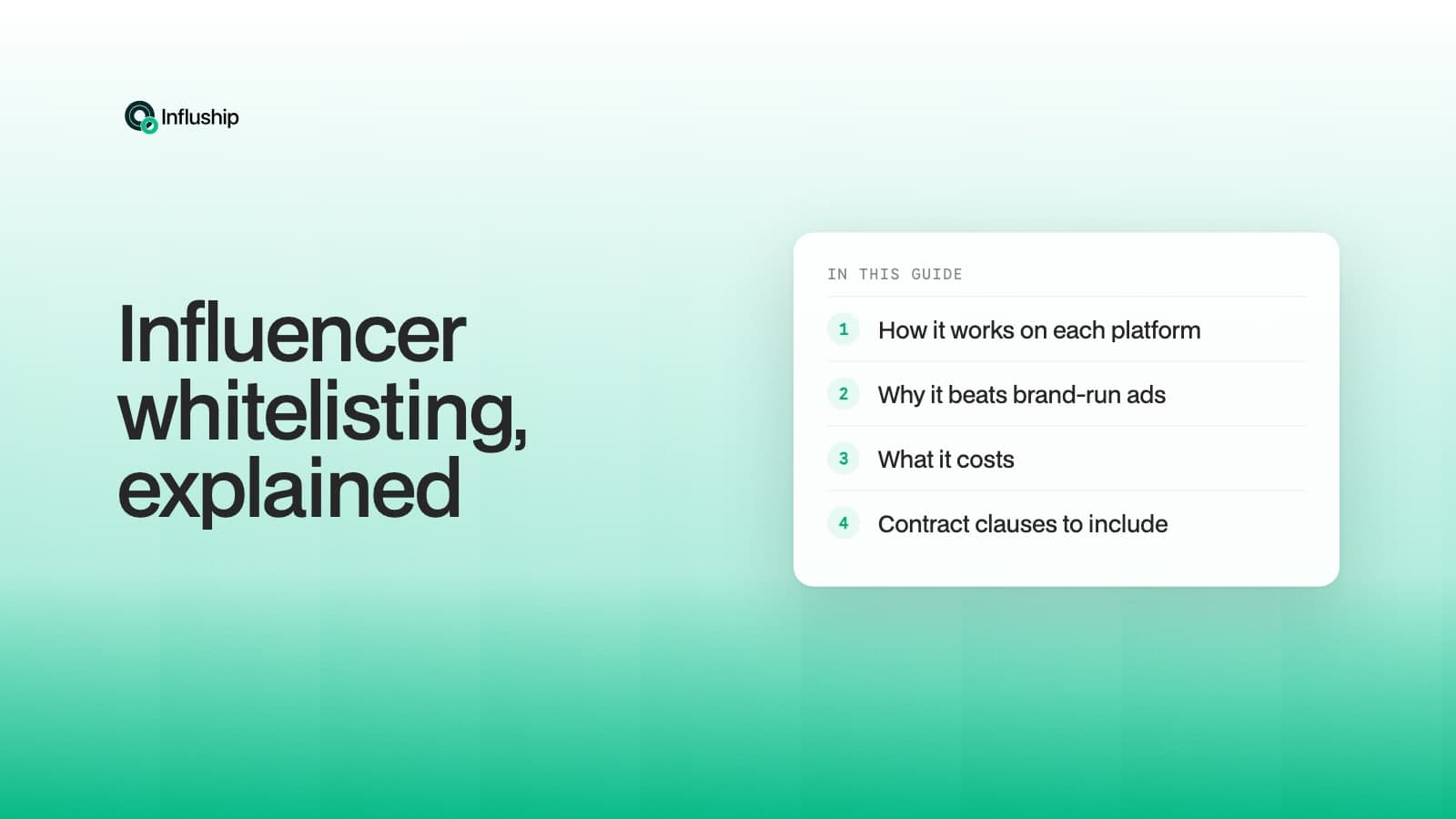
Whitelisting is when a brand runs paid ads through a creator's social media account. The ad shows the creator's name and profile picture, but the brand controls the targeting, budget, and duration. It combines the trust of influencer content with the precision of paid media.
The industry also calls this "allowlisting," "creator licensing," or "partnership ads" depending on the platform. Instagram uses "Partnership Ads." TikTok uses "Spark Ads." The mechanics differ, but the concept is the same: the brand pays to amplify creator content from the creator's handle.
How Whitelisting Works on Each Platform
Every platform has its own version of whitelisting with different permission flows, naming conventions, and technical setups. Here is how each one works.
Instagram Partnership Ads
Instagram (and Facebook) calls whitelisted ads "Partnership Ads." Meta retired the old "Branded Content Ads" label in 2023 and consolidated everything under this name.
What the creator does: The creator publishes a post with the "Paid Partnership" label and toggles on "Allow brand partner to boost." They can grant access at the content level (one post at a time) or at the account level (the brand can boost any tagged content). For one-off campaigns, content-level access is cleaner. For ongoing ambassador deals, account-level access saves time.
What the brand does: In Meta Ads Manager, the brand creates a new campaign, selects the creator's post under "Partnership Ads," sets the audience targeting, budget, and schedule, then launches. The ad appears in feeds as a post from the creator's handle with a "Sponsored" label.
Ad code option: Meta also supports ad codes. The creator generates a code in their content settings and shares it with the brand. The brand enters the code in Ads Manager to link the content without needing account-level access. This works well for creator content that was not originally published with the paid partnership label.
One limitation: the brand cannot edit the creator's caption or visual content. You can add a CTA button and change the destination URL, but the creative itself stays as the creator published it.
TikTok Spark Ads
TikTok's version of whitelisting is called Spark Ads. The process is video-specific: each piece of content requires its own authorization code.
What the creator does: Open the video, tap the three dots, select "Ad settings," toggle "Ad authorization" to on, choose the authorization duration (7, 30, 60, or 365 days), and tap "Generate code." The creator copies this code and sends it to the brand.
What the brand does: In TikTok Ads Manager, go to Tools, then Creative Assets, then Spark Ad Posts. Click "Apply for Authorization," paste the code, confirm the post details, and click "Link." The video is now available to use as an ad creative. TikTok supports batch authorization for up to 20 codes at a time.
Key differences from Instagram: Spark Ads codes are per-video, not per-account. The code expires based on the duration the creator selected. If the brand wants to extend the campaign, the creator must generate a new code. The brand cannot edit the video caption after authorization.
Spark Ads retain the original video's organic engagement. Likes, comments, and shares from the ad campaign add to the original post's metrics. This is a selling point for creators who care about their public engagement numbers.
YouTube Creator Partnerships
YouTube's equivalent is less established than Instagram or TikTok. The platform rebranded BrandConnect into "YouTube Creator Partnerships" and integrated it into YouTube Studio for creators and Google Ads for brands.
How it works: Creators with 25,000+ subscribers are eligible. Through "Brand Partner Access," a creator links a specific video to a brand's Google Ads account. The brand can then run the video as a partnership ad across YouTube and Google's ad network, and view both organic and paid performance metrics in Google Ads.
YouTube whitelisting is less common than Instagram or TikTok for two reasons. First, the subscriber threshold locks out smaller creators. Second, YouTube's ad ecosystem (pre-roll, mid-roll, discovery ads) is built around the brand's own video assets, not creator content. Most brands that work with YouTube creators use the integration model: the creator mentions the brand within their own video, and the brand repurposes the clip for ads on other platforms.
Why Whitelisting Outperforms Brand-Run Ads
The performance gap between whitelisted ads and standard brand ads is large and consistent across campaigns.
Higher click-through rates. Meta reports that campaigns combining Partnership Ads with standard brand ads see 53% higher CTR than brand ads alone. Other industry benchmarks put creator-handle ads at 2-4x the CTR of brand-handle ads. The reason: people scroll past ads from brands they don't recognize. They stop for content from a person.
Lower cost per acquisition. Brands running whitelisted campaigns report 30-50% lower CPA compared to standard ads. Meta's own data shows 19% lower CPA when Partnership Ads are layered on top of existing campaigns. The trust signal built into creator content does the persuasion work that brand ads need extra impressions to achieve.
Better CPMs. Whitelisted ads see up to 40% cheaper CPMs. Platforms reward content that gets engagement with lower auction costs. Creator content tends to earn more engagement than polished brand creative, which pushes CPMs down.
Access to creator audience lookalikes. When you run ads through a creator's account, the platform can build lookalike audiences from the creator's follower base, not yours. If the creator has 200K followers in your target demographic, their lookalike audience is more relevant than one built from your brand's page. This is the advantage most brands undervalue.
Social proof is built in. A whitelisted ad shows the creator's name, profile picture, and (on TikTok) the original post's engagement metrics. A viewer sees a real person recommending a product, not a brand promoting itself. That context changes how people process the ad. It feels like a recommendation, not an interruption.
What Whitelisting Costs
Whitelisting is a separate line item from the organic content fee. The creator gets paid for making the content, and then gets paid again for lending their account to the brand's ad spend. These are two different things, and the contract should treat them that way.
Industry Standard Pricing
The standard whitelisting fee is 20-30% of the creator's base content rate per 30-day flight. Most deals land at 25%.
Example: A creator charges $2,000 for a Reel. The brand wants 30 days of whitelisting rights. The whitelisting fee is $500 (25% of $2,000). Total deal: $2,500.
For a full breakdown of base rates by platform, follower tier, and content format, see our influencer pricing guide.
Duration Pricing
Longer whitelisting periods cost more, but the per-month rate drops. Here is how most agencies and talent managers structure it:
| Duration | Fee (% of base rate) | Example ($2,000 base) |
|---|---|---|
| 30 days | 20-30% | $400-600 |
| 60 days | 35-50% | $700-1,000 |
| 90 days | 45-65% | $900-1,300 |
| 6 months | 75-100% | $1,500-2,000 |
| 12 months | 100-150% | $2,000-3,000 |
At 6+ months, many creators prefer a flat monthly fee instead of a percentage. A mid-tier creator (100-500K followers) might charge $1,000-2,000/month for ongoing whitelisting rights, independent of the content creation fee.
How to Structure Payment
Keep the organic content fee and the whitelisting fee as separate line items in your contract and invoices. This matters for three reasons:
Budget tracking. You need to know what you're paying for content creation vs. paid media rights. These come from different budget lines at most companies.
Renewal flexibility. If the whitelisted ad performs well, you can extend the whitelisting period without renegotiating the content fee. If it underperforms, you let the whitelisting expire without affecting the organic deal.
Tax and accounting. Content creation fees and licensing fees may be categorized differently for accounting purposes. Keeping them separate makes the bookkeeping clean.
What About Ad Spend?
The whitelisting fee covers the right to run ads through the creator's account. The ad spend itself (what you pay Instagram or TikTok for impressions) is a separate cost entirely. Some talent managers push for a percentage of ad spend on top of the whitelisting fee. Resist this unless you're working with a top-tier creator. A flat whitelisting fee gives you budget predictability. A percentage of spend penalizes you for scaling what works.
Contract Clauses for Whitelisting
Every whitelisting deal needs its own section in the contract. The organic content clause covers deliverables and posting. The whitelisting clause covers ad rights, duration, and restrictions. These are different obligations with different timelines.
For a complete contract template with all 10 essential clauses, see our guide on how to write an influencer contract. You can also generate a contract with whitelisting terms using our free contract builder.
What the Whitelisting Clause Must Specify
Six elements belong in every whitelisting clause:
1. Platforms. Name each platform where whitelisting is permitted. "Social media" is too broad. "Instagram and TikTok" is specific.
2. Duration. The exact start and end dates, or a defined period (e.g., 30 days from first ad launch). Open-ended whitelisting is a red flag for creators and should be a red flag for brands too, since it creates ambiguity around when the fee expires.
3. Spending cap. The maximum ad spend the brand can put behind the whitelisted content. Without a cap, the creator has no control over how much exposure their face and name receive. A reasonable cap also protects the brand from runaway spending by an overzealous media buyer.
4. Geographic restrictions. Some creators limit whitelisting to specific countries or regions. A U.S.-based fitness creator may not want their content running as ads in markets where they have no audience or where the product isn't available.
5. Content modifications. Can the brand add a CTA button? Change the destination URL? Trim the video? Most whitelisting agreements prohibit editing the creative itself but allow CTA overlays and URL changes, since platforms support these natively.
6. Revocation process. How and when the creator can revoke ad access if the brand violates the agreement. Include a cure period (e.g., 48 hours to fix the issue before access is revoked) so minor mistakes don't blow up the deal.
Sample Whitelisting Clause
Here is a clause you can adapt for your contracts:
Brand shall have the right to use the Deliverables as whitelisted/partnership ads through Creator's social media account(s) on [Instagram / TikTok / specify platforms] for a period of [30/60/90] days from the date of first ad launch ("Whitelisting Period"). Creator shall grant Brand advertising access through the applicable platform's partnership tools within 48 hours of content approval. Total ad spend on whitelisted content shall not exceed $[AMOUNT] during the Whitelisting Period. Whitelisted ads shall be limited to the following geographic regions: [US / US and Canada / Worldwide]. Brand shall not edit, alter, or modify the Deliverables without Creator's prior written consent, except for adding platform-native call-to-action buttons and destination URLs. Upon expiration of the Whitelisting Period, Brand shall cease all paid amplification through Creator's account(s) within 24 hours and remove all linked content from its ad accounts within 72 hours. In exchange for whitelisting rights, Brand shall pay Creator an additional fee of $[AMOUNT] ("Whitelisting Fee"), payable upon contract execution.
This clause covers platforms, duration, spending cap, geography, content modification limits, and termination. Adapt the bracketed fields to your deal.
For the full contract template including scope of work, payment terms, exclusivity, FTC compliance, and termination clauses, use our contract builder. For disclosure requirements that apply to whitelisted ads, see our FTC guidelines breakdown.
Common Whitelisting Mistakes
These five mistakes come up in most first-time whitelisting deals. Each one is avoidable with the right contract language and process.
1. Running Ads Without Explicit Authorization
Some brands take creator content from organic posts and run it as ads from their own accounts, calling it "whitelisting." That is not whitelisting. That is unauthorized use of someone's content and likeness.
Whitelisting requires the creator to grant ad access through the platform's tools (Partnership Ads on Instagram, Spark Ads on TikTok). If you do not have explicit authorization through the platform and the contract, you do not have the right to run ads.
2. No Spending Cap in the Contract
A creator agrees to whitelisting for $500 and expects the brand to spend $1,000 on the ad. The brand spends $50,000. The creator's face is now in a major paid campaign they did not anticipate or price for.
Always include a maximum ad spend in the contract. If you exceed the cap, renegotiate. Creators price whitelisting based on expected exposure. More spend means more exposure means a higher fee.
3. Forgetting to Revoke Access After the Campaign
On Instagram, account-level access persists until someone removes it. If you granted a brand account-level access for a 30-day campaign and forgot to revoke it, they can boost your future content months later. The contract should include a termination step: the brand removes the creator from their ad account, and the creator confirms access has been revoked.
TikTok handles this better because Spark Ad codes expire automatically based on the duration the creator selected. But on Instagram, manual revocation is required.
4. Not Tracking Whitelisted vs. Organic Performance Separately
A whitelisted post generates two streams of data: organic metrics (from the creator's feed) and paid metrics (from the ad campaign). If you lump these together, you cannot tell what the ad spend bought you vs. what the creator's organic reach delivered for free.
Set up your ad tracking to isolate whitelisted campaign performance. Use UTM parameters on the destination URL. Compare CPA, CTR, and ROAS for whitelisted ads against your standard brand ads so you know whether to keep investing in whitelisting or shift budget elsewhere.
5. Treating Whitelisting as a Free Add-On
Some brands try to include whitelisting in the base content fee by burying it in the usage rights section. Creators and their managers know the value of whitelisting. If you do not price it as a separate line item, one of two things happens: the creator rejects the deal, or they inflate the base rate to account for it. Either way, you lose negotiating flexibility.
Price it separately, negotiate it separately, and contract it separately. This gives both sides room to adjust the whitelisting terms without reopening the entire deal.
FAQ
Is whitelisting the same as running ads with UGC?
No. UGC ads run from the brand's ad account using creator content. Whitelisted ads run from the creator's ad account (or through their handle via platform tools). The audience sees the creator's name and profile picture on a whitelisted ad. On a UGC ad, they see the brand. This distinction affects CTR, CPA, and how the audience perceives the ad. Whitelisted ads carry the creator's social proof. UGC ads carry the brand's.
Can a creator revoke whitelisting access mid-campaign?
On TikTok, no. Once a Spark Ad code is generated and linked, the brand has access for the duration the creator selected. The creator cannot revoke it early through the platform. On Instagram, the creator can remove the brand from their Partnership Ads settings at any time, which stops all active ads. Your contract should address this: include a clause that prohibits early revocation unless the brand violates the agreement, and specify a resolution process for disputes.
Should I whitelist every piece of creator content?
No. Whitelist the content that performs best organically. If a creator delivers three Reels and one gets 3x the engagement of the others, that is your whitelisting candidate. Running mediocre content as a whitelisted ad wastes budget. Let the organic metrics tell you what the audience responds to, then amplify the winners.
How much ad spend should I allocate to whitelisted content?
A common starting point: allocate 2-3x the creator's total fee (content + whitelisting) as ad spend for the first flight. If the creator deal is $2,500 total, start with $5,000-7,500 in ad spend. Monitor CPA and ROAS for the first 5-7 days, then scale or cut based on performance. Whitelisted ads tend to outperform early, so front-load your budget to capture the best CPMs before ad fatigue sets in.
Do whitelisted ads require FTC disclosure?
Yes. Whitelisted ads are paid promotions and must comply with FTC disclosure requirements. The platform's "Sponsored" label (added automatically on Instagram and TikTok for whitelisted ads) satisfies part of the requirement, but the FTC recommends that the content itself also include a clear disclosure like #ad. If the original organic post included a disclosure, the whitelisted version carries it over. If the post did not include one (because it was not originally a sponsored post), you need to confirm that the platform's automatic label meets FTC standards for your specific case.