For most of the last decade, an influencer deal looked the same: agree a flat fee, pay it up front or on delivery, get a post, and hope it worked. The brand carried all the risk. If the post flopped, the creator still got paid in full, and the only thing you walked away with was a screenshot of some impressions and a vague sense that you'd "built awareness."
Performance-based influencer marketing flips that. Instead of paying for the post, you pay for what the post does, conversions, sales, sign-ups, installs, tied to a commission, a cost-per-action, or a revenue share. The creator has skin in the game. You stop funding impressions you can't bank. And the whole relationship starts to look less like buying an ad and more like hiring a salesperson who only gets paid when they sell.
This shift is happening for obvious reasons. Creator fees keep climbing while CFOs keep asking what each dollar actually returned. Affiliate and creator-commerce infrastructure (TikTok Shop, LTK, Shopify Collabs, mature affiliate networks) finally made outcome tracking easy. And a generation of full-time creators now treats brand partnerships as a portfolio, some flat-fee, some performance, the way any rational small business diversifies revenue.
This guide is written for the brand side, by the team that builds the discovery tooling brands use to find creators. It covers what performance-based actually means, the model types and when to use each, the conversion rates you can realistically expect (with honest caveats about why nobody can hand you a precise number), how to structure a deal creators will accept, how to find creators who'll take performance terms in the first place, and the tracking and pitfalls that decide whether the whole thing works. It's most useful if you're a DTC or SaaS brand that wants ROI-tied creator deals and lower downside than a flat-fee gamble.
What "performance-based" actually means
Performance-based influencer marketing is any arrangement where some or all of a creator's pay is contingent on measurable results rather than the act of posting. The defining feature is risk transfer: you move some of the downside off your budget and onto the outcome. That's the whole idea. Everything else, commission percentages, CPA rates, bonus tiers, is just the mechanism for splitting risk and reward.
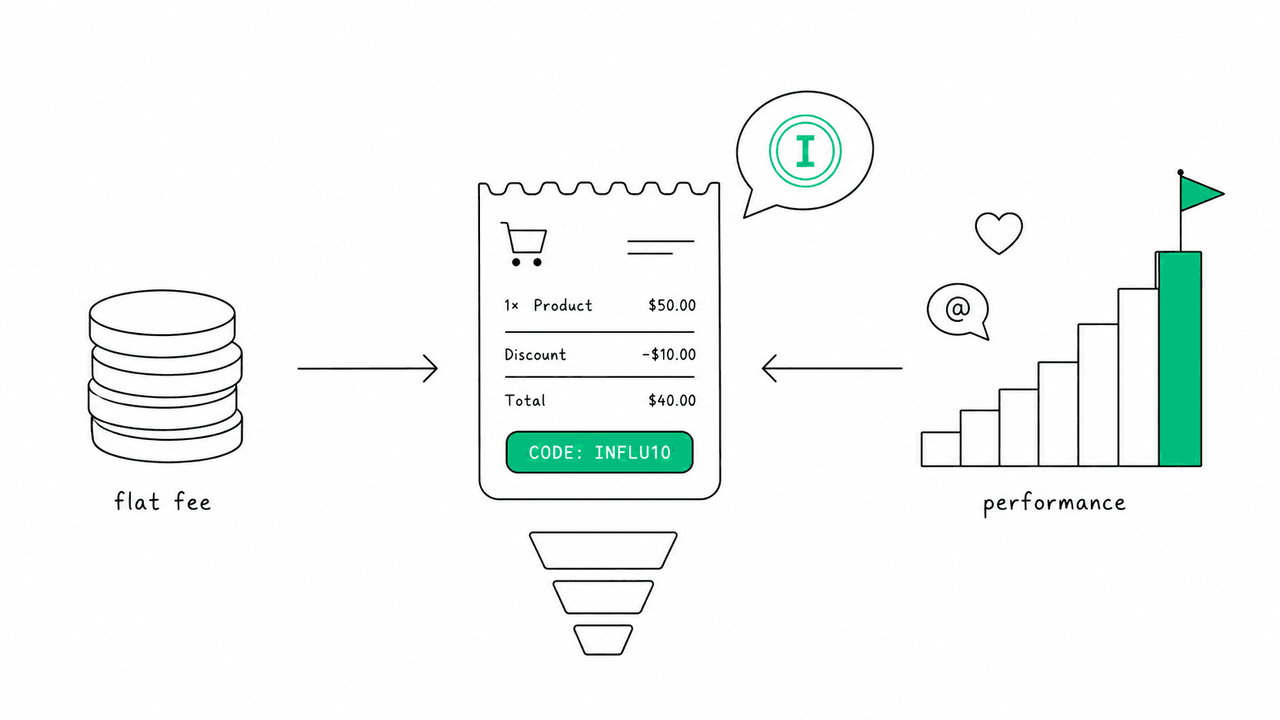
It helps to draw the line clearly. A flat-fee deal pays a fixed amount for a deliverable regardless of results. A performance deal pays based on tracked actions. A hybrid deal does both: a smaller guaranteed fee plus an upside-tied component. Most real-world programs that scale end up hybrid, and we'll get to why.
One important distinction up front: "affiliate marketing" and "performance-based influencer marketing" overlap heavily but aren't identical. Classic affiliate marketing is open-ended, anyone with a link earns a commission, often coupon and deal sites with no real audience relationship. Performance-based influencer marketing applies the same payment logic to creators you've actually selected for their audience and fit. You get affiliate-style accountability with influencer-style trust and targeting. Think of it as affiliate economics layered onto a curated creator roster.
The model types: CPA, CPC, rev-share, and flat-plus-bonus
There isn't one performance model. There are four common structures, and choosing the right one is mostly about who carries which risk and what you can actually track.
Commission / revenue share
The creator earns a percentage of the revenue their unique link or code generates. This is the most common performance structure for DTC and ecommerce because it maps cleanly onto a sale. Commission rates vary enormously by margin and category, but creator commissions commonly land somewhere in the 10–30% range, with higher-margin categories (beauty, supplements, digital products) pushing the top end and thin-margin goods sitting lower. Rev-share is the model creators understand best, it's how every affiliate program has worked for years.
CPA (cost per action / acquisition)
Instead of a percentage, you pay a fixed bounty per completed action: $20 per new customer, $5 per app install, $40 per booked demo. CPA suits businesses where the "sale" is a discrete event with a known value, especially SaaS, apps, and lead-gen, where revenue is recurring or hard to attribute to a single transaction. The advantage is predictability: you know your exact cost per outcome. The catch is you have to set the bounty correctly against your real customer lifetime value, or you either overpay or get no takers.
CPC (cost per click) and CPM hybrids
Paying per click pushes risk back toward the brand, you're paying for traffic, not outcomes, so a creator with a big but low-intent audience can run up clicks that never convert. Pure CPC is rare in creator deals for that reason. It shows up mostly as a component in larger media buys or as a guardrail (a small per-click payment that tops out at a cap). For most brands, CPC is worse than CPA or rev-share because it rewards the wrong thing.
Flat fee plus performance bonus (hybrid)
A modest guaranteed fee covers the creator's production cost and time, then a commission or per-sale bonus rewards results. This is the structure that actually scales, because it solves the central tension of performance deals: good creators won't work for free on spec, but you don't want to pay full freight for an unproven outcome. A hybrid de-risks the creator enough to say yes while keeping most of your spend tied to results. If you take one structural lesson from this guide, it's that hybrid is usually the right default.
What conversion rates can you actually expect?
This is the question everyone wants answered with a single number, and anyone who gives you one is guessing. Conversion rate on creator-driven traffic depends on the platform, the creator's audience intent, the offer, the price point, the category, and how warm the traffic is by the time it hits your site. A skincare code dropped to a high-intent micro audience converts nothing like a broad awareness post from a mega-creator. So treat any benchmark as a range to sanity-check against, not a target. The source-level influencer ROI statistics separate measured outcomes from marketers' reported beliefs.
With that caveat: social and influencer referral traffic generally converts in the low single-digit percentages on ecommerce, broadly in line with, and sometimes below, typical ecommerce site conversion rates, which industry trackers like Shopify and others tend to put in the low single digits. The variance is the whole story: a tightly matched micro-creator with an audience that trusts them can beat your site average comfortably, while a poorly matched macro placement can convert near zero despite huge reach. Higher-intent formats (a dedicated review, a tutorial that ends in a code) outperform a passing mention by a wide margin.
The practical implication for performance deals is this: don't model your economics off a best-case conversion rate. Model off a conservative one, then let the upside be a pleasant surprise. Because you're only paying on results, a low conversion rate hurts the creator more than it hurts you, that's the point of the structure, but it also means you need enough creators in the program for the winners to emerge. Performance influencer marketing is a portfolio game: most placements will be mediocre, a few will pay for the rest. For a grounding in what creators charge under traditional models (useful context when you're negotiating the guaranteed portion of a hybrid), see our influencer pricing guide and the broader influencer marketing pricing breakdown.
How to structure a performance deal creators will accept
The hard part of performance-based influencer marketing isn't the math, it's getting good creators to agree. Established creators have leverage and a steady flow of flat-fee offers. Asking them to bet their time on your conversion rate is asking them to absorb risk they didn't create. Structure the deal so saying yes is rational.
- Lead with a hybrid, not pure performance. A guaranteed base that covers their production effort signals you respect their time and removes the "work for free" objection. Keep the base modest and the upside generous.
- Make the commission worth their while. A creator does the math on expected sales x your price x commission rate. If that number is smaller than your flat-fee offer would have been, they'll take the flat fee elsewhere. Generous rates on high-margin products are how you win performance creators.
- Offer long cookie windows and code-based attribution. Creator-driven purchases often happen days later, on a different device, after the viewer remembers the brand. A 30 to 90 day attribution window and a memorable discount code (which doesn't rely on a click being tracked at all) protect the creator's earnings and make the deal credible.
- Sweeten with a customer discount. A creator code that also gives the buyer 10–15% off converts dramatically better than a bare link. It gives the creator's audience a reason to act now and gives the creator a real pitch.
- Be transparent about tracking. Creators have been burned by brands that under-report sales. Show them the dashboard, agree the attribution rules in writing, and pay on time. Trust is the entire foundation of performance deals, and it compounds, the creators who trust your tracking become your repeat performers.
- Build in tiered bonuses. Escalating commission (a higher rate after they drive their first 50 sales, say) turns a one-off into an incentive to keep promoting, which is where performance programs really pay off.
How to find creators willing to work on performance
Not every creator will entertain a performance deal, and the ones who will share recognizable traits. The skill is targeting them deliberately instead of pitching commission to creators who only do flat fees and getting ignored.
Target creators who already run affiliate links
The single best signal is that a creator already monetizes through commission. Creators active on TikTok Shop, LTK, Amazon Storefronts, or existing brand affiliate programs have already accepted the performance model, they're just looking for better products and better rates. They understand the math, they know how to drive a code, and they won't be offended by the structure. Start your outreach here.
Favor smaller, high-intent creators
Nano and micro creators are more open to performance deals than macro creators, for two reasons. Their audiences convert better (higher trust, tighter niche), and they have less leverage to demand pure flat fees. A micro creator with a genuinely engaged audience is often a better performance bet than a macro creator with broad, passive reach, the conversion math favors intent over size. The tradeoff is you need more of them, which makes discovery and vetting the bottleneck.
Look for creators who sell, not just creators who post
Some creators are entertainers; some are recommenders. You want the recommenders, the ones whose audiences buy what they suggest. Tells include: they make "things I actually use" content, their comments are full of "link?" and "where did you get that," and they already feature products without it feeling like an ad. These creators thrive on performance deals because selling is what their audience already expects from them.
Use semantic search to find them at scale
Finding affiliate-active, high-intent, well-matched creators by hand doesn't scale past a handful. Filtering a database by follower count returns thousands of irrelevant accounts. The faster route is describing the creator you want in plain language. With Influship's influencer discovery, you can search something like "micro creators who post product reviews and affiliate links for home goods with an engaged US audience" and get matches ranked by how well they fit that intent, with the engagement and audience-quality data attached so you can vet before you pitch. For performance programs, where you need volume of well-matched creators rather than a single big name, that ability to shortlist dozens of genuine fits fast is the difference between a program that scales and one that stalls.
Tracking and attribution: the part that makes or breaks it
Performance-based influencer marketing only works if you can measure performance accurately and fairly. Get attribution wrong and you either underpay creators (who then quit) or overpay for sales you'd have made anyway. Three tracking methods do the heavy lifting, and most programs use more than one.
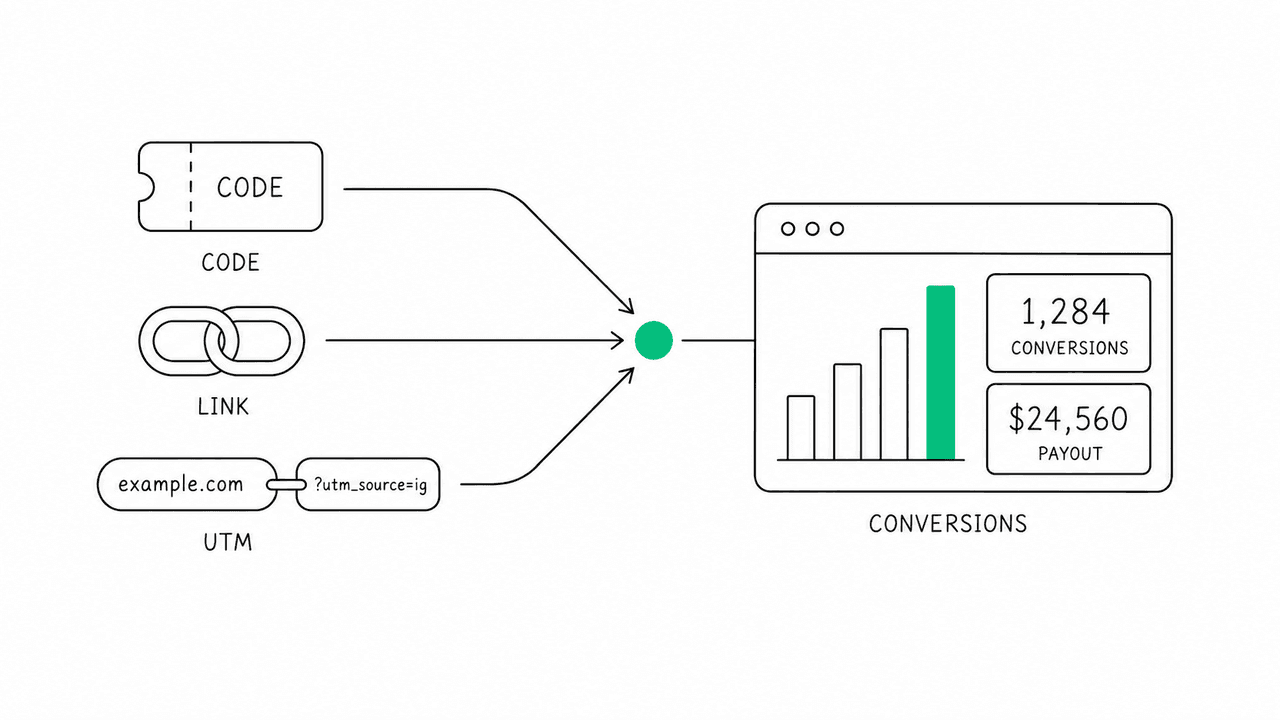
- Unique discount codes. The most reliable creator-attribution method, because it doesn't depend on cookies or click tracking at all. The buyer types the code at checkout, full stop. Codes survive cross-device journeys (someone sees the post on their phone, buys on their laptop) that break link tracking entirely. The downside is code leakage, codes get posted to deal sites, so use creator-specific codes and watch for volume that doesn't match the creator's reach.
- Trackable affiliate links. A unique link (through an affiliate platform, Shopify Collabs, or your own system) attributes the click and the resulting sale within a cookie window. Pair links with codes so you capture both the people who click and the people who remember the brand and search for it later.
- UTM parameters. Tag every creator link with UTM parameters (source/medium/campaign) so the traffic and conversions show up cleanly in your analytics. UTMs won't handle payment by themselves, but they give you the platform-by-platform and creator-by-creator picture you need to decide who to renew and who to drop.
Whatever you use, agree the attribution rules in writing before the campaign starts: the cookie window, how you handle a sale that used both a code and a link, and what happens to returns and refunds. Ambiguity here is where creator relationships go to die.
Where performance deals work best, and where they don't
Performance models aren't universally better, they fit some businesses far better than others. DTC ecommerce with healthy margins, a clear product, and a trackable checkout is the natural home: every element of the model lines up. SaaS works well too when the conversion event is clean (a paid sign-up, an install, a booked demo), which is why CPA bounties suit it and why we cover the creator-marketing angle specifically in our guide to influencer marketing for SaaS.
Performance deals fit poorly when the sales cycle is long and multi-touch (the creator drives interest but the sale closes months later through a different channel, and attribution collapses), when margins are too thin to fund a meaningful commission, or when your real goal is awareness rather than immediate conversion, in which case forcing a performance frame just guarantees creators ignore you. Brand-building and performance are different jobs; don't try to buy the first with the payment model designed for the second.
Common pitfalls
- Setting commissions too low. The fastest way to get zero good creators is to offer a rate that doesn't clear what they'd earn on a flat fee. Run the creator's math before you set the rate.
- Expecting pure performance from established creators. Top creators have flat-fee demand and won't gamble their time on your funnel. Offer hybrids, or fish in the nano/micro and affiliate-active pools where performance is normal.
- Sloppy attribution. Under-reporting sales, short cookie windows, and codes that don't track destroy the trust the whole model runs on. One creator who feels cheated tells the others.
- Treating it as set-and-forget. Performance programs need active management: identifying your top performers, raising their rates, giving them fresh creative angles, and cutting the dead weight. The winners deserve more attention, not less.
- Ignoring content quality. Because you're paying on results, it's tempting to stop caring how the content looks. Don't, the best-performing creator content also becomes your best paid-ad creative if you negotiate usage rights up front.
- Too small a roster. Performance is a portfolio. With only a handful of creators, one bad match tanks the whole program. Build enough breadth that the winners can carry it.
Getting started
If you're moving from flat-fee to performance, don't flip everything at once. Run a pilot: pick 15–25 well-matched, affiliate-active creators, offer a hybrid (modest base plus a generous commission and a customer discount code), set clean attribution with codes and UTM-tagged links, and a 60 to 90 day window. Measure conversion and cost-per-acquisition by creator, keep the winners, raise their rates, and rotate the rest. That loop, find, test, double down on what converts, is the entire discipline.
The hardest input is the first one: a roster of creators who are genuinely well-matched and open to performance terms. That's the part discovery software exists to solve, and it's where Influship focuses. If you're an early DTC or SaaS brand watching every dollar, performance-based deals are the lowest-risk way into influencer marketing, and our startup program and pricing are built for exactly that stage.
Sources and further reading
- Shopify — Ecommerce Conversion Rate Benchmarks (context for realistic conversion ranges on referred traffic).
- Influencer Marketing Hub — Influencer Marketing Benchmark Report (creator pricing, model adoption, and program benchmarks).
- Federal Trade Commission — Disclosures 101 for Social Media Influencers (disclosure rules apply to affiliate and commission deals too).
- Influship — Influencer Pricing Guide (what creators charge under traditional models).