Most product seeding fails before the package ever ships. Not because the product is wrong, or the creator is wrong, but because the first email reads like it was sent to 400 people, which it was. The creator deletes it in two seconds, and the whole program stalls at the inbox.
Product seeding is the strategy of sending free product to creators in the hope they post about it organically. It is one of the cheapest ways to get content, and one of the most ignored. The bottleneck is almost never the gift. It is the outreach sequence that gets a creator to say yes to the gift in the first place.
This post is the outreach half of the job: the emails you send before a relationship exists. Cold first contact, the seeding offer, the follow-ups, and the email that converts a happy gifted creator into a paid partner. If you want the note that ships inside the box once a creator has said yes, that is a different document, and we wrote it separately: influencer product gifting email templates. Treat the two as a pair. This one starts the relationship; that one warms the package.
Below are eight copy-paste templates with bracketed [tokens] you swap per creator, subject-line options for each, and notes on what actually moves reply rates. Everything is built around the FTC's position that gifted product is a material connection that has to be disclosed, so the gifting language here is written to keep you safe.
What product seeding outreach actually needs
Start with the definition, because the strategy changes the email. Influencer outreach is the umbrella term for contacting creators to start a collaboration. Product seeding is one flavor of it: you lead with a free product and no payment, betting that enough recipients post to make the math work. Paid outreach is the other flavor: you lead with a fee and a deliverable. The two need different emails because they make different promises. Seeding outreach is soft and low-ask. Paid outreach is specific and commercial.
Seeding outreach gets ignored for predictable reasons, and we have catalogued the failure modes in detail in why your influencer outreach gets ignored and how to fix it. The short version: low personalization (the email could be sent to anyone), no clear ask (the creator has to do work to figure out what you want), and a transactional tone that makes a gift feel like a contract. Fix those three and your reply rate roughly doubles.
Every seeding sequence is really just three emails wearing different hats:
- First contact — a soft intro that earns the open and proves you are real.
- The offer — the actual gifting proposal, with FTC-safe language and a one-step ask.
- The nudge — one or two short follow-ups for the 70% who do not reply to the first send.
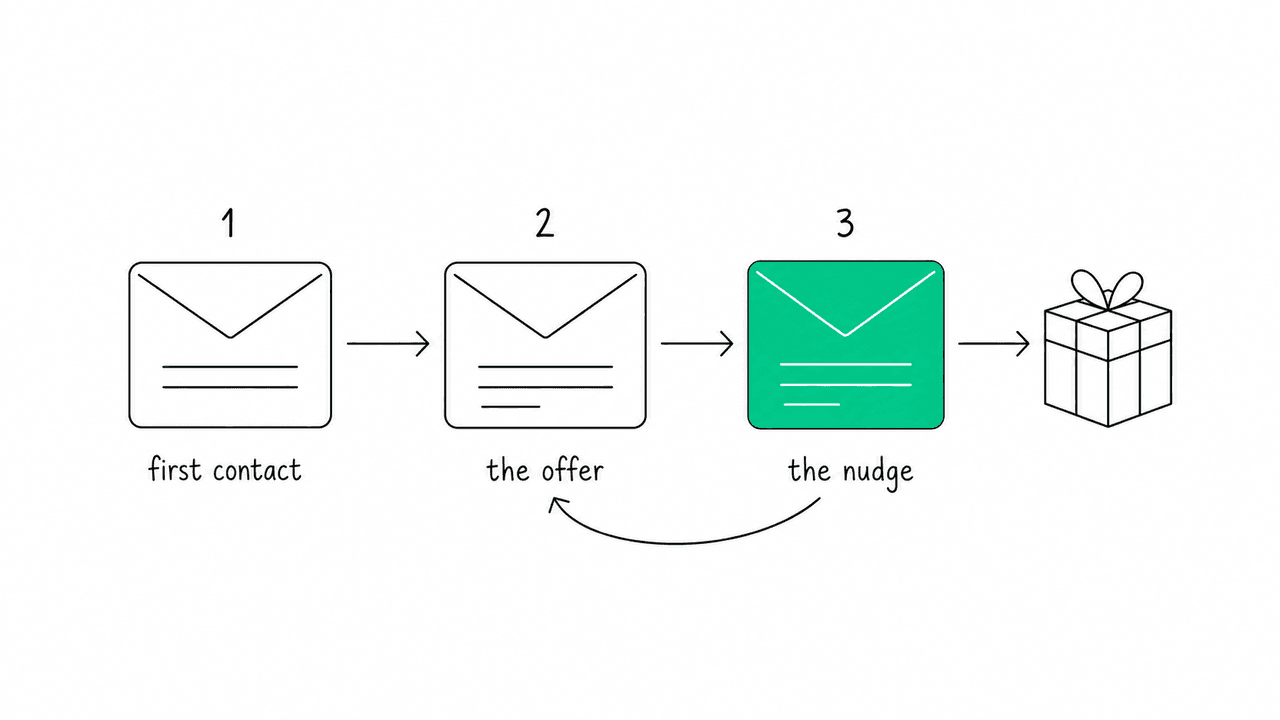
Everything else is a variation on those three. Here is each one as copy-paste text.
Template 1 — Cold first-contact email (the soft intro)
Use this when you have no relationship and you want to open a door without leading with the offer. It is deliberately light. You are testing for interest, not closing a deal.
Subject-line options:
Your [specific content reference]— references their actual work; highest open rate because it reads like a reply, not a pitch.Quick question, [First Name]— neutral and curiosity-driven; clears spam filters that "free" and "gift" trip.[Your Brand] x [Their Handle]?— signals a collaboration without committing to terms.
Hey [First Name],
I'm [Your Name] from [Brand] — we make [one-line product description].
Your [specific content piece, e.g. "reel on training around a desk job"] is exactly the kind of thing our [product] is built for, so I wanted to reach out directly rather than through a form.
Would it be alright if I sent you a couple of details about a collaboration? No pressure either way.
[Your Name]
Why it works: the one specific reference does the personalization work, the ask ("would it be alright if I sent details") is a yes/no that costs the creator nothing, and there is no link or attachment to trip a spam filter. You are asking permission to pitch, which is a smaller request than the pitch itself.
Skip this email when the creator publicly lists a gifting or collaboration inbox. If they have told you they accept pitches, go straight to Template 2 and save everyone a round trip.
Template 2 — The product-seeding offer email
This is the actual gifting proposal. Send it as the first email to creators who accept pitches, or as the reply when someone says yes to Template 1. The job here is to make accepting a free product feel easy and obligation-free while staying compliant.
Subject-line options: Sending you a [product]? / Re: [original thread] / Something I think you'll actually use
Hey [First Name],
Thanks for the reply. Here's the short version: I'd love to send you our [product] as a gift, on us, no payment and no posting requirement.
If you try it and want to share it with your audience, that would be wonderful, and all I ask is that you tag it as gifted (a #gifted or "thanks [Brand] for the gift" is enough to keep it above board). If it's not your thing, keep it with my compliments.
To get it out this week I just need a shipping address and your [size/shade/variant, if relevant]. Reply here and it'll be on its way.
[Your Name]
Why the disclosure line matters: the FTC's Endorsement Guides treat a free product as a material connection that has to be disclosed clearly and conspicuously whenever a creator posts about it. Setting the expectation in the offer email — gift first, disclosure if they post — protects both of you and signals you are a brand that knows the rules. It also genuinely raises reply rates, because removing the posting requirement removes the part creators dread.
Pair this with the in-box note. The card that ships with the package does the rest of the work: it thanks the creator, restates the disclosure, and gently opens the door to content. Do not cram that into this email. Use a dedicated gifting note template instead.
Template 3 — Follow-up #1 (the 3-day nudge)
Roughly 70% of creators will not reply to your first email. That is not rejection, it is an inbox. Send one short bump three days later, in the same thread so the context travels with it.
Subject: Re: [original subject]
Hey [First Name],
Floating this back up in case it slipped past — still happy to send a [product] your way, no strings. Just need an address.
[Your Name]
Why it works: it is under 30 words, it repeats the offer in one line so they do not have to scroll, and replying in-thread keeps the original pitch visible. Do not re-pitch from scratch and do not guilt-trip. "Just checking if you saw this" reads as passive aggression; "floating this back up" reads as human.
Template 4 — Follow-up #2 (the value-add breakup)
The second and final follow-up goes out four to five days after the first nudge. Two follow-ups is the ceiling for seeding — past that you are not persistent, you are a problem. Make the last one a soft breakup that leaves the door open.
Subject: Re: [original subject]
Hey [First Name],
I'll stop cluttering your inbox after this one. If the timing's off, no worries at all — the offer stands whenever you want it, just reply to this email and I'll ship the [product] same week.
Either way, genuinely a fan of your [content niche] stuff.
[Your Name]
Why it works: the breakup framing ("I'll stop after this") triggers a small loss-aversion reflex and often pulls a reply that two direct asks could not. The standing offer means a creator who reads it in three weeks can still convert with zero friction.
Template 5 — Converting a happy gifted creator to paid
This is the highest-value email in the sequence and the one most brands forget to send. A creator who posted about your product organically has already proven three things: they like it, they post well, and their audience responded. That is a warm lead for a paid partnership, and warm leads convert far better than cold ones.
Wait until they have posted something organically — even a Story — before you send this. Asking too early turns a gift back into a transaction.
Subject-line options: Loved your [product] post — idea / Working together more officially?
Hey [First Name],
Your [Story/post] on the [product] was genuinely great, and it performed — [specific signal, e.g. "a handful of people asked us where to buy it"].
Would you be open to doing something more structured? I'm thinking [deliverable, e.g. "one in-feed reel plus usage rights for 30 days"] at [rate or "a rate that works for you — what's your usual?"]. We'd put it in a short agreement so you're covered on usage and timing.
Happy to share more detail if you're interested.
[Your Name]
Why it works: it leads with their result, not your need, and it names a concrete deliverable so the creator can price it. Mentioning a short agreement up front signals professionalism — and you should actually use one. For the terms to put in writing (rate, usage, exclusivity, timeline), start from a micro-influencer contract template rather than a verbal handshake.
Template 6 — Micro and nano outreach (high-volume, lighter touch)
Nano and micro creators are the engine of most seeding programs: nano-influencer marketing runs on volume, and these creators usually accept product alone and post at higher engagement rates than their bigger peers. But you are emailing dozens at a time, so the touch has to be lighter while still feeling personal. Compress the first-contact and offer emails into one.
Subject: Your [specific post] + a [product]
Hey [First Name]!
Saw your [specific post] — loved it. I run [Brand] ([one-line product]). Would you want one to try, on us? No payment, no posting required; just tag it gifted if you do end up sharing.
Reply with an address and I'll send it out this week.
[Your Name]
Why it works: one specific reference, the whole offer in three sentences, the disclosure baked in, and a one-step ask. At this volume the personalization token (the specific post) is the only thing standing between you and the delete key, so never skip it — a fake "love your content" is worse than nothing. For finding these creators at scale, our guide to finding micro-influencers covers the sourcing side.
Personalization tokens and a subject-line bank
Every template above uses bracketed tokens. Here is what each one means and where to find it.
| Token | What to put there | Where to find it |
|---|---|---|
[First Name] | The creator's actual first name, not their handle | Bio, link-in-bio page, or their about section |
[specific content reference] | One real post, reel, or video you watched | Their recent grid — pick something from the last two weeks |
[one-line product description] | What you make, in plain words, no jargon | Your own positioning — keep it under 12 words |
[size/shade/variant] | Any choice the creator needs to make for shipping | Your SKU list — only ask if it is genuinely needed |
[content niche] | Their lane: fitness, skincare, home cooking, etc. | Their bio and the through-line of their last 9 posts |
[specific signal] | A concrete result from their gifted post | Comments, your own traffic/DMs, a discount-code spike |
The subject-line bank. Subject lines decide whether the email is read at all. These ten are ordered roughly from highest to lowest reply rate in seeding outreach, with the reasoning.
Your [specific post]— reads like a reply to their own content; near-impossible to ignore.Quick question, [First Name]— curiosity plus a name; clears spam filters.Sending you a [product]?— the offer as a question feels like a favor, not a pitch.[Your Brand] x [Their Handle]?— signals collaboration without naming terms.Something I think you'll actually use— specific and slightly self-aware.Loved your [topic] post — idea— leads with a compliment they can verify.For your [niche] audience— frames the product around their people, not yours.No-strings [product] for you— works only if "product" is a normal word (avoid for anything spammy).Re: [original subject]— for follow-ups; keeps the thread and context intact.One more thing— for the breakup follow-up; low-pressure, high open rate.
Two subject lines to never use: anything with "FREE" in caps (instant spam folder) and anything with "collab opportunity" (the most-deleted phrase in creator inboxes).
Outreach metrics to track
Seeding has its own funnel, and the only way to fix a leak is to know which stage is leaking. Track four numbers.
- Reply rate — replies divided by emails sent. Cold, well-targeted, personalized seeding outreach lands in roughly the 30-50% range; if you are under 20%, the problem is personalization or product-creator fit, not the template. For context, generic mass sales outreach averages far lower — HubSpot's cold email research puts typical cold-email reply rates in the low single digits, which is exactly why the personalization above matters.
- Gift-acceptance rate — of those who reply, how many give you an address. Healthy programs see most repliers accept; a low number means your offer email is asking for too much or feels transactional.
- Gift-to-post conversion — of those who receive product, how many post organically. Expect roughly 20-30% on cold seeding. This is the number that tells you whether your product-creator fit is real.
- Gifted-to-paid conversion — of creators who posted, how many you turned into paid partners with Template 5. This is where seeding pays for itself.
The pattern to watch for: high reply rate but low gift-to-post conversion means you are good at outreach but sending to the wrong creators. High gift-to-post but low reply rate means your fit is great but your emails are not landing. Each leak has a different fix.
How to send these at scale
Done manually, seeding outreach is a grind: find a creator, verify they fit, find a real personalization detail, write the email, log it, follow up on a schedule. The writing is the easy part — these templates handle that. The expensive part is the finding and the qualifying, which is where most programs quietly die.
That is the part to systematize. The bottleneck in seeding is rarely "what do I say," it is "who do I say it to, and is the personalization token even true." You need to source creators who match your product, confirm their audience and engagement are real before you spend a package on them, and pull the specific content detail that makes the email land.
This is exactly what Influship's influencer discovery is built for: search creators in plain language, filter by audience and engagement, and qualify fit before a single email goes out — so the volume you send is volume worth sending. If you want to see it run against your own product and audience, book a demo and we'll walk through sourcing a seeding list live.
For more outreach-adjacent copy — briefs, pitches, follow-ups, and the rest of the program — our influencer marketing templates collection has the full set.
Frequently asked questions
How long should an influencer outreach email be? Short. Aim for 40-90 words for cold first contact and the offer, and under 30 for follow-ups. A creator decides whether to reply in the time it takes to read the first two sentences, so the whole email should be readable in about ten seconds. Long, multi-paragraph pitches with bullet points read as automated and get deleted.
Should I offer payment or free product first? Product first, for most creators under about 100K followers. Leading with a no-strings gift gets a higher reply rate than leading with money, because it removes the negotiation and the obligation. Save paid offers for creators who have already posted about you organically (use Template 5) or for larger creators who explicitly expect payment. Seeding is the cheap, warm top of the funnel; paid is the conversion.
How many follow-ups before I stop? Two, maximum. One nudge three days after the first email, one soft breakup four to five days after that. Past two follow-ups you stop being persistent and start being a nuisance, and you risk getting marked as spam, which hurts your sending domain. If a creator has not replied after two follow-ups, move on; the standing offer in Template 4 means they can still come back on their own.
DM or email for outreach? DM for creators under about 50K who do not list a business email; email for larger creators, anyone with a manager, and any time you want a paper trail. DMs need to be even shorter than emails (under 50 words, no links in the first message) and the creator can check your profile to verify you are real, which raises trust. Whichever channel you use, the rules are the same: one specific reference, a one-step ask, and FTC-safe gifting language.
Sources and further reading
- Federal Trade Commission, "Disclosures 101 for Social Media Influencers" — the official guidance on disclosing gifted product and other material connections. ftc.gov
- Federal Trade Commission, "The FTC's Endorsement Guides: What People Are Asking" — detail on what counts as a material connection. ftc.gov
- HubSpot, cold email benchmarks and best practices — context on baseline reply rates for cold outreach. blog.hubspot.com
- Influship, "Why Your Influencer Outreach Gets Ignored (and How to Fix It)" — reply-rate failure modes referenced throughout. influship.com