You do not need a five-figure budget to run influencer marketing. The belief that you do is the single most expensive myth in the space, because it pushes founders to either overpay one macro creator or skip the channel entirely. Both are mistakes. The lowest-cost tier of creators is also the highest-converting one, which means a startup with $500 can run a real campaign and outperform a competitor who spent $5,000 badly.
This is a playbook, not a pep talk. It is built around three levers that cost almost nothing upfront: product seeding, a nano-influencer strategy, and affiliate-first deals where no money leaves your account until a sale happens. Then it ends with a literal $500 allocation table you can copy, plus a $0 version and a $1,000 step-up.
It is written for startups, small businesses, bootstrapped DTC brands, and solo founders who are doing this themselves with no agency and no retainer. If that is you, the constraint is not your budget. It is knowing which tactics give you the most output per dollar. Here they are.
Why a small budget is an advantage, not a handicap
Influencer marketing is not pay-to-play with macro creators. The data has been pointing the other way for years. Nano influencers, creators with roughly 1,000 to 10,000 followers, post the highest engagement rates of any tier and convert better per dollar. According to Influencer Marketing Hub's benchmark data, nano creators on TikTok average around a 10.3% engagement rate versus roughly 7.1% for mega-influencers, and on Instagram nanos average about 2.71% versus roughly 1.2% for mega accounts.
That gap is not a rounding error. It is the whole reason a small budget works. A nano recommendation reads like a friend's, not an ad, so the audience that sees it is more likely to act. We broke the engagement and conversion data down in our nano-influencer marketing guide, and the tradeoff between reach and conversion is the core of our macro vs. micro influencer comparison. The short version: when your budget is small, you should be buying conversions, and nanos are where conversions are cheapest.
The three near-free levers this guide covers all exploit that advantage. Seeding gets you authentic content for the cost of product. A nano strategy gets you cheap, high-trust reach at volume. Affiliate-first deals shift your risk to zero by paying only on results. Run all three together and $500 goes a long way.
Lever 1: Product seeding (gifting)
Product seeding means sending creators free product with no payment and no guaranteed post. You ship, they receive, and they decide whether to share. People use "seeding" and "gifting" interchangeably, but there is a useful distinction: gifting is the one-off act of sending product, while seeding is the strategy of doing it at volume to build a content pipeline. "Influencer seeding" pulls around 260 monthly searches and "influencer gifting" around 320, per Semrush, so plenty of brands are looking for exactly this play.
Why it works on a budget: your only hard cost is COGS. If your product costs you $8 to make and retails at $40, you are buying a shot at a piece of user-generated content for $8. Even at a modest post rate, the cost per UGC asset stays low, and that content is reusable in ads, on your product pages, and across your own social.
How to run a seeding campaign
Pick 15 to 30 creators who are a genuine fit for your niche. Send each one a personalized note (not a templated mass-blast), a simple brief card in the box with suggested hashtags and a unique discount code, and clear expectations: there is no obligation to post, but make posting as easy as possible. The goal is to remove every excuse not to share. Our product gifting email templates give you the outreach scripts, and the brief card should be a one-page version of a real influencer brief.
Set realistic expectations on output. A typical seeding campaign sees roughly 20% to 40% of seeded creators actually post, depending on fit and how easy you made it. You lift that rate by choosing creators who already post about your category, including a discount code they can share with their audience (it gives them a reason and a benefit), and following up once with a friendly check-in rather than a demand. Do not chase. The creators who were going to post will post.
Lever 2: A nano-influencer strategy
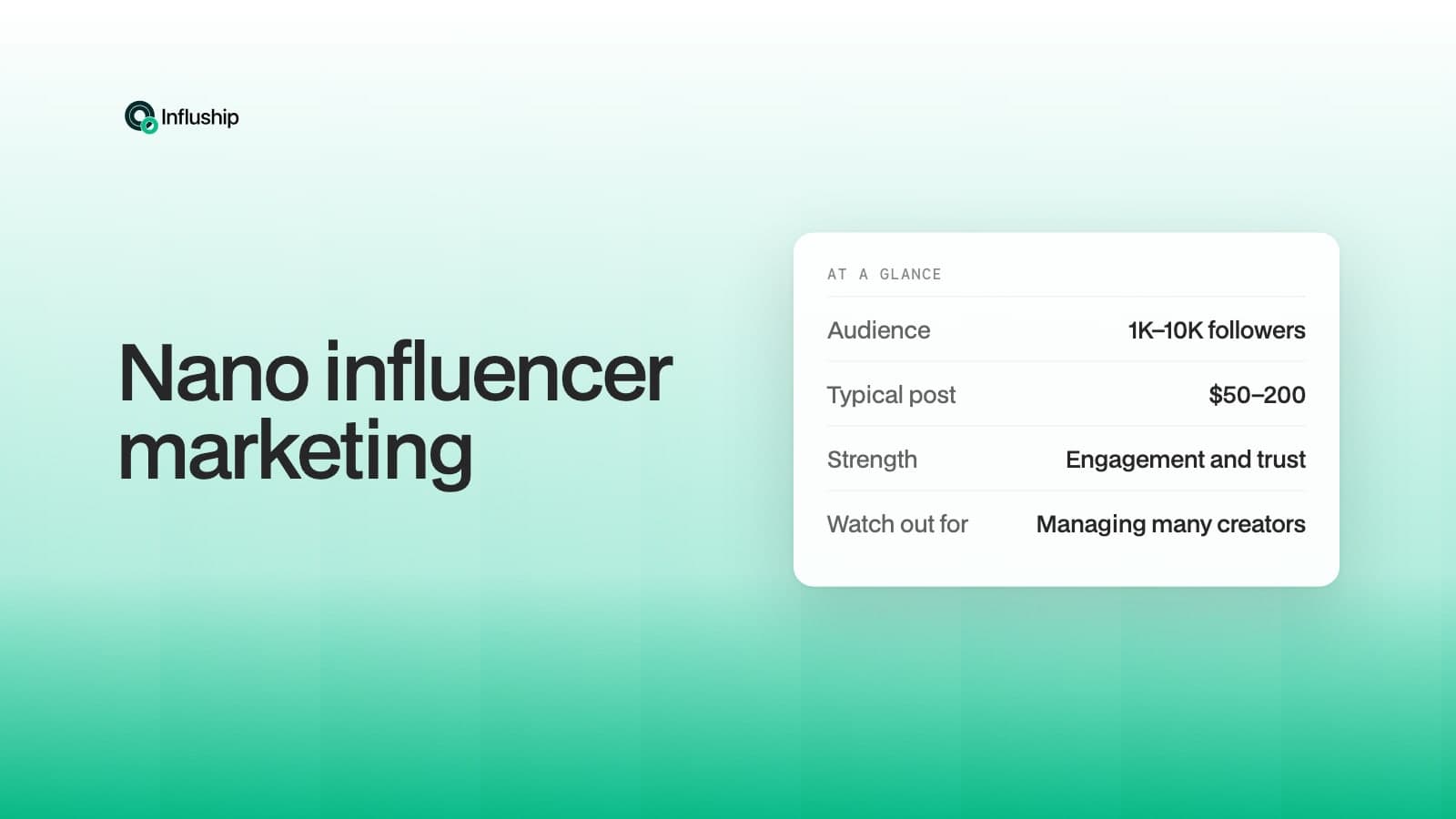
Nano influencers are creators with 1,000 to 10,000 followers. They convert because they have high trust and high engagement, and many will post for product alone or a small fee. For a small business, this is the single best tier to build a program around, because the economics let you run a portfolio instead of a single bet.
Sourcing nanos on a budget
Start with people who already like you. Your own customers and followers are the highest-converting nanos you will ever find, because they have used the product and their recommendation is real. Check your tagged posts, brand mentions, and reviews for anyone in the 1k to 10k range who creates content about your category.
From there, expand with hashtag and location search. On Instagram, browse niche hashtags with 10,000 to 500,000 posts under the "Recent" tab to surface active small creators; if you run physical locations, search local geotags. This is free but slow. To move faster without hiring an agency, use AI semantic discovery to describe the exact creator you want in plain language and get a vetted shortlist. Our influencer discovery tool indexes creators down to the nano range, and the find micro-influencers use case walks through the workflow. AI discovery matters more for small budgets, not less, because you cannot afford to waste outreach on bad-fit accounts.
Volume beats prestige
The core move is a portfolio approach. For the same spend, 20 nanos beat 1 macro. Some posts will flop, some will overperform, and the aggregate is more predictable and more resilient than a single concentrated bet. You also walk away with 20 pieces of content instead of one, and 20 audience pockets instead of one. When your budget is tight, spreading it across many small, trusted creators is the lower-variance, higher-output choice.
Lever 3: Affiliate-first deals (pay only on results)
The cheapest deal structure of all is one where $0 leaves your account until a sale happens. Instead of a flat fee, offer creators a commission and a unique discount code. They earn when they drive purchases, and you spend only against revenue. "Influencer affiliate marketing" is a well-trafficked search (around 320 monthly searches), and for a startup it is the most budget-safe model that exists. For the full mechanics, see our deep dive on performance-based influencer marketing.
The tooling does not have to be expensive. You need three things: a way to track sales (unique per-creator discount codes are the simplest, free option), unique affiliate links with UTM parameters so you can attribute traffic, and a clear commission rate. Many ecommerce platforms have free or low-cost affiliate apps; if you are pre-platform, a spreadsheet plus codes works until you outgrow it.
The best version combines this with seeding: gift first, and after a creator posts something good, convert them to an affiliate. Now you have proof they can produce, and an ongoing revenue-share relationship instead of a one-off transaction. That is how a $500 campaign turns into a self-funding channel.
The $500 allocation (the money table)
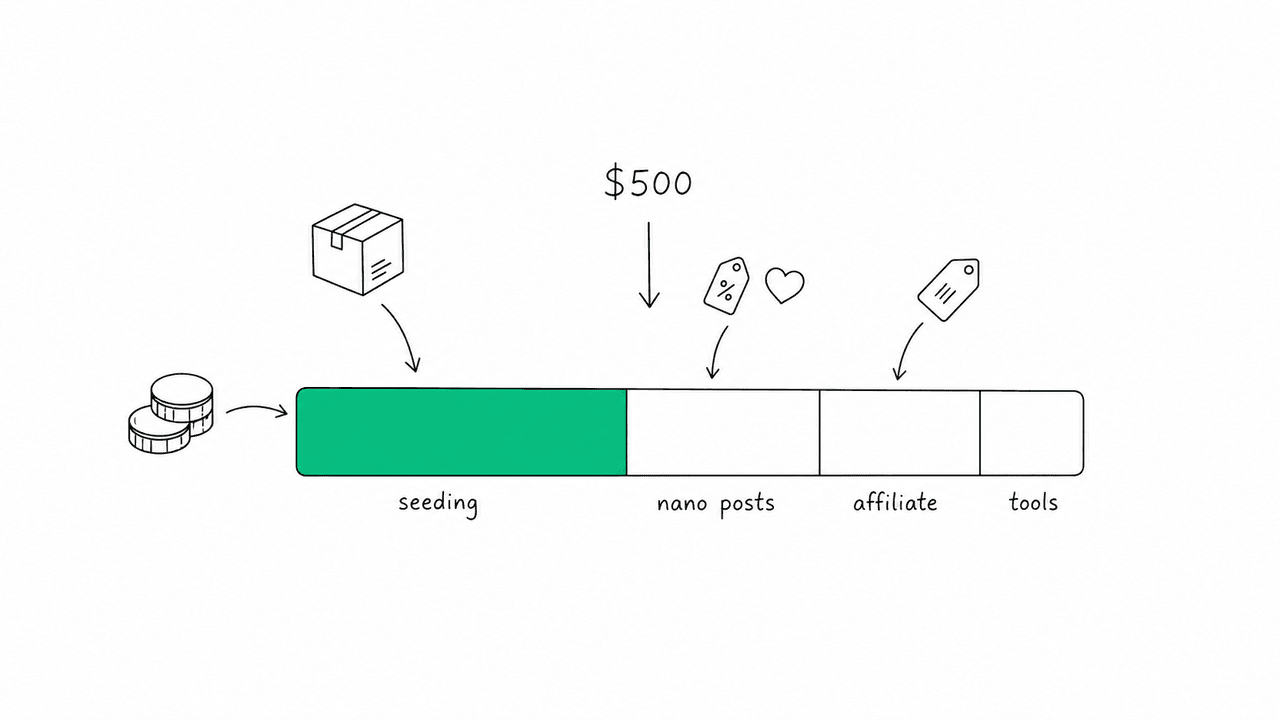
Here is a concrete way to spend exactly $500 across the three levers. Adjust the numbers to your COGS and niche, but the shape holds: most of your budget should buy content and reach, a slice should fund a couple of guaranteed posts, and a reserve should sit ready for affiliate payouts.
| Allocation | Amount | What it buys |
|---|---|---|
| Product / COGS for seeding | $150 | Seed ~20 nano creators (assumes ~$7.50 COGS each) |
| Paid nano posts | $200 | 3 guaranteed posts at $50–75 each, with set dates and messaging |
| Affiliate commission reserve | $100 | Pay only on sales; refills itself as revenue comes in |
| Tools & shipping | $50 | Postage, discount-code app, UTM tracking |
A realistic scenario: 20 seeded creators yield 6 to 8 organic posts (a 30% to 40% post rate), the 3 paid posts land on schedule, and the affiliate codes drive a trickle of attributable sales. You end the month with roughly 10 pieces of content, a handful of trusted relationships, a content library for ads, and a few affiliate creators who keep selling for you with no further upfront spend.
The $0 (pure sweat) version
With no budget, lean entirely on seeding-by-relationship and affiliate-first deals. Reach out to existing customers who already post, offer affiliate codes with a strong commission, and send product only to the few highest-fit creators. Your cost is COGS on a handful of units plus your time. It is slower and lower-volume, but it is real, and it proves the channel before you put a dollar behind it.
The $1,000 step-up
Double the budget and you do not double the creators; you upgrade quality and add tracking. Seed 30 instead of 20, move your best performers from gifting to paid ($75–150 each), raise the affiliate reserve to $250, and spend a little on a discovery tool subscription so sourcing stops eating your week. This is also the point where converting nano UGC into paid ad creative starts to pay for itself.
Measuring on a budget
You can measure a small campaign with free tools. Unique discount codes tell you which creators drove sales. UTM-tagged links show traffic in your analytics. Native platform insights (Reels plays, Story taps, saves) tell you which content resonated. You do not need an enterprise dashboard to know what worked.
At this spend, "good" looks like a low cost per post, a low cost per reusable UGC asset, and a steady stream of code redemptions. Track those three and you will know within a month whether to scale. One caution: do not pay for inflated audiences. Run any creator you are about to pay through a quick audience check first. Our real audience size calculator and our guide on how to detect fake followers exist precisely so a small budget does not get wasted on a creator whose 8,000 followers are mostly bots.
Avoiding the budget-killer mistakes
Most failed small-budget campaigns fail the same handful of ways. Overpaying for follower counts (vanity over engagement) burns your budget on reach that does not convert. No tracking means you cannot tell a winning creator from a dud, so you cannot reinvest. Treating partnerships as one-and-done instead of building relationships throws away the compounding value of repeat, increasingly authentic posts.
Two compliance mistakes can cost more than your whole budget. Ignoring FTC disclosure is one: gifted product counts as a material connection, so every post (paid or gifted) needs clear disclosure like #ad. Many nanos are new to brand deals and will not know this, so spell it out in your brief. See our breakdown of the FTC influencer marketing guidelines. The other is having no agreement at all, even for gifting. A one-page deal that covers deliverables, usage rights, disclosure, and timing protects you and reads as professional. Use our free influencer marketing contract builder to generate one in a couple of minutes. For benchmarking what a fair nano fee actually is, keep our influencer pricing guide handy, and if you plan to scale sourcing with automation, our AI influencer discovery primer covers the tooling.
Frequently asked questions
Can you do influencer marketing with no money?
Yes. Product seeding (sending free product, no payment) and affiliate-first deals (commission only) let you run real campaigns with essentially no upfront cash beyond COGS. You trade money for time and relationships. It is slower than a funded campaign, but it works, and it is the right way to validate the channel before you spend.
How much should a startup spend on influencer marketing?
Start small and let results dictate the budget. $500 is enough to seed 20 creators, fund a few paid nano posts, and hold an affiliate reserve. If the codes and UTM links show a positive return, step up to $1,000 and reinvest revenue. There is no minimum that locks you out; there is only the discipline to measure and scale what works.
What is the cheapest type of influencer marketing?
Gifting combined with nano influencers is the cheapest model that still drives results. Your cost is product, not fees, and nanos deliver the highest engagement and conversion per dollar. Layer affiliate codes on top and you spend almost nothing until a sale happens.
Do nano-influencers work for small businesses?
They are the best fit for small businesses, full stop. Nanos are affordable, they convert at higher rates than larger tiers, and they are happy to work for product or small fees. A local or niche small business can build an entire program on nanos and never touch a macro creator.
Recap and next steps
Three levers, almost no upfront cost: seed product to nano creators for authentic content, run a nano-first strategy for cheap high-trust reach, and structure deals as affiliate-first so you pay only on results. Put $150 toward seeding, $200 toward a few paid nano posts, $100 in an affiliate reserve, and $50 on tools and shipping, and you have a complete $500 campaign. As it works, reinvest revenue and step up.
When you are ready to find on-niche nano creators without burning a week on manual search, start with AI-powered influencer discovery, and if you are building this as a young company, our startups page lays out how Influship fits a lean team. Want a walkthrough on your own niche? Request a demo or see pricing.
Sources and further reading
- Influencer Marketing Hub, Influencer Marketing Benchmark Report (nano vs. mega engagement-rate benchmarks).
- Federal Trade Commission, Disclosures 101 for Social Media Influencers (material connection and disclosure rules for gifted product).
- Semrush keyword data: "influencer seeding" (~260/mo), "influencer gifting" (~320/mo), "influencer marketing for startups" (~170/mo).
- Influship, Nano Influencer Marketing Guide (post-rate, conversion, and pricing benchmarks).
- Influship, Influencer Pricing Guide (nano and micro rate cards by platform).