Most influencer outreach fails before the first email goes out. The list is wrong, the contact is wrong, or the pitch is the same thing every other brand sends. Then the marketer blames the template.
Outreach is the step between having a creator list and having a signed deal, and it is the most neglected part of the whole funnel. Teams spend weeks on discovery, then fire off a generic blast and wonder why nobody replies. The average cold outreach reply rate sits around 8.5%. Top performers hit 15-20%. That gap is not luck. It is process.
This is the end-to-end playbook: how to build a list worth contacting, how to find the right email or DM, the four-touch sequence that gets replies, six copy-paste templates by scenario, the tools that scale it, and the response-rate benchmarks you should track. If you want the short formal definition first, see the influencer outreach glossary entry. If your replies are already low and you want a diagnostic, read why your outreach is being ignored. This guide owns the system. That post owns the troubleshooting.
One number to keep in mind the whole way through: creators with 50K-plus followers receive roughly 20-40 brand pitches a week, and most go unread. You are not competing for attention in a quiet inbox. You are competing in a loud one. Everything below is about earning the open and the reply in that context.
What influencer outreach actually is (and where it fits)
Influencer outreach is the act of contacting creators to start a partnership conversation. It sits between influencer discovery (you have a shortlist) and the partnership itself (you have a brief, terms, and a signed agreement). Discovery answers who. The deal answers what and how much. Outreach is the bridge, and it is where most programs leak.
The reason it gets neglected is that it feels like grunt work. Finding emails, writing personalized notes, following up on a schedule. None of it is glamorous. But it is the single highest-leverage step you control. A great list reached badly produces nothing. A great list reached well books partnerships.
Step 1 — Build a targeted list before you write a word
Your reply rate is capped by your list quality. Fifty well-matched creators beat five hundred random ones, every time. Volume is a tax: more sends, more burned contacts, more spam complaints, a lower sender reputation. Precision is the opposite. Fewer sends, higher relevance, more replies.
Qualify every creator against five filters before they earn a spot on the list:
- Audience overlap. Does their audience actually match your buyer? A fitness creator with a teenage audience is wrong for a $200 supplement.
- Engagement rate, not follower count. A creator with 30K followers and 6% engagement will usually outperform one with 300K and 0.8%. Judge engagement against the tier, since it falls as audiences grow. See macro vs micro influencers for where the tiers sit.
- Recent posting cadence. A creator who posts twice a month is a slow, unreliable partner. Look for consistency in the last 30-60 days.
- Brand safety. Scan recent content for anything that clashes with your brand. One bad post can sink a partnership before it starts.
- Audience authenticity. Bought followers and engagement pods waste your budget. Learn the signals in how to detect fake followers.
Building a vetted shortlist by hand is slow. Influship runs semantic search over creators and returns a match score with reasons, so you can go from a plain-English brief to a qualified list fast. That is the discovery step done right, and it makes everything downstream easier. If you are starting from zero, the broader guide to finding influencers for your brand and the find micro-influencers use case cover sourcing in depth.
Step 2 — Find the right contact (email or DM)
Finding the actual contact is the hardest practical blocker in outreach. A perfect pitch sent to a dead inbox is worthless. Work through these in order:
- Instagram business email. Tap the profile, then the Email or Contact button on a creator or business account. That address is there precisely for brand inquiries.
- Link in bio. Linktree, Beacons, and Stan pages often list a dedicated business email or a management contact alongside the social links.
- YouTube About tab. Open the channel, go to About, and look under Business inquiries (sometimes behind a captcha to reveal the email).
- Media kit. Mid-tier and larger creators publish a media kit with rates and a contact, often linked in the bio or available on request.
- Management and agency lookups. If a bio reads "repped by" or lists a talent agency, email the manager, not the creator's personal account.
The decision rule: for nano and micro creators (under ~50K), a thoughtful DM usually beats email. They run their own accounts and check DMs. For mid-tier and macro creators with management, email the manager. DMs to a large account get buried, and managers expect deal conversations over email.
Doing this by hand for fifty creators takes hours. Contact-data tooling surfaces verified emails at scale, which is where the tool stack in Step 6 comes in.
Step 3 — The outreach sequence that gets replies (4 touches)
This is the core of the whole system. One email almost never lands. Most replies come on the second or third touch, not the first. The trick is to follow up without nagging, and to add value each time instead of repeating "just bumping this." Run a four-touch sequence, then stop.
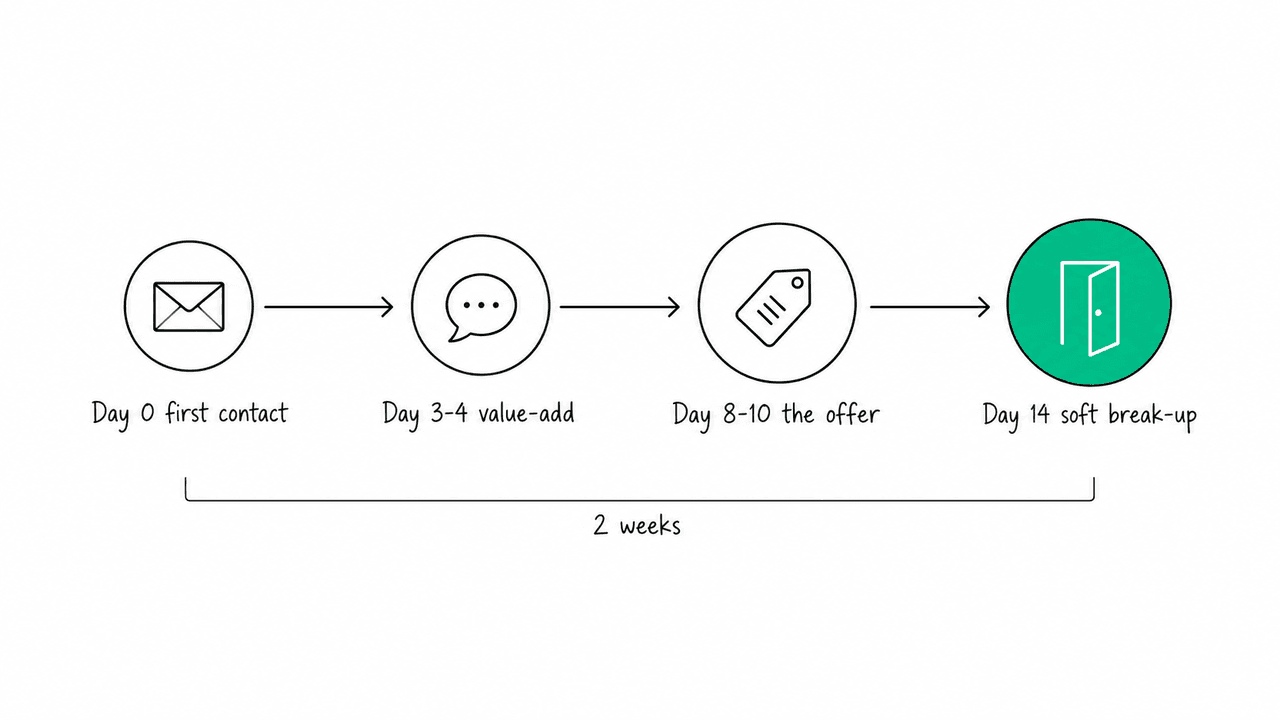
- Touch 1 — Day 0: the personalized first contact. Reference one specific thing about their content, say who you are in one line, and make a small, clear ask. No attachments, no pitch deck, no wall of text.
- Touch 2 — Day 3-4: the value-add bump. Reply to your own thread with something useful, not a guilt trip. A second specific reference, a relevant detail, or a one-line clarification of what is in it for them.
- Touch 3 — Day 8-10: the offer. Get concrete. Compensation range, deliverables, timeline. Vague pitches get ignored. Specific offers get a yes or a counter.
- Touch 4 — Day 14: the soft break-up. "Totally understand if the timing is off, I'll close this out on my end, but the door is open if you'd ever like to revisit." Break-up emails reliably surface replies from people who meant to respond and forgot. Then stop.
Touch quality beats volume, and the personalization data proves it. Outreach with no personalization replies at about 9%. Adding the creator's name lifts it to roughly 14%. Referencing something specific about them pushes it to around 18% — double the no-personalization baseline. Every touch should feel written for one person.
On timing and channel: send Tuesday through Thursday, mid-morning in the creator's time zone, and avoid weekends. For higher-value targets, an email-then-DM combo works well — email first, then a short DM a day later pointing to it ("just sent you a note, would love your take"). Never mass-blast an identical message to a list. It is the fastest way to torch your reputation and your deliverability.
How many follow-ups is too many?
Three to four touches total, then move on. Past that you are not persistent, you are annoying, and you are burning a contact you might want next quarter. If four well-timed, personalized touches get no reply, the answer is no for now. Re-add them to a future campaign instead of pushing.
Step 4 — Copy-paste outreach templates (by scenario)
These are starting points, not scripts. Swap every token in brackets for real detail — the bracketed placeholders are the whole point, and a template sent with them still in it is worse than no template at all. Use the one that matches your scenario.
Cold email — paid collaboration pitch
Your default for a paid partnership with a mid-tier creator or their manager.
Subject: Paid collab with [Brand] — [specific_post] caught our eye
Hi [first_name],
I'm [your_name] at [Brand]. Your [specific_post, e.g. "reel on training for a first half-marathon"] was exactly the kind of practical content our audience responds to.
We're running a paid campaign for [product] and I'd love to include you. [value_prop — one line on why it fits their audience.] Budget is real and flexible, and you keep full creative control.
Open to a quick call this week, or I can send specifics over email — whichever is easier. Worth a conversation?
[your_name]
When to use: first contact for a paid deal. It leads with a specific reference, names a real budget, and promises creative control — the three things creators say they want most.
Product gifting / seeding email
Gifting is its own discipline because the winning move is to ask for nothing. A no-strings offer gets 3-4x the reply rate of a transactional "free product for a post." The short version of the opener:
Hey [first_name],
I'm [your_name] from [Brand] — we make [one-line product]. Saw your [specific_post] and thought you'd genuinely like our [product]. Would love to send you one, no strings. Want me to ship it? Just reply with an address.
When to use: seeding to nano and micro creators where you're building relationships, not buying posts. For the full set of gifting templates — the follow-up, the influencer-marketing-platform invite, the re-engagement note — use the dedicated product gifting email templates.
Instagram DM — micro-influencer
DMs win for smaller creators who run their own accounts. Keep it short and human.
Hey [first_name]! Loved your [specific_post] — [one genuine, specific detail]. I run partnerships at [Brand] ([one-line product]) and think you'd be a great fit for something we're planning. Mind if I send a few details? 🙌
When to use: first contact with a nano or micro creator on Instagram or TikTok. The ask is tiny — permission to send details — which is far easier to say yes to than a full pitch.
Follow-up / bump template
Touch 2 in the sequence. Add value, never guilt.
Hi [first_name],
Following up in case my note got buried. One more reason I think this fits: [specific_reason tied to their content or audience]. Happy to send full details whenever you have a minute — no rush.
[your_name]
When to use: 3-4 days after first contact. Reply on the same thread so the original message is visible.
Affiliate / commission offer
For performance-led partnerships where the creator earns on what they drive.
Hi [first_name],
[your_name] from [Brand]. Your audience trusts your [niche, e.g. "skincare"] recommendations, which is why I wanted to reach out. We run an affiliate program paying [X]% per sale with a [Y]-day cookie, plus a custom code for your audience. Top partners earn [realistic_range]/month. Want me to set you up?
[your_name]
When to use: creators with high purchase intent who prefer upside to a flat fee. Be honest about realistic earnings — inflated numbers kill trust fast.
Long-term ambassador invite
For creators you've already worked with once and want to retain.
Hi [first_name],
Working with you on [past_campaign] was easily one of our best collabs — [specific_result, e.g. "your reel drove our highest-converting day"]. We're building a small ambassador group and you're at the top of the list: [perks — retainer, early access, affiliate stack]. Would you want in?
[your_name]
When to use: turning a one-off into an ongoing relationship. See the brand ambassador program guide for structuring perks and terms.
Whenever a template mentions sponsored content, gifting, or affiliate codes, the partnership needs a clear disclosure. Cover it up front so it never becomes a surprise — see the FTC influencer marketing guidelines.
Step 5 — Negotiation and moving to a deal
A reply is not a deal. When a creator answers, move fast and stay specific. Acknowledge their interest, then get to terms: deliverables, timeline, usage rights, and price. On price, ask for their rate before you name yours — you'll often anchor lower than you feared, and you avoid overpaying. If you need a reference for what is fair, the influencer pricing guide breaks down rates by tier and platform.
Once terms are agreed, send the brief so the creator knows exactly what good looks like — the influencer brief and the more detailed campaign brief guide show how to give structure without killing creativity. Then lock it down in writing. Use how to write an influencer contract and the free contract builder so deliverables, payment, and usage are unambiguous before anyone starts filming.
Step 6 — Tools to scale influencer outreach
At ten creators you can run outreach in a spreadsheet and your inbox. At a hundred, you need tooling. Think in categories, not just brands, because most teams need two or three of these working together:
- Discovery + contact platforms find creators and surface their contact info. This is the top of the funnel — get the list and the emails right.
- Outreach / CRM tools handle sequencing, follow-up reminders, and reply tracking so nobody falls through the cracks. See what an influencer CRM does.
- Email finders specialize in verified contact data when a platform doesn't surface it.
- All-in-one platforms bundle discovery, outreach, payments, and reporting in one place, usually at a higher price point.
The well-known names — Modash, Upfluence, Grin, Insense — each lean into different parts of this. Modash is strong on discovery data, Grin and Upfluence on full campaign management for larger teams, Insense on UGC and paid amplification. For a category-by-category breakdown, see the best influencer marketing tools.
Influship's edge is that the two steps where outreach actually breaks — building the list and finding the contact — live in one flow. AI semantic discovery, contact data, match scoring with reasons, and a lightweight CRM in a single tool, so you aren't stitching three subscriptions together. If you're weighing it against an incumbent, the Influship vs Modash comparison lays out the trade-offs.
Step 7 — Track the right metrics
You can't improve outreach you don't measure. Track four numbers per campaign: open rate, response rate, positive-reply rate, and cost-per-booked-creator. Response rate is the one that diagnoses what's broken:
- Above 20%: warm outreach, or excellent cold targeting. Keep doing exactly this.
- 10-20%: solid cold outreach. This is the realistic ceiling for most cold programs.
- 5-10%: messaging problem. Emails are opening but not getting answered — tighten personalization and the ask.
- Below 5%: targeting problem. You're reaching the wrong creators or the offer doesn't fit. Fix the list before you touch the copy.
If your replies are stuck below the benchmark, the full diagnostic lives in why your influencer outreach is being ignored — it walks through each failure mode in detail. This guide owns the process; that post owns the troubleshooting.
Common influencer outreach mistakes
- Mass-blasting. One identical message to a list tanks your reply rate and your sender reputation.
- No follow-up. Most replies come on touch two or three. Stopping at one leaves the majority of your wins on the table.
- Pitching before qualifying. Reaching out to creators you haven't vetted wastes everyone's time.
- Ignoring management contacts. DMing a macro creator's personal account instead of their manager gets you buried.
- Leading with the ask. Open with what's in it for them, not what you want from them.
- No tracking. Without response-rate data you're guessing at what to fix.
Frequently asked questions
What is influencer outreach?
Influencer outreach is the process of contacting creators to start a partnership conversation — by email or DM — between discovery (you have a shortlist) and the signed deal. Full definition in the glossary.
How do you do influencer outreach?
Seven steps: build a vetted, well-matched list; find the right email or DM; run a four-touch sequence with rising specificity; send a personalized, scenario-fit pitch; negotiate to terms and a brief; scale with discovery and CRM tooling; and track response rate to diagnose what to fix.
What's a good influencer outreach response rate?
Average cold outreach replies at about 8.5%. Solid cold programs run 10-20%, and top performers hit 15-20%. Above 20% usually means warm outreach or excellent targeting. Below 5% points to a targeting problem.
Email or DM for influencer outreach?
DM nano and micro creators (under ~50K) who run their own accounts — they check DMs and reply faster. Email mid-tier and macro creators with management, and email the manager directly, not the personal account.
How many follow-ups should you send?
Three to four touches total, then stop. Most replies arrive on touch two or three. Past four, you're burning a contact you may want for a future campaign — re-add them later instead of pushing.
What are the best influencer outreach tools?
It depends on your bottleneck. For discovery and contact data, look at Influship and Modash; for full campaign management, Grin and Upfluence; for UGC and paid, Insense. Compare them in the best influencer marketing tools roundup.
Outreach is only as good as your list and your contact data
The best sequence in the world fails against a bad list, and the best list fails if you can't find the contact. Get those two right and outreach turns from a guessing game into a repeatable system. Influship handles the hardest parts — building a vetted, well-matched shortlist and surfacing the contacts — so your sequence lands in the right inboxes.
Book a demo to see how it builds your outreach list, or explore influencer discovery to start from a plain-English brief.
Sources and further reading
- Influencer Marketing Hub — Influencer Marketing Benchmark Report 2025 (market size, ROI, and adoption context).
- Backlinko — Cold Email Statistics (average response rates and personalization lift on replies).
- U.S. Federal Trade Commission — Disclosures 101 for Social Media Influencers (disclosure rules for paid, gifted, and affiliate partnerships).
- Influship — Why Your Influencer Outreach Is Being Ignored (the full response-rate diagnostic).
- Influship — Influencer Marketing Statistics for 2026 (creator-driven discovery and purchase data).